How does Stripe prevent API breaks with date-based versioning
TL;DR
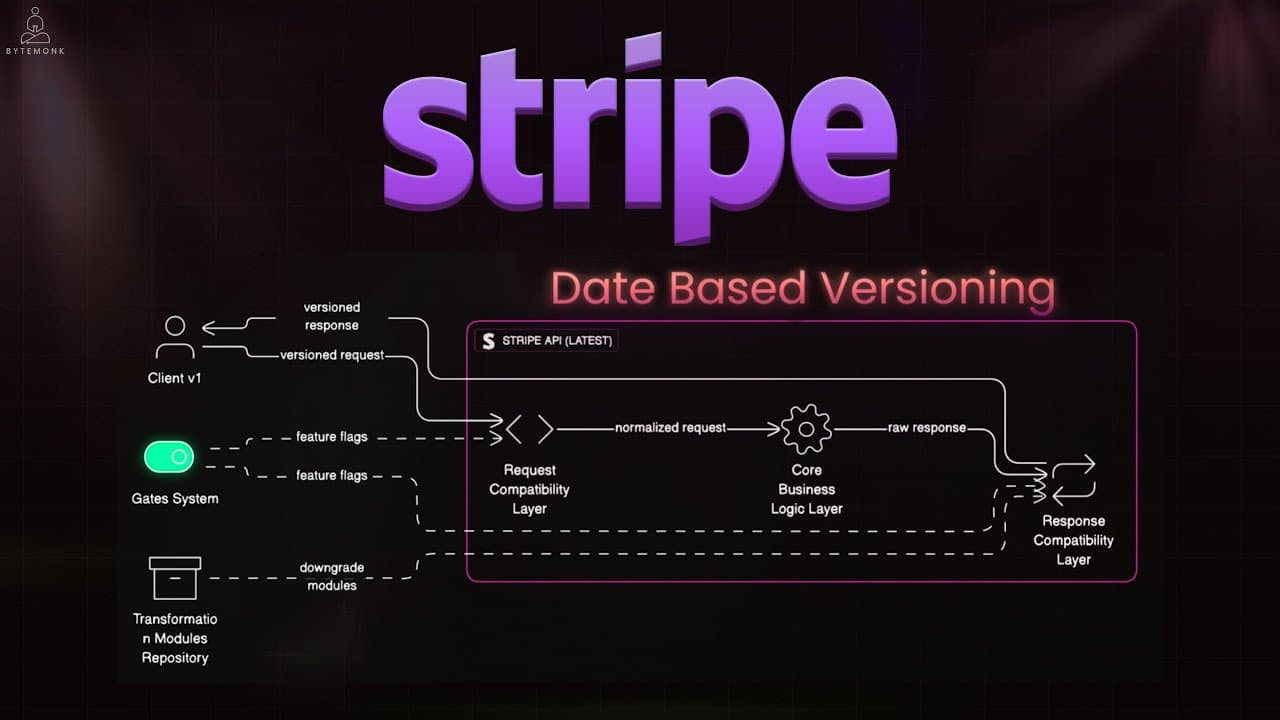
Date-based versioning pins each Stripe account to a specific API version, so upgrades don’t break existing integrations unless the user chooses to upgrade. Behind the scenes, compatibility layers and transformation modules adapt requests and responses to older versions while the core logic uses the latest code. This enables stable APIs without sacrificing forward motion.
Transcript
Stripe's API, it just doesn't break. You can take those seven famous lines of Ruby code from 2011, the ones that let developers accept payments in minutes, and guess what? They still work today. Over a decade later, no version upgrade, no breaking changes, no surprise errors. So, how does Stripe pull this off? It's not magic, it's architecture. Str... Read More
Key Insights
- Date-based versioning keeps API behavior stable by pinning accounts to a specific version.
- Requests are checked by a compatibility layer before reaching core logic.
- The core logic speaks the latest version, while compatibility layers translate inputs and outputs for older versions.
- Accounts can override the version for a single request via a header for testing new features.
- Gates act as feature flags that enable or disable behavior per version.
- Transformation modules downgrades new responses to older formats when needed.
- The system uses reverse-step transformations so old clients receive expected structures.
- This approach reduces code complexity while preserving backward compatibility.
Install to Summarize YouTube Videos and Get Transcripts
Explore YouTube Video Summarizer or Get YouTube Transcript Extractor
Questions & Answers
Q: What is the core idea behind date-based versioning in Stripe
Date-based versioning assigns a fixed version to each account based on the date when it started using Stripe, ensuring that the integration behaves as it did at that time unless the user chooses to upgrade. This prevents breaking changes from automatic migrations and keeps legacy integrations stable while new features can be tested and rolled out independently.
Q: How do compatibility layers work in this system
The request compatibility layer checks the account’s pinned version and filters allowed parameters accordingly. If a deprecated field is used with an older version, the layer blocks it for that account, preserving backward compatibility for older clients while letting newer behavior proceed for updated accounts.
Q: What happens in the core API logic with multiple versions
The core API logic always operates against the latest version. It does not need to handle legacy branches because the compatibility layers transform inputs to the latest format before processing and then transform outputs back to the requested version for the client. This keeps the core clean and modern.
Q: How are old and new responses reconciled
After the core logic generates a response in the latest format, the response compatibility layer converts it back to the structure expected by the client’s pinned version. This ensures a decade old integration can still receive data in a familiar shape without requiring code changes.
Q: What role do gates play in Stripe’s API design
Gates are feature flags mapped to specific API versions and stored in a manifest. They determine whether a particular behavior is allowed for a given version. This enables Stripe to toggle features without cluttering the main code path with version checks and helps manage evolution across many versions.
Q: How do transformation modules help with breaking changes
When a breaking change occurs, Stripe writes a transformation module that downgrades the new response into the old format. The system applies these modules in reverse from the latest version back to the client’s pinned version, ensuring compatibility without forcing widespread code changes.
Q: Can developers test newer API versions safely
Yes, developers can override the version for a single request using a header to test a newer version. This allows previewing new features or verifying compatibility without permanently changing the pinned version. Once confident, they can upgrade the default version in the dashboard.
Q: Why is this approach beneficial for fintech teams
This architecture preserves stability for real money transactions by avoiding forced migrations and downgrades. It reduces maintenance burden, enables rapid innovation behind a compatibility layer, and offers a predictable upgrade path. Teams can adopt new capabilities at their own pace while keeping existing integrations reliable.
Summary & Key Takeaways
-
Stripe avoids breaking changes by pinning accounts to a fixed date-based API version, ensuring stability while updates occur behind the scenes. Compatibility and transformation layers play a central role in adapting outputs for older versions. Users can manually upgrade when ready, without forced migrations.
-
Gates and transformation modules provide controlled feature rollouts, enabling safe changes across versions while maintaining performance and developer trust.
-
The architecture emphasizes moving fast without breaking existing integrations, with a clear separation between the latest code and versioned behavior through layered customization and time-based versioning.
Read in Other Languages (beta)
Share This Summary 📚
Summarize YouTube Videos and Get Video Transcripts with 1-Click
Try YouTube Summary with ChatGPT & Claude or YouTube Transcript Generator
Explore More Summaries from ByteMonk 📚





Summarize YouTube Videos and Get Video Transcripts with 1-Click
Try YouTube Summary with ChatGPT & Claude or YouTube Transcript Generator