How Does SAML Enable Secure Single Sign-On?
TL;DR
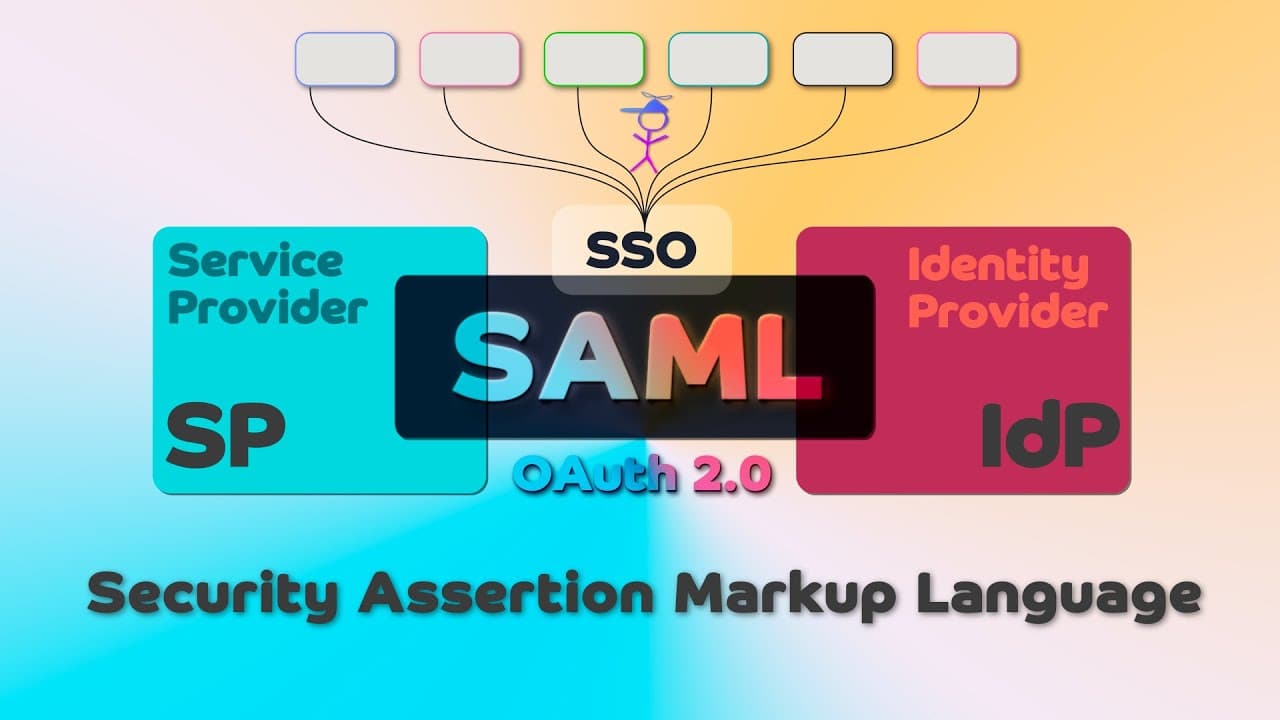
SAML enables single sign-on by letting a trusted identity provider authenticate a user and send a signed XML assertion to a service provider. The service provider validates that assertion before granting access, allowing users to enter multiple applications with one set of credentials while organizations exchange identity and authorization data without sharing passwords.
Transcript
security assertion markup language or saml is an open standard for exchanging authentication and authorization data between two parties an identity provider and a service provider saml is family used to enable single sign-on which allows user to access multiple applications with a single set of login credentials in this video we will discuss the ba... Read More
Key Insights
- SAML is an open, XML-based framework that exchanges authentication and authorization data between an identity provider and a service provider. It allows separate organizations and systems to trust established user identities without exposing passwords or other sensitive login information.
- Single sign-on is an access model that lets users authenticate with one set of credentials and enter multiple applications or services. It reduces the number of accounts and passwords users must manage while providing simpler access to the resources they need.
- An identity provider is the system that establishes and authenticates a user's identity. It stores and manages digital identities, then supplies authentication information and access rights to service providers that trust it, with Google Workspace, Microsoft, Okta, and Auth0 presented as examples.
- A service provider is the application or service that a user wants to access. A SAML-enabled service provider relies on a trusted identity provider for authentication, allowing the user to enter without creating and managing a separate account for that service.
- A SAML assertion is a signed XML document containing identity and authorization information. It can include a user's name, email address, roles, permissions, issue time, expiration time, and the identity provider's signature, which helps detect tampering during transit.
- The SAML authentication flow is based on browser redirection and assertion validation. A service provider redirects the user to an identity provider, the user authenticates, and the identity provider returns an assertion that the service provider verifies before providing the requested resource.
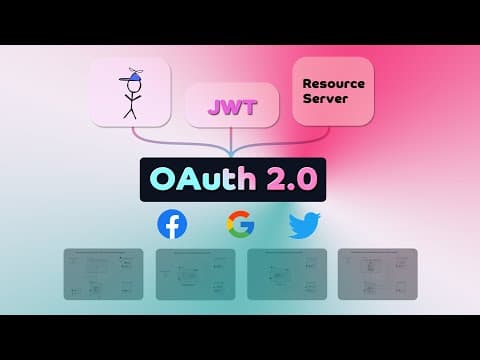
- OAuth 2.0 is primarily designed for delegated authorization, while SAML specializes in identity exchange and single sign-on. OAuth allows third-party applications to receive limited access to resources or perform approved actions without receiving the user's underlying credentials.
- SAML is favored when identity federation and strong identity assurance are critical, including enterprise, government, and healthcare settings. OAuth 2.0 with JSON Web Tokens is often better aligned with modern microservices because JSON communication is simpler and more prevalent in those architectures.
Install to Summarize YouTube Videos and Get Transcripts
Explore YouTube Video Summarizer or Get YouTube Transcript Extractor
Questions & Answers
Q: What is SAML and what problem does it solve?
SAML, or Security Assertion Markup Language, is an open, XML-based framework for exchanging authentication and authorization data between an identity provider and a service provider. It solves the problem of users maintaining separate accounts and passwords for every application. Through single sign-on, users authenticate once with a trusted identity provider and can then access multiple participating services without sharing their passwords with each service.
Q: How does SAML single sign-on work?
SAML single sign-on begins when a user attempts to access a SAML-enabled service provider. The service provider redirects the user to an identity provider, where the user authenticates. The identity provider then redirects the user back with a SAML assertion containing identity information. The service provider validates the assertion and, if it is authentic and acceptable, grants access to the requested resource.
Q: What is an identity provider in SAML?
An identity provider is the system responsible for establishing and authenticating a user's identity. It stores and manages digital identities, provides a way for users to prove who they are, and sends authentication data and access rights to trusted service providers. This centralized role lets users access protected resources without creating separate accounts for every service. Examples given include Google, Google Workspace, Microsoft, Okta, and Auth0.
Q: What is a service provider in SAML?
A service provider is an application or service that a user wants to access. Instead of authenticating the user independently, a SAML-enabled service provider relies on identity information received from a trusted identity provider. After validating the returned SAML assertion, it decides whether to grant access. Salesforce, Google Workspace, Microsoft 365, and Okta are identified as examples of services that can support SAML-based single sign-on.
Q: What information does a SAML assertion contain?
A SAML assertion is an XML document that communicates a user's identity and authorization status from an identity provider to a service provider. It can contain the user's name and email address, roles or permissions, the time the assertion was issued, its expiration time, and a signature from the identity provider. The signature verifies authenticity and helps ensure that the assertion was not altered during transit.
Q: What is the difference between SAML and OAuth 2.0?
SAML primarily supports identity exchange, identity federation, and single sign-on, while OAuth 2.0 mainly supports delegated authorization. SAML tells a service provider about an authenticated user's identity and access rights. OAuth lets a third-party application access selected data or perform approved actions without receiving the user's credentials. OAuth can support authentication through extensions such as OpenID Connect, but authentication is not OAuth's primary purpose.
Q: Why is OAuth 2.0 often used for microservices instead of SAML?
OAuth 2.0 with JSON Web Tokens aligns well with modern microservices because those environments commonly use JSON-based communication. SAML uses XML assertions and is a robust protocol built for scenarios such as single sign-on and identity federation, which can make it more complex for straightforward service-to-service authentication and authorization. OAuth 2.0 is therefore commonly used when one service must securely access another service's API.
Q: When should an organization consider using SAML?
An organization should consider SAML when strong identity federation, centralized authentication, and single sign-on are important. The approach is favored in enterprises, government institutions, and healthcare organizations. Government systems may require robust identity verification, healthcare providers must restrict access to sensitive patient data, and enterprises can use SAML to let employees enter email, internal applications, and cloud resources without repeatedly signing in.
Summary & Key Takeaways
-
SAML is an open, XML-based framework for exchanging authentication and authorization data between identity providers and service providers. It commonly supports single sign-on, allowing a user to authenticate once and access multiple applications without maintaining separate credentials for every service.
-
A typical SAML flow begins when a user requests a protected resource from a service provider. The service redirects the user to an identity provider for authentication. After successful authentication, the identity provider returns a signed SAML assertion, which the service provider validates before granting access.
-
SAML is particularly suitable for enterprises, government institutions, and healthcare organizations that require identity federation, strong identity assurance, and centralized access. OAuth 2.0 instead focuses mainly on delegated authorization and aligns more naturally with service-to-service interactions and JSON-based microservices when combined with JSON Web Tokens.
Read in Other Languages (beta)
Share This Summary 📚
Summarize YouTube Videos and Get Video Transcripts with 1-Click
Try YouTube Summary with ChatGPT & Claude or YouTube Transcript Generator
Explore More Summaries from ByteMonk 📚

Summarize YouTube Videos and Get Video Transcripts with 1-Click
Try YouTube Summary with ChatGPT & Claude or YouTube Transcript Generator