How Do Big Tech Platforms Check Usernames Fast?
TL;DR
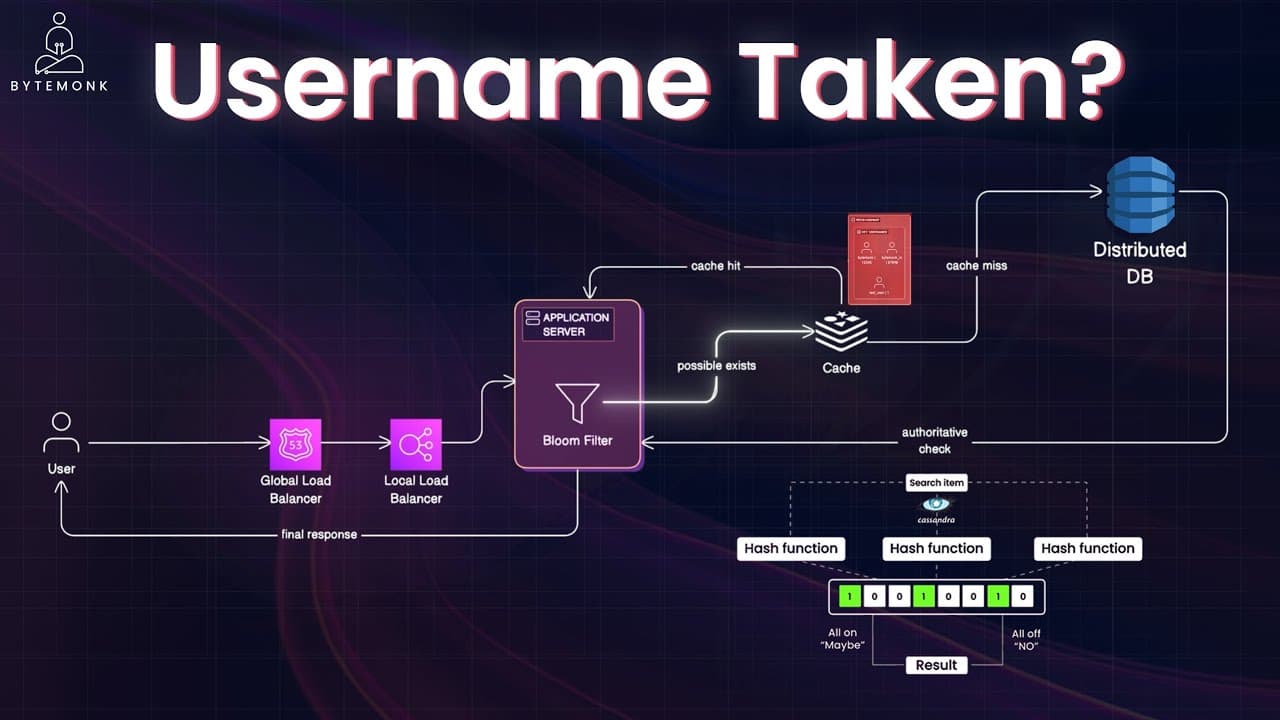
Large platforms check username availability by filtering requests through Bloom filters, in-memory caches, and distributed databases. Bloom filters quickly reject names that are definitely absent, caches answer repeated exact lookups, and databases provide authoritative results. Load balancers route each request across regions and backend servers, while tries and B+ trees support prefix suggestions and ordered searches.
Transcript
When you are signing up for a new app, you enter your preferred username and get a message saying, "This username is already taken." It feels like a small inconvenience, but behind the scenes, that simple check is surprisingly complex. When you're dealing with billions of users, checking whether a username exist can't rely on a basic database query... Read More
Key Insights
- Username availability is difficult at billion-user scale because sending every check directly to a database can create high latency, bottlenecks, unnecessary load, and broader performance problems. Large platforms reduce that pressure by placing faster filtering and caching mechanisms before the authoritative database.
- Redis hashmaps are useful for exact-match username lookups because they store field-value pairs in memory. A username can act as a field, while a user ID or placeholder flag becomes its value, allowing cache hits to return immediately without contacting persistent storage.
- Tries are tree-like structures that organize usernames character by character around shared prefixes. A lookup takes O(M) time, where M is the string length, and the same structure supports autocomplete and suggestions, although limited prefix overlap can produce substantial memory consumption.
- B+ trees are sorted indexing structures that support exact lookups in O(log n) time as well as ordered scans and range queries. Their high fan-out keeps the tree shallow, so searches across millions of entries can often require only three to four disk or memory reads.
- Bloom filters are probabilistic membership structures composed of a bit array and several hash functions. A zero in any checked position proves that a username is absent, while an all-one result means it is probably present and requires verification through a cache or database.
- Bloom filters are memory-efficient because they do not store complete usernames. The transcript estimates that representing one billion usernames with a 1% false-positive rate requires roughly 1.2 GB of memory, making the filter practical as a first defense against unnecessary disk lookups.
- Load balancing is performed at global and local levels in the described architecture. DNS-based or anycast routing directs users to nearby regional data centers, while local systems such as NGINX or AWS ELB distribute incoming checks among backend application or service instances.
- The authoritative username result comes from a distributed database after the Bloom filter and cache cannot answer conclusively. Systems such as Cassandra and DynamoDB divide data across many machines using approaches such as consistent hashing, distributing load while maintaining scalable exact lookups.
Install to Summarize YouTube Videos and Get Transcripts
Explore YouTube Video Summarizer or Get YouTube Transcript Extractor
Questions & Answers
Q: How do large platforms check username availability quickly?
Large platforms use a layered lookup pipeline instead of querying a database for every request. A load balancer routes the check to an application server, where a Bloom filter can reject a definitely absent username immediately. Uncertain checks continue to an in-memory cache such as Redis or Memcached. Only cache misses reach a distributed database, which returns the authoritative result.
Q: What role does a Bloom filter play in username checks?
A Bloom filter acts as the first filtering layer for username membership checks. It hashes a username several times and examines the corresponding positions in a bit array. If any position is zero, the username is definitely absent. If every position is one, the username is only probably present, so the system continues to a cache or database for confirmation.
Q: Can a Bloom filter give an incorrect username result?
A Bloom filter can produce false positives, meaning it may report that a username is probably present when it is actually absent. It does not produce false negatives, so a result saying the username is not present can be trusted. Because probable matches receive an authoritative follow-up check, false positives add work but do not need to become final availability decisions.
Q: Why are Redis hashmaps useful for username lookups?
Redis hashmaps provide fast in-memory exact-match lookups. A system can represent each username as a field and associate it with a lightweight value such as a user ID or placeholder flag. If that field exists, Redis returns a cache hit immediately and avoids the database. Memory limitations prevent one Redis instance from holding every username indefinitely, so it remains one layer in the architecture.
Q: How do tries support username suggestions and autocomplete?
Tries organize usernames as character-by-character paths that share common prefixes. This structure supports a lookup in O(M) time, where M is the username length, rather than making lookup time depend on the total number of stored names. Because related names share branches, tries also support prefix searches, autocomplete, and suggestions when a requested username is already taken.
Q: Why are B+ trees used for indexing usernames?
B+ trees keep username keys sorted, enabling exact lookups in O(log n) time while also supporting range scans and alphabetically ordered queries. Their high fan-out lets each node contain hundreds of keys, keeping the tree shallow. The transcript notes that millions of entries can often be searched with only three to four disk or memory reads, although large-scale updates and distribution add complexity.
Q: How does load balancing help a global username service?
Load balancing spreads username checks across locations and backend instances. At the global level, DNS-based or anycast routing directs a user toward a nearby regional data center, such as sending a European user to an EU facility. Inside that center, a local load balancer such as NGINX or AWS ELB distributes requests among servers that run Bloom-filter, cache, and application logic.
Q: When does the distributed database check a username?
The distributed database is queried only after earlier layers cannot settle the request. A Bloom filter first removes usernames that are definitely absent, and an in-memory cache answers recently used or stored exact matches. Following a cache miss, a database such as Cassandra, DynamoDB, or Spanner performs the authoritative existence check and returns a definitive result to the application server.
Summary & Key Takeaways
-
Username availability becomes a distributed systems problem when a platform serves billions of users. A basic database query for every request can introduce latency, bottlenecks, and unnecessary load. Large platforms therefore combine specialized data structures, caching layers, distributed storage, and load balancing to answer common checks quickly while preserving a definitive source of truth.
-
Different data structures serve different lookup requirements. Redis hashmaps provide fast exact-match cache checks, tries organize strings by shared prefixes for autocomplete, and B+ trees offer exact ordered lookups and range scans. Bloom filters provide memory-efficient membership testing, immediately identifying definitely absent usernames while sending uncertain results to more authoritative layers.
-
A typical request first reaches global and local load balancers, then an application server containing a Bloom filter. An uncertain result proceeds to Redis or Memcached, followed by a distributed database after a cache miss. Cassandra, DynamoDB, or Spanner can distribute data across machines, allowing the complete pipeline to remain fast and scalable.
Read in Other Languages (beta)
Share This Summary 📚
Summarize YouTube Videos and Get Video Transcripts with 1-Click
Try YouTube Summary with ChatGPT & Claude or YouTube Transcript Generator
Explore More Summaries from ByteMonk 📚





Summarize YouTube Videos and Get Video Transcripts with 1-Click
Try YouTube Summary with ChatGPT & Claude or YouTube Transcript Generator