How Modern AI Systems Use Embeddings and RAG
TL;DR
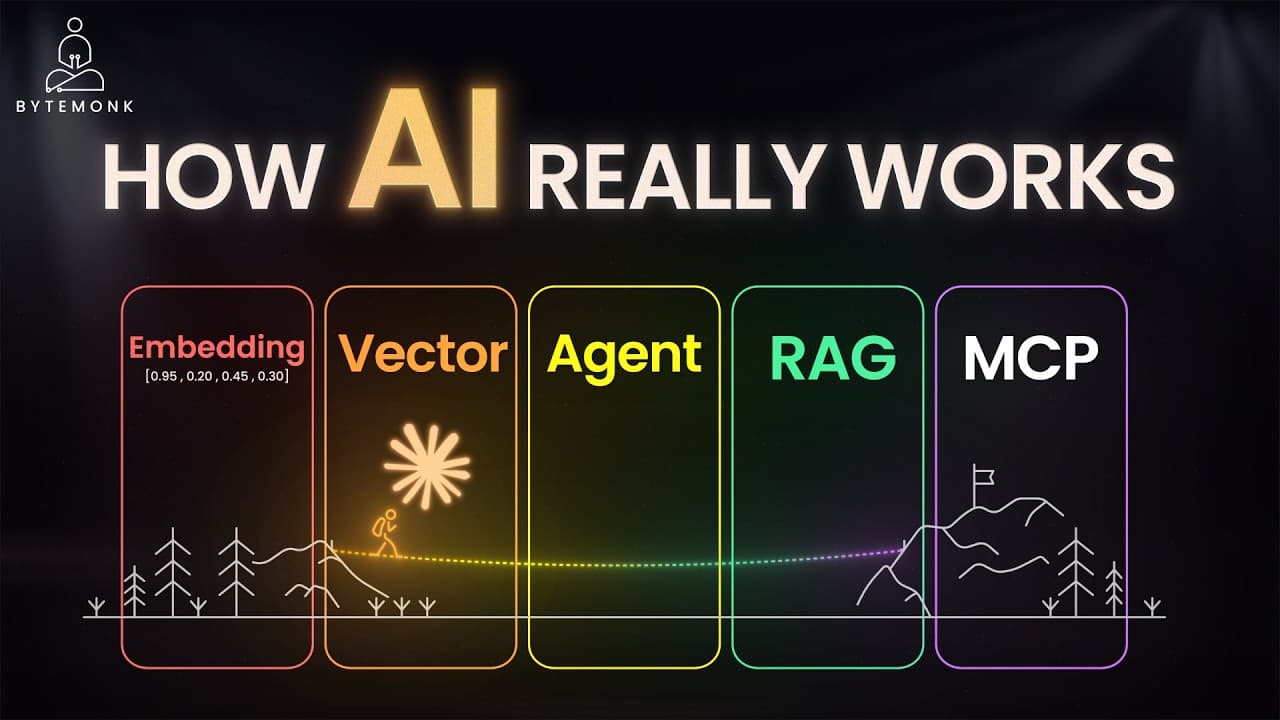
Modern AI systems rely on embeddings to understand meaning, vector databases for memory, and agent orchestration for decision-making. Retrieval-augmented generation (RAG) ensures accuracy by grounding AI responses in real data, while MCP facilitates seamless integration with various tools. These components form a resilient AI infrastructure that can be self-hosted for greater control and security.
Transcript
Most engineers are building on AI APIs they don't fully control and don't fully understand. In this video, we'll cover the core concepts powering modern AI systems. Embeddings, vector databases, agent orchestration, rag, and MCP. Whether you have heard these terms a hundred of times or you are encountering them fresh, by the end you'll have a clear... Read More
Key Insights
- Embeddings are vectors that capture the meaning of text, allowing AI to understand and interpret tasks beyond raw words.
- Vector databases store embeddings, enabling AI to perform similarity searches and recall relevant information efficiently.
- Agent orchestration allows AI to perceive, reason, and act, transforming it from a simple chatbot to a productivity partner.
- Retrieval-augmented generation (RAG) combines retrieval from databases with language model generation for accurate, context-based answers.
- Model Context Protocol (MCP) is an open standard that simplifies AI integration with various data sources and tools.
- Self-hosting AI infrastructure provides redundancy, cost control, and data privacy, protecting against external outages.
- Twingate offers secure access to self-hosted AI models, ensuring zero trust and minimal security risks.
- Modern AI systems are built as infrastructure, requiring careful design for resilience, ownership, and security.
Install to Summarize YouTube Videos and Get Transcripts
Explore YouTube Video Summarizer or Get YouTube Transcript Extractor
Questions & Answers
Q: How do embeddings help AI understand meaning?
Embeddings help AI understand meaning by converting text into vectors that capture semantic information. This allows AI to interpret the intent behind different tasks, even if they use different words. By mapping tasks in a high-dimensional space, AI can recognize similarities in meaning, enabling more accurate and context-aware responses.
Q: What role do vector databases play in AI systems?
Vector databases play a crucial role in AI systems by storing embeddings, which are high-dimensional vectors representing the meaning of data. This storage allows AI to perform similarity searches, retrieving relevant information based on meaning rather than keywords. As a result, AI systems can recall and utilize pertinent data efficiently, enhancing their memory and contextual understanding.
Q: How does agent orchestration enhance AI capabilities?
Agent orchestration enhances AI capabilities by enabling it to perceive, reason, and act on user requests. This involves managing a loop of reasoning and action, where AI agents collaborate to plan, execute, and verify tasks. Frameworks like React help AI alternate between reasoning and actions, making it more reliable for complex workflows and transforming it into a true productivity partner.
Q: What is retrieval-augmented generation (RAG) in AI?
Retrieval-augmented generation (RAG) in AI combines retrieval from a knowledge base with language model generation to produce accurate, context-based responses. By grounding AI answers in real data from vector databases, RAG minimizes hallucinations and ensures that the information provided is specific and up-to-date, enhancing the reliability and usefulness of AI interactions.
Q: How does Model Context Protocol (MCP) benefit AI systems?
Model Context Protocol (MCP) benefits AI systems by providing a universal standard for integrating with various tools and data sources. Acting like a USBC port for AI, MCP simplifies connections, allowing AI agents to access and utilize different services seamlessly. This versatility reduces siloed operations, making AI systems more adaptable to existing infrastructure and enhancing their overall functionality.
Q: Why are engineering teams moving to self-hosted AI models?
Engineering teams are moving to self-hosted AI models to gain greater control over their infrastructure. Self-hosting provides redundancy, cost control, data privacy, and resilience against external outages. By running models on private GPU clusters and internal tools, teams can ensure continuous operation, maintain security, and manage data more effectively without relying on external providers.
Q: What security solution does Twingate offer for AI infrastructure?
Twingate offers a security solution for AI infrastructure by providing secure access to self-hosted models through zero trust principles. It uses existing identity providers for authentication, establishing encrypted tunnels for secure communication. This approach ensures that only authorized users can access specific services within a Kubernetes cluster, reducing security risks and maintaining a strong security posture.
Q: What is the significance of designing AI systems as infrastructure?
Designing AI systems as infrastructure is significant because it ensures resilience, ownership, and security. By treating AI as infrastructure, teams can build systems that are robust against outages, maintain control over their operations, and secure sensitive data. This approach allows for scalable, reliable, and efficient AI solutions that can adapt to changing needs and integrate seamlessly with existing tools and services.
Summary & Key Takeaways
-
Embeddings are crucial for AI to understand the meaning behind text and other data types, forming the foundation of modern AI systems. Vector databases store these embeddings, enabling efficient similarity searches that enhance AI's memory and context capabilities.
-
Agent orchestration transforms AI into a productivity partner by allowing it to reason and act based on user requests. This involves multiple agents collaborating to plan, execute, and verify tasks, using frameworks like React for reliable workflows.
-
Retrieval-augmented generation (RAG) ensures AI responses are grounded in real data, minimizing hallucinations and enhancing accuracy. Model Context Protocol (MCP) further enhances AI systems by providing a universal integration standard, making them versatile and less siloed.
Read in Other Languages (beta)
Share This Summary 📚
Summarize YouTube Videos and Get Video Transcripts with 1-Click
Try YouTube Summary with ChatGPT & Claude or YouTube Transcript Generator
Explore More Summaries from ByteMonk 📚

Summarize YouTube Videos and Get Video Transcripts with 1-Click
Try YouTube Summary with ChatGPT & Claude or YouTube Transcript Generator