How Does Agentic AI Perceive, Plan, and Act?
TL;DR
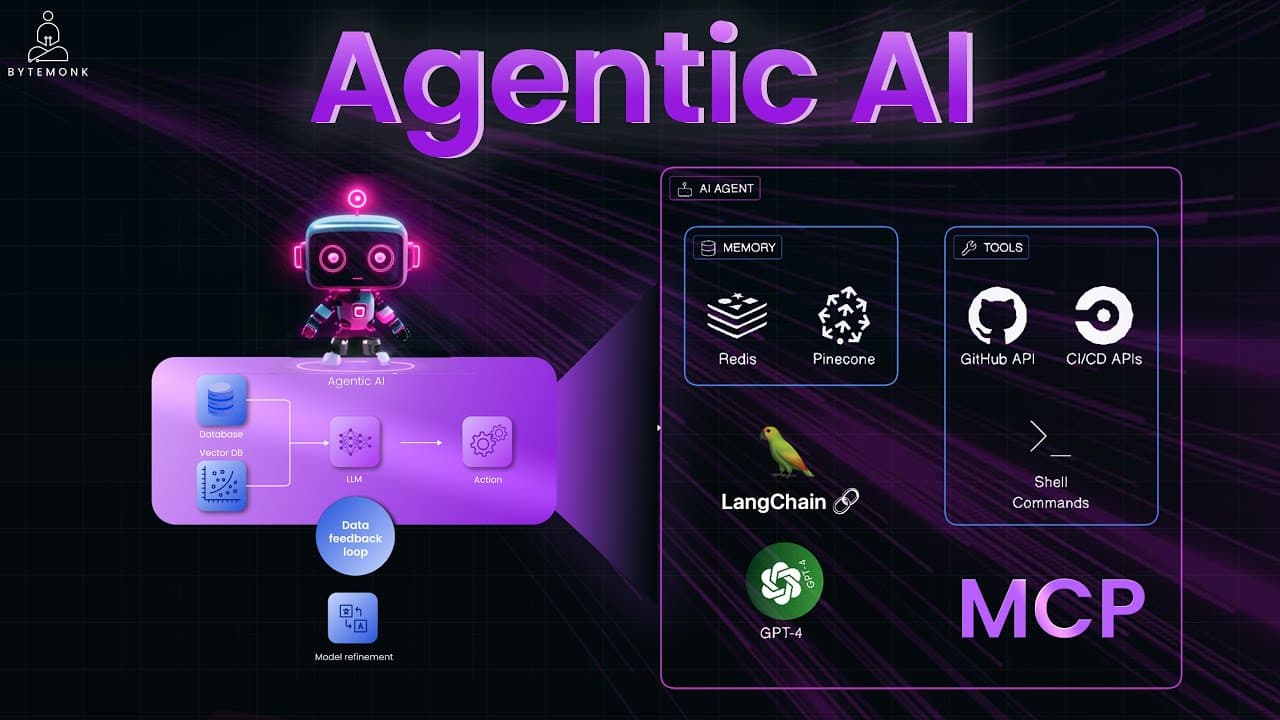
Agentic AI takes a human-defined goal, determines the required steps, uses permitted tools, and adapts based on outcomes with minimal ongoing input. Its core loop combines perception, reasoning, action, and learning, supported by an LLM, memory, tools or APIs, and an orchestration framework that keeps multi-step work coordinated and grounded within defined boundaries.
Transcript
agentic AI is everywhere right now but is it really new or just a fancier way of saying autonomous AI in this video we'll cut through the noise i'll show you what truly makes agentic AI different how it perceives plans acts and learns and why it's suddenly showing up in tools workflows and real products whether you are into coding automation or bui... Read More
Key Insights
- Agentic AI is a goal-driven form of automation that perceives its environment, reasons about a task, performs actions, and learns from results. Unlike a conventional assistant, it does not require a separate human prompt for every step of a multi-stage workflow.
- Perception is the stage in which an agent gathers relevant signals from sources such as APIs, databases, user conversations, sensors, or web searches. This information provides the context needed for subsequent planning, decisions, and actions within the environment defined by humans.
- Reasoning is powered by an LLM that breaks a goal into tasks, plans the sequence of work, and chooses suitable tools or APIs. The agent may also use retrieval augmented generation to access external knowledge or real-time data when completing its plan.
- Action is the execution stage where an agent can call APIs, write code, send emails, or run shell commands. If an operation fails, the agent may correct its approach, retry the workflow, or take another configured response based on the observed outcome.
- Learning is supported by storing actions, outcomes, prior decisions, and relevant experience. Short-term memory can preserve conversation history and recent steps, while long-term memory using vector databases can help the agent recall earlier results and handle similar situations more effectively.
- A functional AI agent requires four central components: an LLM, a memory layer, tools or APIs, and an orchestration framework. Together, these components provide reasoning, continuity, real-world capabilities, workflow management, tool routing, and connections between goals and executable tasks.
- A code deployment agent can automate work beyond generating a deployment script. It can detect a push, retrieve code, run tests, check for breaking changes, choose a deployment pipeline, release the update, notify a team, and initiate configured recovery actions.
- Model Context Protocol provides structure for coordination among agents, tools, APIs, memory, and goals. It acts as a middle layer that helps components share context and follow organized tool calls, which is especially important when solving multi-step problems across different systems and environments.
Install to Summarize YouTube Videos and Get Transcripts
Explore YouTube Video Summarizer or Get YouTube Transcript Extractor
Questions & Answers
Q: What is agentic AI and how does it work?
Agentic AI is a goal-driven system that does more than respond to isolated prompts. It understands a human-defined objective, gathers information from its environment, plans the steps required, selects appropriate tools, executes actions, and stores outcomes. Its operation follows a recurring loop of perception, reasoning, action, and learning, allowing it to adapt while remaining within defined boundaries.
Q: How is agentic AI different from a traditional AI assistant?
A traditional AI assistant is reactive, meaning it usually waits for a user to provide instructions one prompt at a time. Agentic AI is proactive within its assigned scope. It receives a goal, determines the necessary steps, uses available tools, responds to failures, and continues working with minimal human input. It assists through action, adaptation, and retained experience.
Q: What are the four stages of the agentic AI loop?
The four stages are perception, reasoning, action, and learning. During perception, the agent gathers signals from sources such as APIs, databases, chats, sensors, or web searches. Reasoning uses an LLM to plan and select tools. Action executes tasks, while learning stores results and experiences that can improve future handling of similar situations.
Q: What components are needed to build an AI agent?
An AI agent needs four main components: an LLM, a memory layer, tools or APIs, and an orchestration framework. The LLM performs reasoning and planning. Memory retains context, past steps, and outcomes. Tools enable real actions, while the orchestration framework manages workflows, routes decisions, connects the LLM to tools, and handles operational steps such as retries.
Q: How does memory help an agent complete tasks?
Memory helps an agent remain consistent across multiple steps and recall earlier outcomes. Short-term memory can preserve recent conversation history and the current workflow state. Long-term memory can use vector databases such as Pinecone, Weaviate, or FAISS to retrieve previous results or decisions. Stored experience supports learning and can improve responses to similar situations over time.
Q: How can an AI agent automate code deployment?
A code deployment agent can detect a new code push, pull the repository, run tests, inspect changes for problems, select the appropriate deployment pipeline, release the update, and notify the team through Slack. If something fails, the agent can perform configured actions such as rolling back the release, examining logs, or creating a ticket for further attention.
Q: Which frameworks and tools can orchestrate AI agents?
The transcript identifies LangChain, OpenAI's agent SDK, CrewAI, and Microsoft's AutoGen as orchestration options. LangChain supports chained steps and modular agents, while OpenAI's agent SDK integrates with OpenAI tools. CrewAI supports teams of agents with defined roles, and AutoGen enables agents to collaborate through structured chat flows. These frameworks connect goals, memory, decisions, and tools.
Q: Why does Model Context Protocol matter for agentic workflows?
Model Context Protocol matters because agentic workflows involve coordination among LLMs, tools, APIs, memory systems, and sometimes multiple agents. MCP structures conversations, tool calls, and memory access so each component can understand the relevant context. This organized middle layer helps agents remain focused while reasoning across tools, environments, and multi-step tasks in scalable real-world workflows.
Summary & Key Takeaways
-
Agentic AI goes beyond reactive chat by pursuing goals with minimal human input. It gathers environmental data, reasons about tasks, selects appropriate tools, executes actions, and stores outcomes for future use. This perceive, reason, act, and learn loop enables an agent to adapt when conditions change or individual steps fail.
-
A working agent requires an LLM for reasoning, memory for retaining context and outcomes, tools or APIs for performing real actions, and an orchestration framework for coordinating the workflow. Possible components mentioned include GPT-4, Pinecone, FAISS, GitHub APIs, LangChain, CrewAI, AutoGen, and OpenAI's agent SDK.
-
A code deployment agent illustrates the difference between assistance and agency. Instead of merely writing a script, it can detect a code push, pull the repository, run tests, check changes, select a pipeline, deploy the update, notify a team, and respond to failures through rollback, log inspection, or ticket creation.
Read in Other Languages (beta)
Share This Summary 📚
Summarize YouTube Videos and Get Video Transcripts with 1-Click
Try YouTube Summary with ChatGPT & Claude or YouTube Transcript Generator
Explore More Summaries from ByteMonk 📚

Summarize YouTube Videos and Get Video Transcripts with 1-Click
Try YouTube Summary with ChatGPT & Claude or YouTube Transcript Generator