What makes Amazon S3 achieve 11 nines durability
TL;DR
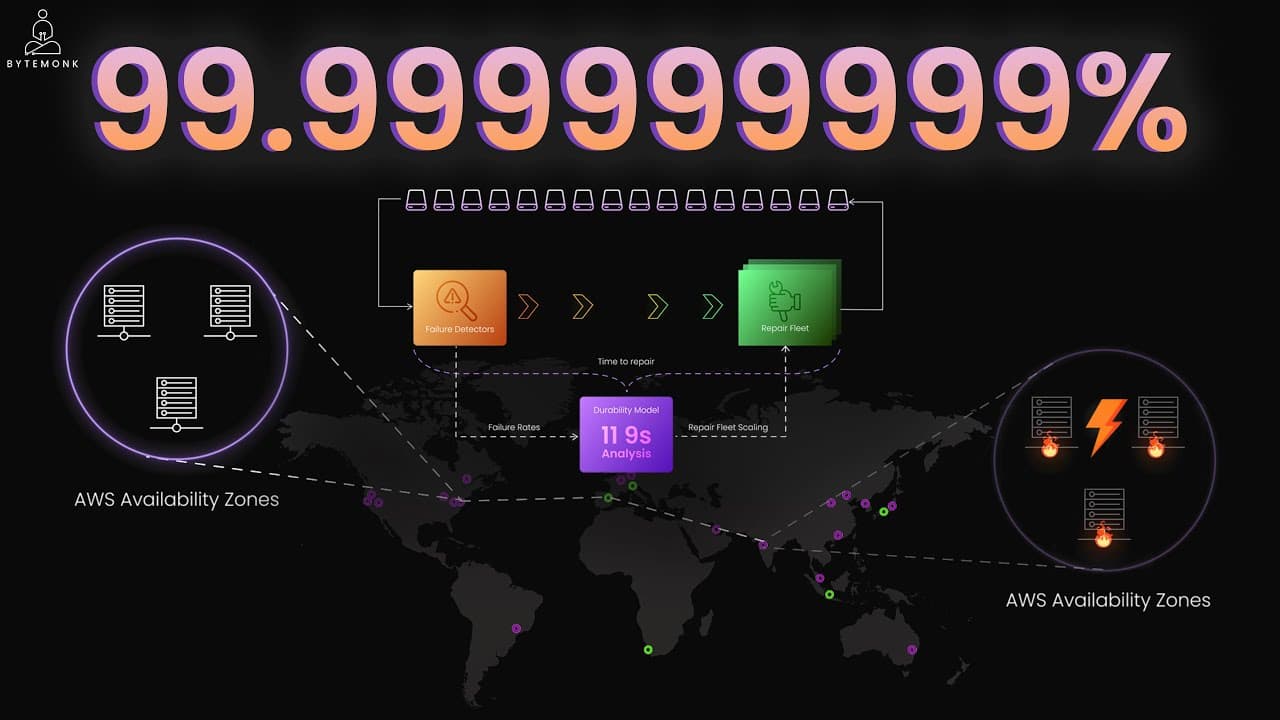
11 nines durability is achieved by spreading data across multiple availability zones using replication and erasure coding, continuously checking data integrity with checksums, and performing fast, parallel recoveries. It also uses metadata separation, versioning, and strong operational processes to protect against hardware failures, software errors, and human mistakes.
Transcript
Imagine being an engineer at a startup and waking up to a storage server crash. Years of critical data gone. It's a nightmare scenario for any business. This is exactly the kind of disaster Amazon S3 is built to prevent. Amazon S3 is a cloud object storage service designed to store and retrieve any amount of data from anywhere. And it's famous for ... Read More
Key Insights
- S3 uses multi AZ replication and erasure coding to protect against data loss.
- Automated recovery systems perform parallel repairs to restore data quickly after failures.
- Checksums and ongoing integrity checks guard against silent data changes.
- Bracketing verifies reconstructability of data before writing success is reported.
- Data and metadata are stored separately for protection and performance.
- Versioning and object lock defend against human error and accidental deletions.
- Cross region replication provides additional resilience against regional disasters.
- A durable culture with formal durability reviews guides all changes to S3 infrastructure.
Install to Summarize YouTube Videos and Get Transcripts
Explore YouTube Video Summarizer or Get YouTube Transcript Extractor
Questions & Answers
Q: What is meant by 11 nines durability in S3
11 nines durability refers to an extremely high probability that data stored in S3 will not be lost over time. This durability is achieved by distributing data across multiple availability zones, using erasure coding to create parity data, and continuously checking and repairing data as needed. The goal is to keep data intact long term even with hardware failures.
Q: How does S3 protect data from hardware failures
S3 protects data by replicating it to multiple servers across different availability zones and by using erasure coding to create parity pieces. If some drives fail, the system can reconstruct the original data from the remaining pieces. The recovery process is run in parallel across many disks to speed restoration and maintain durability.
Q: What role do checksums play in S3 durability
Checksums act as digital fingerprints for data. When data is stored, a checksum is created; later checksums are used to verify data integrity. If any bit flips or corruption is detected, S3 can reconstruct the correct data from healthy shards, ensuring long term integrity and preventing silent data loss.
Q: What is bracketing in S3, and why is it important
Bracketing is an extra verification step where S3 reconstructs the original file from stored shards before confirming a successful write. This ensures that the data is not only stored but also immediately recoverable. It provides assurance to users that their file can be retrieved exactly as stored.
Q: Why is separating data and metadata beneficial in S3
Separating data from metadata allows independent scaling and protects against system-wide issues. Metadata handles fast lookups and permissions, while the data storage is optimized for throughput and durability. If one system encounters a problem, the other can continue operating, preserving overall resilience.
Q: How does S3 protect against human error
S3 includes protections such as versioning to preserve previous object versions and object lock to prevent changes for a specified period. Cross region replication and auditability further reduce risk from accidental deletions or overwrites, enabling recovery and compliance.
Q: What is the purpose of cross region replication
Cross region replication automatically copies data to a different geographic region, ensuring data remains available even if a disaster affects one region. This extends durability beyond a single data center and supports disaster recovery planning through geographic diversity.
Q: What makes S3 durability culture unique
The durability culture at Amazon involves durability reviews for every change, simulations of failure scenarios, and rigorous engineering processes. This aerospace-like mindset treats data protection as a core system design requirement, ensuring ongoing resilience as features and infrastructure evolve.
Summary & Key Takeaways
-
S3 protects data by distributing it across multiple zones and using erasure coding to reduce the risk of data loss. It combines automatic health checks with rapid recovery to maintain durability even under multiple drive failures.
-
The system continuously verifies data integrity with end to end checksums and a final bracketing step before confirming writes, ensuring recoverability and correctness of stored data.
-
Durability is reinforced by separating data from metadata, enabling independent scaling and safeguarding from single points of failure while enabling fast metadata access.
Read in Other Languages (beta)
Share This Summary 📚
Summarize YouTube Videos and Get Video Transcripts with 1-Click
Try YouTube Summary with ChatGPT & Claude or YouTube Transcript Generator
Explore More Summaries from ByteMonk 📚





Summarize YouTube Videos and Get Video Transcripts with 1-Click
Try YouTube Summary with ChatGPT & Claude or YouTube Transcript Generator