How does a high frequency trading system work?
TL;DR
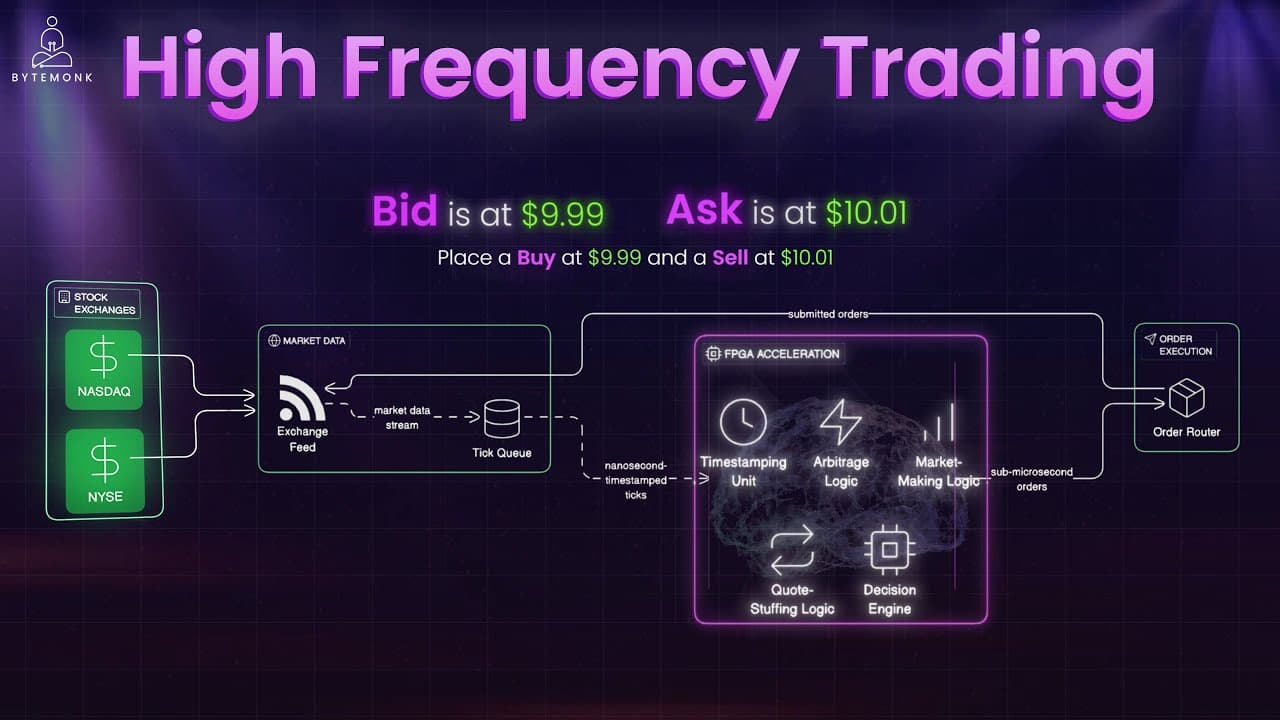
The system ingests market data, updates an in memory order book, and makes split second trading decisions with FPGA acceleration and a smart order router. Nanosecond timestamping, kernel bypass, and pre trade risk checks keep latency to a minimum while ensuring safety and compliance.
Transcript
Highfrequency trading systems are engineered for speed, not milliseconds, but microsconds and even nanconds. In this video, we'll dive into the actual architecture behind these lightning fast systems. You'll see how market data is ingested, how an in-memory order book works, how decisions are made using FPGAs and strategy engines, and how orders ar... Read More
Key Insights
- Market data ingestion uses multicast feeds and specialized NICs to reduce delay.
- Order books are kept in memory and replicated to ensure fast failover.
- Event driven pipelines rely on nanosecond timestamps to preserve sequence.
- FPGA acceleration enables tick to trade decisions in sub microseconds.
- Software based strategy engines continuously adapt to market state.
- Smart order routers evaluate venues and order types in real time.
- Pre trade risk checks prevent unsafe orders within microseconds.
- Post trade systems track orders, execution logs, and performance metrics.
Install to Summarize YouTube Videos and Get Transcripts
Explore YouTube Video Summarizer or Get YouTube Transcript Extractor
Questions & Answers
Q: What makes high frequency trading faster than traditional trading systems?
High frequency trading relies on a combination of ultra low latency networking, in memory data structures, and hardware acceleration. Multicast feeds and kernel bypass minimize data path delay, while nanosecond timestamping preserves exact event order. FPGA logic can decide on trades faster than software alone, creating a speed advantage.
Q: How is market data delivered to HFT systems?
Market data is delivered via multicast feeds from exchanges, often within a collocation facility near the exchange. Specialized hardware like ultra low latency NICs and a custom TCP stack reduce processing time, enabling the system to ingest and decode messages at microsecond and sub microsecond speeds that feed the rest of the pipeline.
Q: What role do in memory order books play in HFT?
The in memory order book provides the live snapshot of all current buy and sell orders and is updated in real time as messages arrive. Replication like replica A and B ensures fault tolerance, so if one lag or fails, the other can take over, keeping the system responsive during trading.
Q: Why is nanosecond timestamping important in HFT?
Nanosecond timestamping lets the system maintain the exact sequence of market updates, benchmark internal component latencies, and synchronize with external systems like FPGA engines and exchanges. This level of precision is essential because even tiny misordering or delay can impact decision accuracy and trading outcomes.
Q: How do FPGAs contribute to tick to trade decisions?
FPGAs run custom logic at hardware speeds and can evaluate a market event the moment it arrives. They can produce a trading decision in sub microseconds, bypassing software latency, and in some cases push entire decision making into hardware. This provides a significant speed edge in fast moving markets.
Q: What is the function of a smart order router in HFT?
The smart order router decides where and how to execute orders across multiple venues based on liquidity, latency, fill probability, and rebates. It works after the strategy engine decides to trade but before the order is sent, ensuring the best path for execution while balancing speed and safety.
Q: How do pre trade risk checks fit into the process?
Pre trade risk checks run in microseconds and verify order size, spending limits, and strategy correctness. If anything looks off, the order is blocked before it reaches an exchange, preventing potential financial disasters and ensuring the system remains within defined risk parameters while maintaining throughput.
Q: What happens after a trade is executed in an HFT system?
Post trade components track the full lifecycle of orders, including status updates, execution timestamps, and routing details in the order management system. A parallel monitoring and metrics stack captures latency, throughput, and health data, providing audit trails and insights for optimization and compliance.
Summary & Key Takeaways
-
The video explains a real world HFT pipeline from data ingestion to trade execution, highlighting low latency hardware and software components. It emphasizes in memory state, event driven processing, and precise timing as core principles. It also covers risk controls and monitoring essential for safe high speed trading.
-
It describes market data feeds, replication for fault tolerance, and how events propagate through an ultra fast pipeline to decision engines and routers. The focus is on speed, precision, and automation across the full stack.
-
It concludes with a look at monitoring and metrics that validate performance and provide post trade insight for optimization and auditing.
Read in Other Languages (beta)
Share This Summary 📚
Summarize YouTube Videos and Get Video Transcripts with 1-Click
Try YouTube Summary with ChatGPT & Claude or YouTube Transcript Generator
Explore More Summaries from ByteMonk 📚


Summarize YouTube Videos and Get Video Transcripts with 1-Click
Try YouTube Summary with ChatGPT & Claude or YouTube Transcript Generator