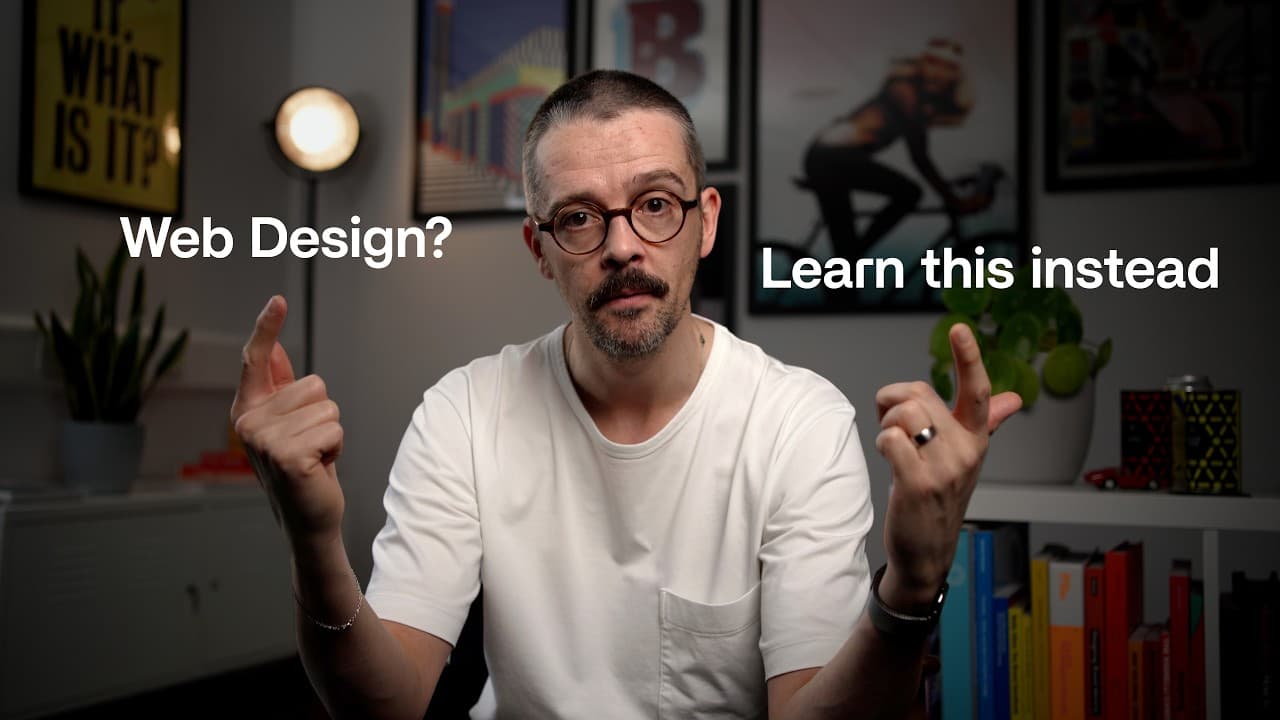
How to stay valuable in web design with AI in 2026
TL;DR
Creative problem solving and full stack skills keep you valuable despite AI. Be endlessly curious about both the problem and the input you gather, learn to solve business problems, and develop strong human skills like empathy and selling. These practices help you add end-to-end value and work effectively with AI as a tool.
Transcript
you versus AI. Is that going to be the theme of 2026? Struggling to prove your worth while the technological progress keeps marching on. And if you're thinking about, you know, maybe joining this field, is it still worth learning web design in 2026? For those who don't know me, my name is Matt and I've been in the creative industries for over 20 ye... Read More
Key Insights
- Creativity is powered by curiosity, which fuels input and output quality in design work.
- Solving the problem entirely adds value beyond producing a design, aligning work with client goals and business outcomes.
- A full stack designer can deliver end-to-end solutions from design through deployment and brand strategy.
- AI is a force multiplier for senior designers who know how to use it, reducing the need for junior roles.
- Learning to work with humans creates a competitive advantage that is hard for AI to replicate.
- Understanding brand strategy helps connect design decisions to business impact and audience needs.
- Developing empathy, communication, and listening skills improves collaboration and client satisfaction.
- Selling skills are essential to convert capabilities into client value and secure projects or roles.
- More videos from this channel:
- More from this channel: Flux Academy
Install to Summarize YouTube Videos and Get Transcripts
Explore YouTube Video Summarizer or Get YouTube Transcript Extractor
Questions & Answers
Q: What should I learn to stay relevant in web design with AI?
To stay relevant, focus on solving problems creatively and completely. Cultivate endless curiosity about both general life and the client’s problem, dive deep into research and context, and learn to grasp brand strategy. You should also become a full stack designer who can handle design, development, and brand work, enabling you to deliver end-to-end solutions rather than isolated tasks.
Q: How does curiosity influence creative work in this field?
Curiosity drives the intake of high quality inputs from diverse sources, which in turn fuels better outputs. By exposing yourself to art, different places, and broad knowledge, you create a rich repository of ideas. Asking many questions about the problem helps you see it from multiple angles and form deeper, more useful insights for problem solving.
Q: What does it mean to solve the problem entirely in practice?
Solving the problem entirely means understanding what the client or business truly needs and guiding them toward that end state. It involves taking responsibility for outcomes, integrating design with development and strategy, and ensuring the solution works in practice, not just in appearance. This full involvement increases value and reduces the risk of incomplete work.
Q: Why is being a full stack designer advantageous right now?
A full stack designer can address the entire lifecycle from concept to implementation, including brand strategy and e-commerce integration. This reduces handoffs, accelerates delivery, and provides a cohesive experience for clients. As AI handles repetitive tasks, those who can manage both design and execution remain highly valuable.
Q: How can I use AI effectively without losing creative direction?
Use AI as a tool to amplify your strengths rather than replace them. Build strong prompts, guide AI outputs with domain knowledge, and focus on the human aspects of design such as audience understanding and storytelling. By combining AI speed with thoughtful strategy and empathy, you maintain creative direction while increasing efficiency.
Q: What role do human skills play in a tech driven field?
Human skills like empathy, communication, listening, and sales are critical for understanding client needs and turning them into concrete design outcomes. These skills enable you to extract true requirements, handle objections, and guide projects toward a desirable future, giving you an edge over purely technical execution.
Q: How can I improve my selling ability as a designer?
Selling starts with clearly articulating value and outcomes, understanding client pain points, and demonstrating how your solution helps them reach their goals. Practice presenting benefits over features, handle concerns with confidence, and build trust by showing tangible results from your past work.
Q: What preparation steps help a junior designer compete with AI tools?
Junior designers should build a strong foundation in problem framing, brand understanding, and front end knowledge, while rapidly learning AI tools to speed execution. Proactively seek projects that require end-to-end thinking, develop a portfolio showing problem solving and outcomes, and focus on building soft skills that AI cannot replicate.
Summary & Key Takeaways
-
Summary point 1: The video argues that AI will change the field but does not eliminate value, and that individuals can stay relevant by expanding their capabilities beyond basic design tasks.
-
Summary point 2: It outlines a three step framework for creativity: stay curious, dive deep into the problem, and let ideas incubate by stepping away to form connections.
-
Summary point 3: It emphasizes full stack design, understanding brand strategy, and enhancing human skills such as communication and selling to deliver complete solutions for clients.
Read in Other Languages (beta)
Share This Summary 📚
Summarize YouTube Videos and Get Video Transcripts with 1-Click
Try YouTube Summary with ChatGPT & Claude or YouTube Transcript Generator
Explore More Summaries from Flux Academy 📚



Summarize YouTube Videos and Get Video Transcripts with 1-Click
Try YouTube Summary with ChatGPT & Claude or YouTube Transcript Generator