How to Build a Spotify End-to-End Azure Data Engineering Project
TL;DR
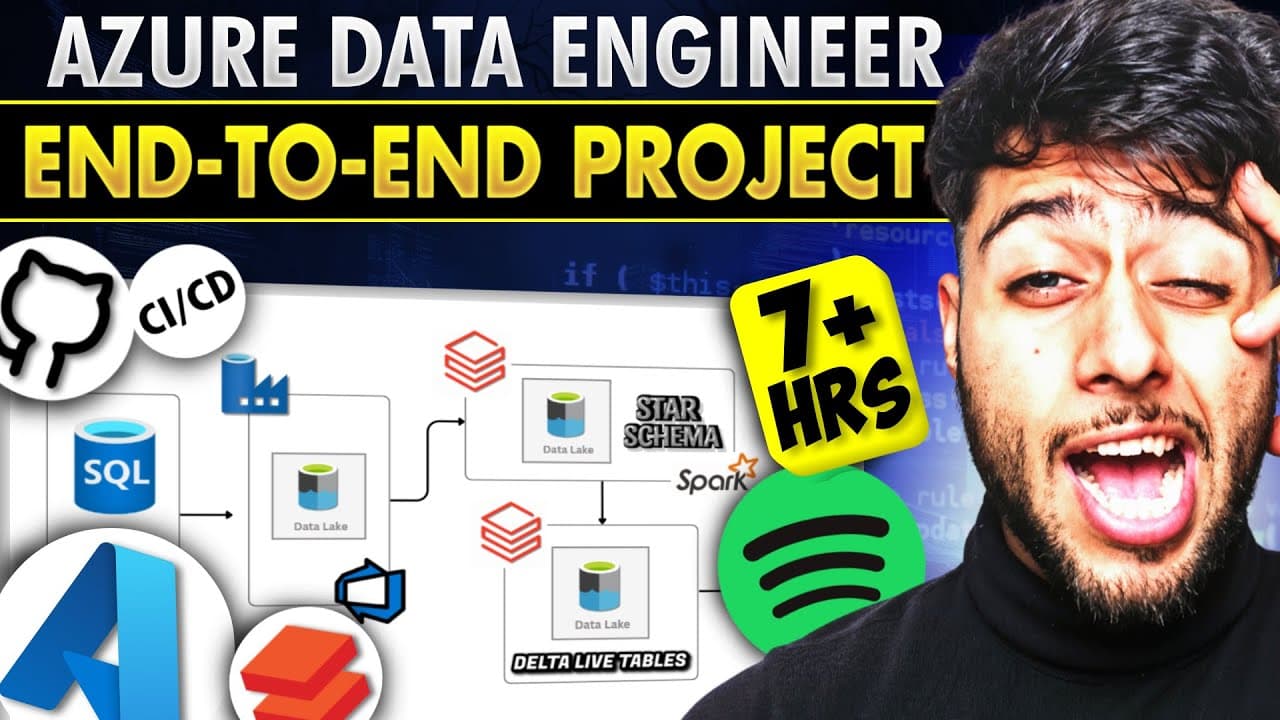
Build the Spotify end-to-end Azure data engineering project by moving data from Azure SQL Database through Azure Data Factory and the bronze, silver, and gold layers, then processing it with Azure Databricks. The 7-hour, beginner-friendly project covers dynamic pipelines, incremental loading, backfilling, Unity Catalog, Spark structured streaming, star schemas, GitHub, and CI/CD. Read on to understand the architecture, tools, and skills covered.
Transcript
If you want to become a competitive Azure data engineer, you need an end toend portfolio project which will help you gain complete understanding of Azure text stack which includes Azure data factory, Azure data bricks, Azure SQL database, Unity catalog, logic apps, medallion architecture, CI/CD and much more with industry standards. And this 7 hour... Read More
Key Insights
- An end-to-end portfolio project is what makes an Azure data engineer competitive, because building simple pipelines alone no longer proves you are a capable developer in today's industry standards.
- Medallion architecture organizes data across three layers named bronze, silver, and gold, also called raw, enriched, and curated, and is the standard followed in the data engineering world.
- The bronze layer loads raw, unprocessed data from the source using Azure Data Factory, where dynamic, parameterized pipelines with incremental data load and backfilling capabilities are built.
- Azure SQL Database serves as the primary source because industries are moving data to the cloud, using a cloud-hosted database instance instead of a basic regular database.
- The silver layer uses Azure Databricks to process the raw bronze data, applying the latest frameworks since Databricks has completely changed in the last one to two years.
- Unity Catalog work in the project includes creating meta stores, credentials, external locations, and managing security and groups, making it a complete Databricks guide.
- The project covers Git and CI/CD, teaching collaboration through Git branches and using Databricks Asset Bundles to push and deploy code to GitHub.
- The tutorial requires no prerequisites and is beginner friendly, using a step-by-step approach so people with zero experience in Azure Data Factory or Databricks can build it.
Install to Summarize YouTube Videos and Get Transcripts
Explore YouTube Video Summarizer or Get YouTube Transcript Extractor
Questions & Answers
Q: How do you build the Spotify end-to-end Azure data engineering project?
Start with Azure SQL Database as the primary source, with GitHub available for static files, and use Azure Data Factory to load raw data into the bronze layer. Process that data in the silver layer with Azure Databricks, Spark structured streaming, and autoloader, then develop slowly changing dimensions and a star schema while moving data through the bronze, silver, and gold architecture.
Q: What tools and technologies does the Spotify Azure data engineering project cover?
The project covers Azure SQL Database, Azure Cloud, Azure Data Factory, Azure Databricks, Unity Catalog, Spark, GitHub, logic apps, medallion architecture, and CI/CD. It also introduces Python utilities, Spark structured streaming, autoloader, Databricks Asset Bundles, slowly changing dimensions, star schemas, and lakeflow pipelines.
Q: Do I need Azure Data Factory or Databricks experience before starting?
No prior experience is required. The instructor says learners with zero experience in Azure Data Factory or Azure Databricks can build the project because it is taught step by step and includes resource creation and environment setup.
Q: What is the medallion architecture used in this project?
Medallion architecture moves data through three layers: bronze, silver, and gold. These are also called raw, enriched, and curated, with each layer representing a stage in the data journey.
Q: What happens in the bronze layer?
Azure Data Factory loads raw, unprocessed source data into the bronze layer. The project builds dynamic, parameterized pipelines that support incremental data loading and backfilling, and it also covers collaboration with Git branches and CI/CD.
Q: How is Azure Databricks used in the silver layer?
Azure Databricks processes the raw data stored in the bronze layer. The project covers Unity Catalog, metastores, credentials, external locations, security, groups, Spark structured streaming, autoloader, and a metadata-driven notebook or pipeline.
Q: Why is Azure SQL Database the primary data source?
The project uses Azure SQL Database as a cloud-hosted database instance because the transcript describes industries as moving their data to the cloud. GitHub can provide static files, but Azure SQL Database is the major source for the project.
Q: What data modeling and deployment skills does the project teach?
The project teaches how to build a dimensional star schema and slowly changing dimensions using DLT and lakeflow pipelines. It also covers pushing code to GitHub with Git branches and using Databricks Asset Bundles to push and deploy code.
Summary & Key Takeaways
-
Becoming a competitive Azure data engineer requires an end-to-end portfolio project covering the complete Azure stack, including Data Factory, Databricks, Azure SQL Database, Unity Catalog, logic apps, medallion architecture, and CI/CD, built to industry standards over a 7-hour step-by-step tutorial.
-
The project follows a real-world architecture where data journeys from an Azure SQL Database source through Azure Data Factory into the bronze layer, using dynamic parameterized pipelines with incremental data loading and backfilling capabilities.
-
Azure Databricks processes bronze-layer data in the silver layer using Spark structured streaming, autoloader, Python utilities, Unity Catalog, star schemas, and slowly changing dimensions, with code pushed to GitHub via Git branches and Databricks Asset Bundles.
Read in Other Languages (beta)
Share This Summary 📚
Summarize YouTube Videos and Get Video Transcripts with 1-Click
Try YouTube Summary with ChatGPT & Claude or YouTube Transcript Generator
Explore More Summaries from Ansh Lamba 📚

Summarize YouTube Videos and Get Video Transcripts with 1-Click
Try YouTube Summary with ChatGPT & Claude or YouTube Transcript Generator