How to Use Spark Declarative Pipelines
TL;DR
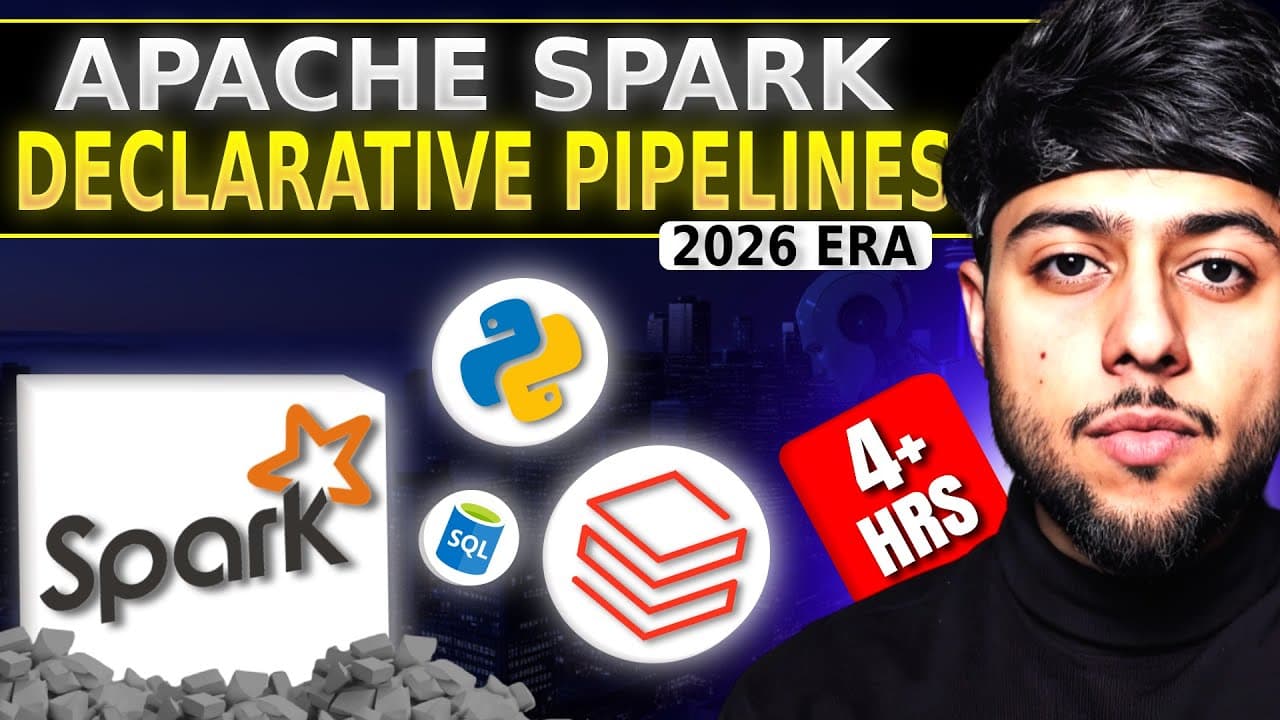
Spark Declarative Pipelines revolutionize PySpark development by focusing solely on data transformations, leaving optimization tasks like partitioning and memory management to Spark's internal mechanisms. This course covers everything from setup to advanced concepts, enabling data engineers to efficiently work with Apache Spark's latest advancements.
Transcript
Everyone wants to learn pispark because of its growing demand. But do you know what the dynamics of pispark are totally changed because of this new package called spark declarative pipelines. And let me tell you one thing this is not just a random or small upgrade. This package has changed the way of writing pispark code and you will see this skill... Read More
Key Insights
- Spark Declarative Pipelines (SDP) focus on 'what' rather than 'how', simplifying PySpark development.
- SDP automates optimization tasks like partitioning, coalescing, and caching, reducing manual overhead.
- Flows in SDP integrate data reading, transformation, and writing, supporting both batch and streaming.
- Materialized views in SDP offer incremental batch processing, often processing only changed data.
- Databricks free edition supports SDP, providing an easy setup without cloud subscriptions.
- SDP's Python-based development environment in Databricks offers a familiar interface for PySpark developers.
- Databricks' Lakeflow editor provides a seamless development experience with visual DAG representation.
- SDP's automated DAG creation and execution streamline complex data pipeline development.
Install to Summarize YouTube Videos and Get Transcripts
Explore YouTube Video Summarizer or Get YouTube Transcript Extractor
Questions & Answers
Q: How do Spark Declarative Pipelines simplify PySpark development?
Spark Declarative Pipelines simplify PySpark development by focusing on the 'what' rather than the 'how'. This means developers only need to define data transformations, while Spark handles optimization tasks such as partitioning and memory management automatically. This approach reduces manual overhead and allows developers to concentrate on data processing logic.
Q: What are the key components of Spark Declarative Pipelines?
The key components of Spark Declarative Pipelines include flows, datasets, and pipelines. Flows are foundational for data processing, integrating reading, transformation, and writing tasks. Datasets, like streaming tables and materialized views, are the outputs of flows. Pipelines manage the execution of flows, creating automated DAGs for efficient processing.
Q: How do materialized views work in Spark Declarative Pipelines?
In Spark Declarative Pipelines, materialized views cache the results of queries and are designed for incremental batch processing. They track changes in upstream data and, upon triggering, process only the changed data when possible. This often results in faster query execution compared to regular views, though full recomputation may occur if necessary for accuracy.
Q: What is the role of Databricks in Spark Declarative Pipelines?
Databricks plays a crucial role in Spark Declarative Pipelines by providing a managed environment that supports SDP development. With Databricks' free edition, users can access a comprehensive setup without cloud subscriptions. The Lakeflow editor offers a seamless development experience with visual DAG representation and automated pipeline management.
Q: How does the Lakeflow editor enhance the development experience?
The Lakeflow editor in Databricks enhances the development experience by providing a user-friendly interface similar to popular IDEs like VS Code. It offers features such as dark mode, visual DAG representation, and automated synchronization of code changes, making it easier for developers to manage complex data pipelines efficiently within the Databricks environment.
Q: Can Spark Declarative Pipelines handle both batch and streaming data?
Yes, Spark Declarative Pipelines can handle both batch and streaming data. Flows within SDP support both batch and streaming semantics, allowing developers to define data processing logic that can be applied to either data type. This flexibility makes SDP a powerful tool for various data engineering tasks, accommodating different data processing needs.
Q: What is the significance of automated DAG creation in SDP?
Automated DAG creation in Spark Declarative Pipelines is significant because it streamlines the execution of complex data pipelines. By automatically generating and managing DAGs based on the defined flows, SDP reduces the need for manual intervention, ensuring efficient execution order and dependency management. This feature enhances the robustness and scalability of data engineering workflows.
Q: How do Spark Declarative Pipelines impact job opportunities in data engineering?
Spark Declarative Pipelines impact job opportunities in data engineering by lowering the barrier to entry for PySpark development. By automating optimization tasks, SDP allows developers to focus on data processing logic, making it accessible to a broader range of professionals. This shift is likely to increase demand for data engineers familiar with SDP, opening up more opportunities in the field.
Summary & Key Takeaways
-
Spark Declarative Pipelines simplify PySpark development by automating optimization tasks, allowing developers to focus on data transformations. This innovative approach supports both batch and streaming data processes, making it a game-changer in data engineering. The course covers setup, key components like flows and materialized views, and hands-on development using Databricks.
-
Materialized views in SDP provide efficient incremental batch processing, automatically determining whether to process data incrementally or fully recompute based on computational cost. This feature reduces latency and improves performance in batch processing scenarios.
-
Databricks' free edition offers a comprehensive environment for learning and developing with SDP, featuring a user-friendly Lakeflow editor and automated DAG management. This setup eliminates the need for complex local installations, making it accessible for data engineers to explore PySpark's latest advancements.
Read in Other Languages (beta)
Share This Summary 📚
Summarize YouTube Videos and Get Video Transcripts with 1-Click
Try YouTube Summary with ChatGPT & Claude or YouTube Transcript Generator
Explore More Summaries from Ansh Lamba 📚




Summarize YouTube Videos and Get Video Transcripts with 1-Click
Try YouTube Summary with ChatGPT & Claude or YouTube Transcript Generator