How to Learn Python for Data Engineering From Scratch
TL;DR
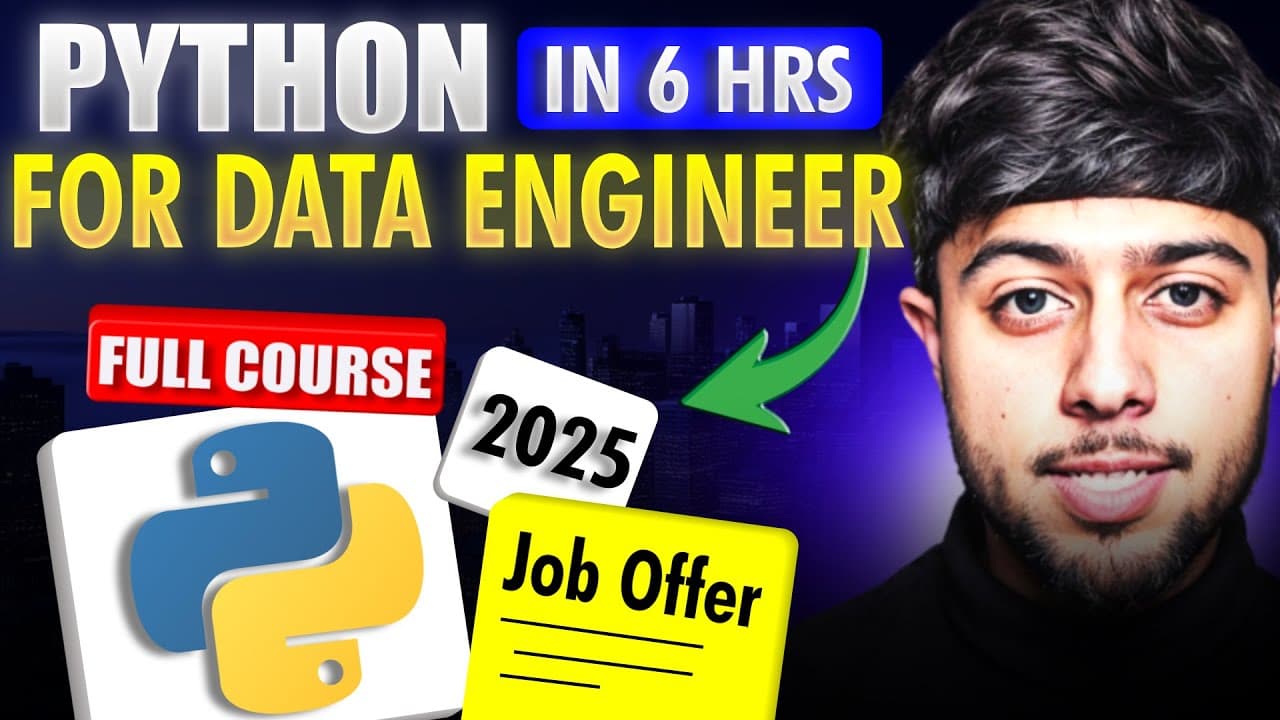
Python is the top-priority programming language for data engineering, ahead of Scala and Java. This 6+ hour course starts from zero and covers non-negotiable concepts like variables, data structures, list comprehension, functions, classes, inheritance, exception handling, multi-threading, and the requests and OS modules, all aligned to real data engineering scenarios.
Transcript
In this 6 hours long Python master class for data engineers will cover Python variables, data structures, list comprehension, conditionals in Python, iterables and infinite loop, dynamic functions, lambda functions, classes and objects, static and instance methods, exception handling in Python, single level, multi-level and multiple inheritance, ge... Read More
Key Insights
- Python is presented as the top-priority programming language for data engineers, ranked above Scala and Java, because it is widely used across software engineering, web development, data analytics, and data science domains.
- The course requires no prerequisites and starts from zero, then levels up rapidly by focusing on the concepts most relevant to data engineering rather than spending time on unrelated fundamentals.
- No installation is needed to begin because online Python compilers (interpreters) are available, letting learners start immediately and build momentum without setup delays.
- Python is technically an interpreted language, not compiled, because the interpreter reads and executes the code line by line, unlike C or C++ which use compilers.
- The first program taught is the print command, where text is displayed by placing a string inside braces and encapsulating it in double quotes, for example printing a greeting.
- The curriculum covers non-negotiable data engineering topics including variables, data structures, list comprehension, conditionals, loops, iterables, and functions including lambda and dynamic functions.
- Advanced topics include classes and objects, static and instance methods, getters and setters, exception handling, and inheritance in single-level, multi-level, and multiple forms.
- The course also teaches parallel processing through multi-threading and multiprocessing, plus the requests module to fetch API data and the OS (operating system) module, which requires a local Python interpreter.
Install to Summarize YouTube Videos and Get Transcripts
Explore YouTube Video Summarizer or Get YouTube Transcript Extractor
Questions & Answers
Q: Why is Python the most important language for data engineers?
According to the course, Python is the top-priority programming language data engineers should learn, ranked above Scala and Java. It is described as the most important skill to master for cracking data engineering interviews. Python is a wide programming language with many use cases and is widely used across other domains including software engineering, web development, data analytics, and data science, making it essential to learn smartly from a data engineering perspective.
Q: Do I need any prerequisites to learn Python for data engineering?
No prerequisites are required for this course. The instructor states clearly that the video starts from zero and is suitable for total beginners as well as those with good years of experience. The course is designed to level up learners very rapidly because data engineers need to focus on the main things instead of devoting time to concepts not directly related to their domain, so anyone can follow along from the beginning.
Q: What topics does the Python course for data engineers cover?
The 6+ hour course covers Python variables, data structures, list comprehension, conditionals, iterables and infinite loops, dynamic functions, lambda functions, classes and objects, static and instance methods, exception handling, single-level, multi-level and multiple inheritance, getters and setters, the requests module to fetch API data, and parallel processing using multi-threading. It also covers multiprocessing, string formatting, loops, and the OS module, all focused on non-negotiable data engineering concepts.
Q: Do I need to install Python to start this course?
No installation is needed to get started. The instructor explains that many online Python compilers are available, so learners can use any of them to begin immediately and save time. Avoiding installation lets students catch momentum quickly when learning something new. Only later, for topics like the OS module, does a local Python interpreter become necessary, and that is discussed at the end of the video.
Q: Is Python a compiled or interpreted language?
Python is an interpreted language, not a compiled one. The instructor clarifies that Python interprets the code line by line, which is why it is called an interpreted language. This differs from languages like C and C++, which use compilers to compile the code. Because of this, the online tools used are technically interpreters, though the instructor uses the terms compiler and interpreter interchangeably during the lesson.
Q: How do you write your first program in Python?
The first popular program in Python uses the print command, which is a function used to display something. When you write print, you use braces, and within them you place whatever you want to print. To print a string, you encapsulate the text in double quotes, for example printing a greeting like hello. The output then appears in the compiler's output area, which sits alongside the code area.
Q: What advanced Python topics are included for experienced developers?
For more advanced or pro learners, the course covers multiprocessing and multi-threading for parallel processing. It also includes classes and objects, static and instance methods, getters and setters, exception handling, and three forms of inheritance: single-level, multi-level, and multiple. Additionally, it teaches the requests module for fetching API data and the OS module, which is the operating system module in the Python library and is described as really important for data engineers.
Q: Which online compiler is recommended for this Python course?
The instructor is not inclined toward any particular online Python compiler and states that all of them are essentially the same because they are just interpreters that run the code and show the output. To find one, you search Google for online Python compiler and pick any link from the results. The description lists Programiz's online compiler as the platform used. The instructor emphasizes choosing any interpreter and simply selecting Python as the language.
Summary & Key Takeaways
-
The 6+ hour Python master class is designed specifically for data engineers, whether complete beginners or experienced professionals unfamiliar with Python. It deliberately focuses only on concepts that are non-negotiable for data engineering, skipping topics less relevant to the domain so learners can level up rapidly and prepare for interviews.
-
The course requires no prerequisites or installation, starting instead with a free online Python compiler so students can begin coding immediately and build momentum. Python is clarified as an interpreted language because the interpreter processes code line by line, distinguishing it from compiled languages such as C and C++.
-
Content progresses from the basic print command through variables, string formatting, conditionals, loops, and data structures, then advances to functions, classes and objects, inheritance, multi-threading, and the requests and OS modules, all tied to real-time data engineering scenarios for 2025 job seekers.
Read in Other Languages (beta)
Share This Summary 📚
Summarize YouTube Videos and Get Video Transcripts with 1-Click
Try YouTube Summary with ChatGPT & Claude or YouTube Transcript Generator
Explore More Summaries from Ansh Lamba 📚
Summarize YouTube Videos and Get Video Transcripts with 1-Click
Try YouTube Summary with ChatGPT & Claude or YouTube Transcript Generator