How to Solve Wordle With Information Theory
TL;DR
Solve Wordle by ranking guesses according to their expected information across every possible gray, yellow, and green feedback pattern. The method measures information as the negative base-two logarithm of a pattern’s probability, so outcomes that shrink the candidate pool more provide more bits. It also accounts for letter positions and uses about 13,000 valid guesses rather than relying solely on the curated list of around 2,300 answers. Read on to see how entropy turns these reductions into a practical score.
Transcript
The game Wordle has gone pretty viral in the last month or two, and never one to overlook an opportunity for a math lesson, it occurs to me that this game makes for a very good central example in a lesson about information theory, and in particular a topic known as entropy. You see, like a lot of people I got kind of sucked into the puzzle, and lik... Read More
Key Insights
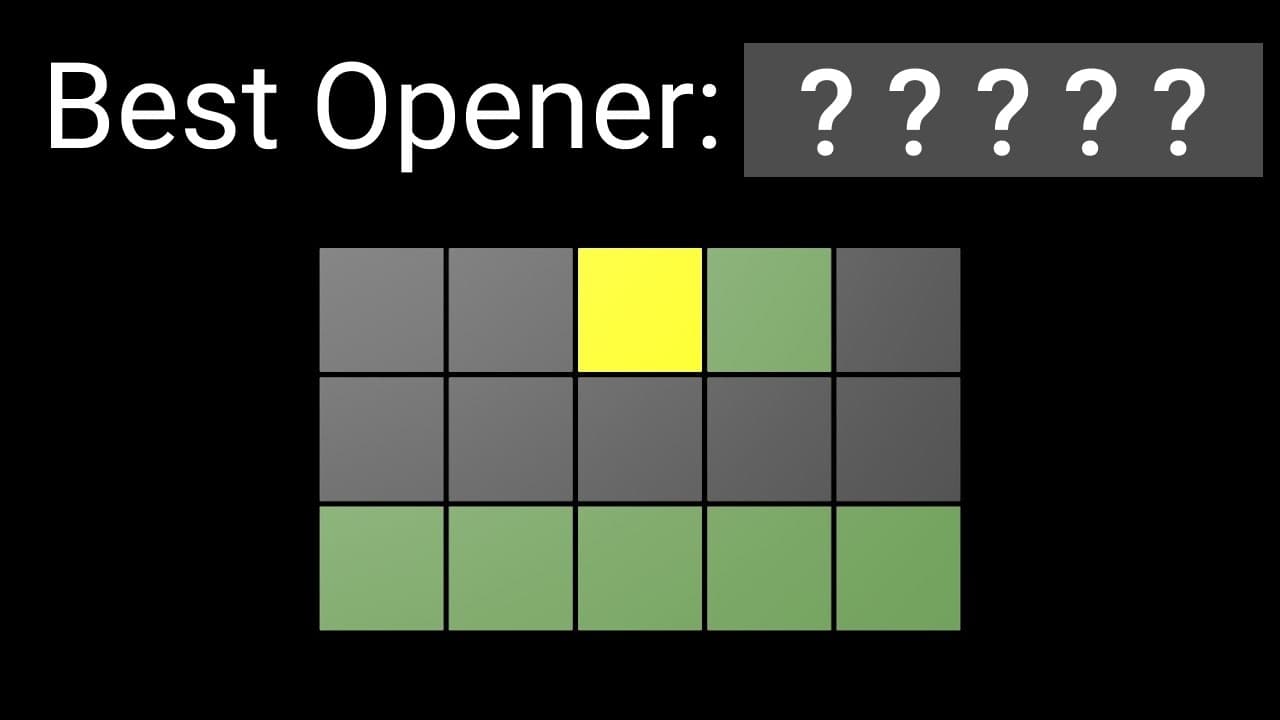
- Wordle is a guessing game in which a mystery five-letter word must be identified within six attempts. Gray feedback marks an absent letter, yellow marks a present letter in the wrong position, and green marks a letter in its correct position.
- A Wordle guess is valuable because its complete color pattern partitions the remaining candidate words. The pattern can sharply reduce the possibility space even when several guessed letters turn gray, since confirmed absences eliminate every candidate containing those letters.
- Common-letter strategies are useful but incomplete because they ignore letter positions and the probability distribution of feedback patterns. Comparing words such as "nails" and "snail" requires considering where letters appear, not merely whether the guesses contain the same letters.
- The valid-guess lexicon contains about 13,000 words, including many uncommon entries, while the curated list of possible answers contains around 2,300 words. The proposed challenge avoids relying directly on that answer list and instead seeks a more general strategy.
- An informative outcome is inherently unlikely because it leaves very few compatible possibilities. For the guess "weary," one illustrated feedback pattern leaves only 58 matching words, but under an equal-likelihood assumption its probability is only 58 divided by roughly 13,000.
- The most probable feedback patterns tend to provide the least information. For "weary," one illustrated pattern leaves about 1,400 matches and has roughly an 11 percent probability, while the all-gray pattern is described as occurring about 14 percent of the time.
- One bit of information corresponds to an observation that cuts the possibility space in half. Two bits reduce it by a factor of four, three bits by a factor of eight, four bits by a factor of sixteen, and five bits by a factor of thirty-two.
- Information is calculated as the base-two logarithm of one divided by an outcome’s probability, equivalently the negative base-two logarithm of that probability. Expected information evaluates a guess by combining each possible pattern’s probability with the information that pattern would reveal.
Install to Summarize YouTube Videos and Get Transcripts
Explore YouTube Video Summarizer or Get YouTube Transcript Extractor
Questions & Answers
Q: How can information theory help solve Wordle?
Information theory provides a quantitative way to rank guesses by how much their possible feedback patterns are expected to reduce the candidate space. The solver evaluates every possible gray, yellow, and green pattern, combining each pattern’s probability with the information it would reveal. This expected-information score makes guesses directly comparable.
Q: What does entropy mean in a Wordle-solving strategy?
Entropy measures the expected information produced by a potential guess. It considers the complete distribution of possible color patterns, balancing rare patterns that eliminate many words against common patterns that eliminate fewer. A guess with higher expected information is more useful for narrowing the possibilities.
Q: How is information measured in bits for Wordle?
One bit corresponds to feedback that cuts the possibility space in half. Reducing it by factors of four, eight, sixteen, and thirty-two provides two, three, four, and five bits, respectively. In general, the information from a pattern is the negative base-two logarithm of its probability.
Q: Why are rare Wordle feedback patterns more informative?
A rare pattern usually corresponds to a small group of compatible words, so observing it sharply reduces the candidate space. For the guess "weary," one illustrated pattern leaves only 58 matches among roughly 13,000 words. Under an equal-likelihood assumption, that pattern has a probability of 58 divided by roughly 13,000.
Q: Why is choosing common letters not enough for Wordle?
Common letters can produce useful matches or absences, but letter frequency alone ignores position and the full distribution of feedback patterns. For example, "nails" and "snail" contain the same letters in different positions and may divide the candidate set differently. A systematic strategy evaluates those resulting partitions rather than only counting common letters.
Q: Can gray letters provide useful information in Wordle?
Yes. A gray letter eliminates every candidate containing that letter, which can substantially shrink the possibility space. The suggested opening pair "other" and "nails" covers many frequent letters, so even receiving only gray results would be informative because words containing those letters could be excluded.
Q: Why avoid using Wordle’s curated answer list?
The curated answer list contains around 2,300 words, while the valid-guess list contains about 13,000. The proposed solver avoids depending on the smaller list because some reasonably common five-letter words are missing and the goal is to build a strategy that can play beyond the official site. The list’s source-code ordering also reveals answers from day to day.
Q: How should a Wordle solver rank an opening guess?
For each possible opening word, the solver should enumerate its possible feedback patterns and determine how many candidates remain after each one. It then calculates each pattern’s probability and information value before combining them into expected information. This ranks guesses by their overall ability to narrow the candidate pool rather than by one favorable outcome.
Summary & Key Takeaways
-
Wordle asks players to identify a mystery five-letter word within six guesses. Every submitted word produces gray, yellow, or green feedback about absent letters, misplaced letters, and correctly positioned letters. A solver can use each resulting color pattern to eliminate incompatible candidates and progressively narrow the remaining possibilities.
-
A systematic strategy must evaluate both how informative each possible feedback pattern would be and how likely that pattern is to occur. Rare outcomes can eliminate nearly every candidate, but common outcomes usually reveal less. Expected information accounts for this tradeoff by weighting the information from every possible pattern by its probability.
-
Information is measured in bits according to how strongly an observation reduces the possibility space. Cutting the candidates in half provides one bit, reducing them by a factor of four provides two bits, and reducing them by a factor of eight provides three bits. The general formula is negative log base two of probability.
Read in Other Languages (beta)
Share This Summary 📚
Summarize YouTube Videos and Get Video Transcripts with 1-Click
Try YouTube Summary with ChatGPT & Claude or YouTube Transcript Generator
Explore More Summaries from 3Blue1Brown 📚

Summarize YouTube Videos and Get Video Transcripts with 1-Click
Try YouTube Summary with ChatGPT & Claude or YouTube Transcript Generator