Products
Features
YouTube Video Summarizer
Summarize YouTube videos
Web & PDF Highlighter
Highlight web pages & PDFs
Chat with PDF
Ask any PDF questions with AI
Ask AI Clone
Chat with your highlights & memories
Audio Transcriber
Transcribe audio files to text
Glasp Reader
Read and highlight articles
Kindle Highlight Export
Export your Kindle highlights
Idea Hatch
Hatch ideas from your highlights
Integrations
Obsidian Plugin
Notion Integration
Pocket Integration
Instapaper Integration
Medium Integration
Readwise Integration
Snipd Integration
Hypothesis Integration
Apps & Extensions
Chrome Extension
Safari Extension
Edge Add-ons
Firefox Add-ons
iOS App
Android App
Discover
Discover
Ideas
Discover new ideas and insights
Articles
Curated articles and insights
Books
Book recommendations by great minds
Posts
Essays and notes from readers
Quotes
Inspiring quotes collection
Videos
Curated videos and summaries
Explore Glasp
Glasp Newsletter
Weekly insights and updates
Glasp Talk
Interview series with great minds
Glasp Blog
Latest news and articles
Glasp Use Cases
Learn how others use Glasp
Build & Support
Glasp API
Access Glasp's API for developers
MCP Connector
Connect Glasp to Claude & ChatGPT
Community
Glasp Reddit Community
Students
Student discount and benefits
FAQs
Frequently Asked Questions
AboutPricing
DashboardLog inSign up

What Is a Determinant and Why Is It Important in Linear Algebra?
3.4M views
•
August 10, 2016
by
3Blue1Brown
YouTube video player
What Is a Determinant and Why Is It Important in Linear Algebra?

TL;DR

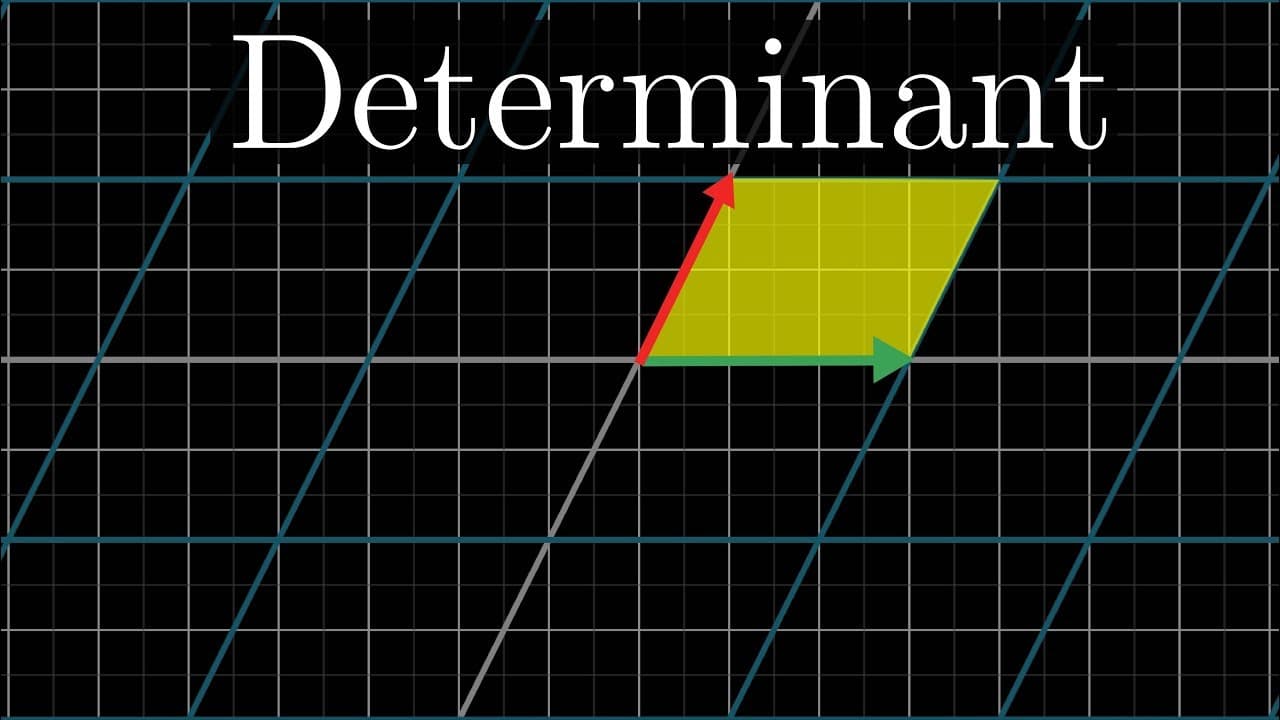
A determinant measures how a linear transformation scales areas in 2D or volumes in 3D. It indicates whether the transformation stretches, squishes, or flips the orientation of space, with a determinant of zero meaning the transformation collapses space into a lower dimension. Understanding the determinant's significance is crucial, more so than just learning to compute it.

Transcript

Hello, hello again. So moving forward, I'll be assuming that you have a visual understanding of linear transformations and how they're represented with matrices, the way that I've been talking about in the last few videos. If you think about a couple of these linear transformations, you might notice how some of them seem to stretch space out, while... Read More

Key Insights

  • 🧭 The determinant of a linear transformation measures how much it stretches or squishes space, and determines if areas are scaled.
  • 📏 The determinant of a transformation can be computed using its matrix, but understanding its meaning is more important than the computation.
  • ️ Linear transformations with a determinant of 0 squish space into a smaller dimension, such as a line or a single point.
  • ⬇️ Negative determinant values indicate flipped orientation in space, and determine the factor by which volumes are scaled.
  • 🔀 Determinant values can be used to determine if the orientation of space has been inverted, with positive determinants indicating no change in orientation.
  • 📐 The determinant of a 2x2 matrix can be computed using the formula ad - bc, representing the area of the transformed unit square.
  • 📦 In three dimensions, the determinant represents the volume of the parallel pipette that a unit cube is transformed into.
  • ✖️ When multiplying two matrices, the determinant of the resulting matrix is equal to the product of the determinants of the original matrices.

Install to Summarize YouTube Videos and Get Transcripts

Explore YouTube Video Summarizer or Get YouTube Transcript Extractor

Questions & Answers

Q: How does the determinant of a matrix relate to the scaling factor of areas and volumes?

The determinant of a matrix represents the factor by which a linear transformation scales the area (in 2D) or volume (in 3D) of a given region in space.

Summary & Key Takeaways

  • Determinants measure the factor by which a linear transformation scales the area or volume of a given region in space.

  • The determinant indicates whether a transformation squishes or stretches space and can also determine changes in orientation.

  • Computing determinants can be done using formulas, but understanding their meaning and implications is more important than the computation itself.


Read in Other Languages (beta)

English

Share This Summary 📚

Summarize YouTube Videos and Get Video Transcripts with 1-Click

Download browser extensions on:

Try YouTube Summary with ChatGPT & Claude or YouTube Transcript Generator

Explore More Summaries from 3Blue1Brown 📚

Bayes theorem, the geometry of changing beliefs thumbnail
Bayes theorem, the geometry of changing beliefs
3Blue1Brown
What Is a Taylor Series and How Does It Work? thumbnail
What Is a Taylor Series and How Does It Work?
3Blue1Brown
Backpropagation, intuitively | Deep Learning Chapter 3 thumbnail
Backpropagation, intuitively | Deep Learning Chapter 3
3Blue1Brown
Binomial distributions | Probabilities of probabilities, part 1 thumbnail
Binomial distributions | Probabilities of probabilities, part 1
3Blue1Brown
But what is a convolution? thumbnail
But what is a convolution?
3Blue1Brown
The AI that solved IMO Geometry Problems | Guest video by @Aleph0 thumbnail
The AI that solved IMO Geometry Problems | Guest video by @Aleph0
3Blue1Brown

Summarize YouTube Videos and Get Video Transcripts with 1-Click

Download browser extensions on:

Try YouTube Summary with ChatGPT & Claude or YouTube Transcript Generator

Apps & Extensions

  • Chrome Extension
  • Safari Extension
  • Edge Add-ons
  • Firefox Add-ons
  • iOS App
  • Android App

Key Features

  • YouTube Video Summarizer
  • Web & PDF Summarizer
  • Web & PDF Highlighter
  • Chat with PDF
  • Ask AI Clone
  • Audio Transcriber
  • Glasp Reader
  • Kindle Highlight Export
  • Idea Hatch

Integrations

  • Obsidian Plugin
  • Notion Integration
  • Pocket Integration
  • Instapaper Integration
  • Medium Integration
  • Readwise Integration
  • Snipd Integration
  • Hypothesis Integration

More Features

  • APIs
  • MCP Connector
  • Blog & Post
  • Embed Links
  • Image Highlight
  • Personality Test
  • Quote Shots

Company

  • About us
  • Blog
  • Community
  • FAQs
  • Job Board
  • Newsletter
  • Pricing
Terms

•

Privacy

•

Guidelines

© 2026 Glasp Inc. All rights reserved.