How AI Solves Complex Geometry Problems
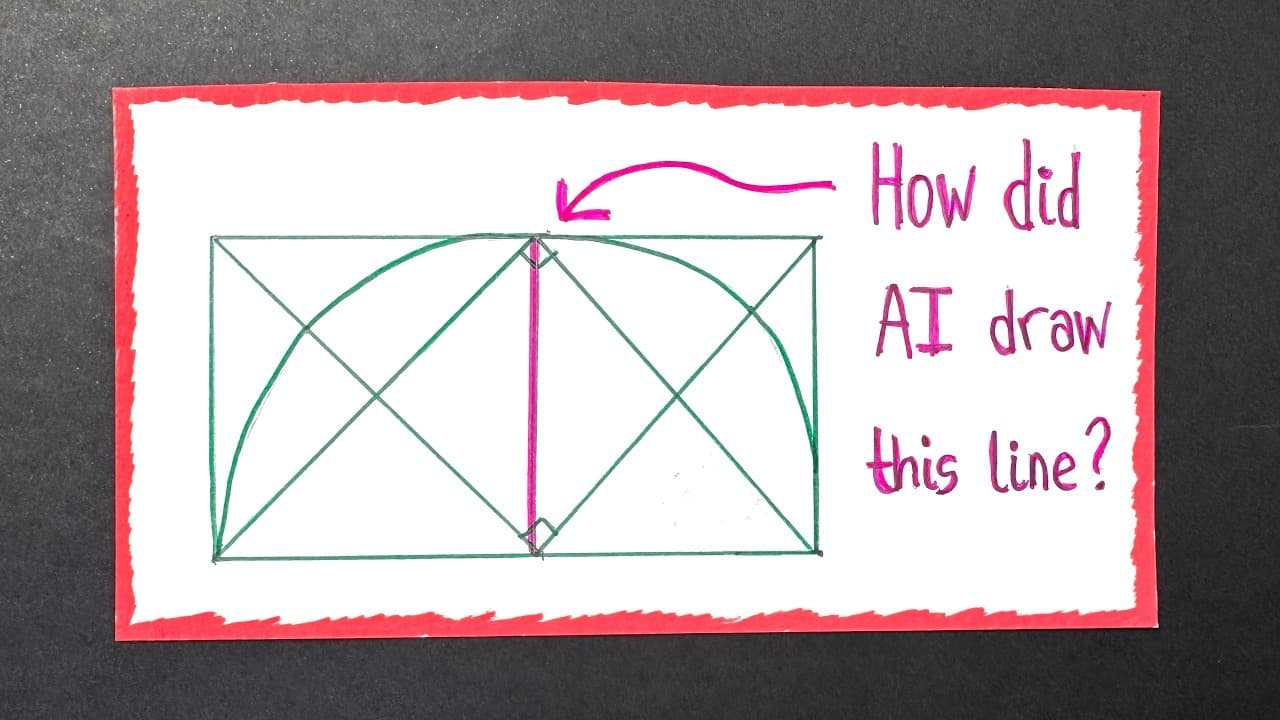
TL;DR
Google DeepMind's Alpha Geometry combines logic and AI to solve International Mathematical Olympiad geometry problems, achieving results comparable to top human competitors. It integrates a deductive database and algebraic reasoning with a language model to create auxiliary constructions, solving 25 out of 30 problems. This approach showcases AI's potential to mimic human-like reasoning and creativity.
Transcript
In January 2024, Google DeepMind released an AI model called Alpha Geometry, which could solve geometry problems from the International Mathematical Olympiad, or the IMO. The IMO is the highest level of competitive math contests at the high school level. Every year, more than 100 countries send six teenagers to represent them at the competition. Ea... Read More
Key Insights
- Alpha Geometry is an AI model by DeepMind that solves IMO geometry problems.
- It combines deductive database (DD) and algebraic reasoning (AR) for problem-solving.
- DD uses a list of geometric rules to deduce new theorems.
- AR solves systems of linear equations using linear algebra.
- The model includes a language component to create auxiliary constructions in diagrams.
- Auxiliary constructions are crucial for solving complex geometry problems.
- Alpha Geometry generated synthetic training data for its language model.
- The model solved 25 out of 30 IMO problems, outperforming many human competitors.
Install to Summarize YouTube Videos and Get Transcripts
Explore YouTube Video Summarizer or Get YouTube Transcript Extractor
Questions & Answers
Q: How does Alpha Geometry solve IMO geometry problems?
Alpha Geometry solves IMO geometry problems by combining a deductive database of geometric rules with algebraic reasoning to handle equations. It uses a language model to create auxiliary constructions, which are essential for solving complex problems. This integration allows the AI to solve 25 out of 30 problems, demonstrating its ability to mimic human-like reasoning and creativity.
Q: What is the role of the deductive database in Alpha Geometry?
The deductive database (DD) in Alpha Geometry serves as a hardcoded list of geometric rules that the AI uses to deduce new theorems. By applying these rules, the model can solve some geometry problems independently. When combined with algebraic reasoning, DD enhances the AI's problem-solving capabilities, allowing it to tackle more complex problems effectively.
Q: Why are auxiliary constructions important in geometry problem-solving?
Auxiliary constructions are important in geometry problem-solving because they introduce additional lines or shapes into a diagram, which are crucial for proving certain theorems. These constructions expand the problem-solving space, enabling the deduction of new facts. In complex problems, multiple auxiliary constructions may be necessary, making them a critical component of effective geometry solutions.
Q: How does Alpha Geometry's language model contribute to problem-solving?
Alpha Geometry's language model contributes to problem-solving by generating auxiliary constructions, which are additional elements added to a diagram to facilitate theorem proving. The model inputs the problem statement and proof steps, producing constructions that aid in solving complex geometry problems. This creativity, combined with logical deduction, enhances the AI's ability to tackle challenging problems effectively.
Q: What limitations does the deductive database face without AI?
Without AI, the deductive database (DD) faces limitations in solving equations and making auxiliary constructions. While DD can deduce new theorems from a list of geometric rules, it struggles with problems requiring complex constructions or equation-solving. These limitations make it less effective in tackling intricate geometry problems without the aid of AI-enhanced components like algebraic reasoning and language models.
Q: How was synthetic training data generated for Alpha Geometry?
Synthetic training data for Alpha Geometry was generated by randomly plotting points and lines on a plane, then using DD plus AR to deduce known theorems. Portions of the diagram were erased to create problems requiring auxiliary constructions for solution. This process produced hundreds of millions of examples, including 9 million that needed at least one auxiliary construction, training the language model effectively.
Q: What performance did Alpha Geometry achieve on IMO problems?
Alpha Geometry achieved impressive performance on IMO problems, solving 25 out of 30. Initially, the deductive database alone solved 7 problems, while combining it with algebraic reasoning increased the count to 14. With human-coded heuristics, the count rose to 18. Integrating a language model for auxiliary constructions further boosted the solution count, showcasing the AI's advanced problem-solving capabilities.
Q: Why is Alpha Geometry's approach significant beyond geometry?
Alpha Geometry's approach is significant beyond geometry because it demonstrates how AI can blend creativity and logic to solve complex problems, a strategy applicable across various domains such as science, medicine, and engineering. By mimicking human-like reasoning, this AI model provides insights into how machines might tackle diverse challenges, potentially transforming problem-solving in multiple fields.
Summary & Key Takeaways
-
Alpha Geometry by DeepMind solves IMO geometry problems using a blend of logic and AI. It employs deductive database and algebraic reasoning to tackle complex problems, while a language model creates necessary auxiliary constructions. This innovative approach allows the AI to solve 25 out of 30 problems, showcasing its potential to think and reason like humans.
-
The model's success lies in integrating a deductive database of geometric rules with algebraic reasoning to handle equations. The addition of a language model for auxiliary constructions enables it to overcome traditional limitations in geometry problem-solving, demonstrating AI's ability to mimic human creativity and logical thinking.
-
Synthetic training data was generated to train the language model, allowing Alpha Geometry to develop auxiliary constructions effectively. This method not only solved complex geometry problems but also provided insights into AI's capability to apply similar strategies across various domains, such as science and engineering.
Read in Other Languages (beta)
Share This Summary 📚
Summarize YouTube Videos and Get Video Transcripts with 1-Click
Try YouTube Summary with ChatGPT & Claude or YouTube Transcript Generator
Explore More Summaries from 3Blue1Brown 📚

Summarize YouTube Videos and Get Video Transcripts with 1-Click
Try YouTube Summary with ChatGPT & Claude or YouTube Transcript Generator