How Does Backpropagation Work Intuitively? | Deep Learning Chapter 3
TL;DR
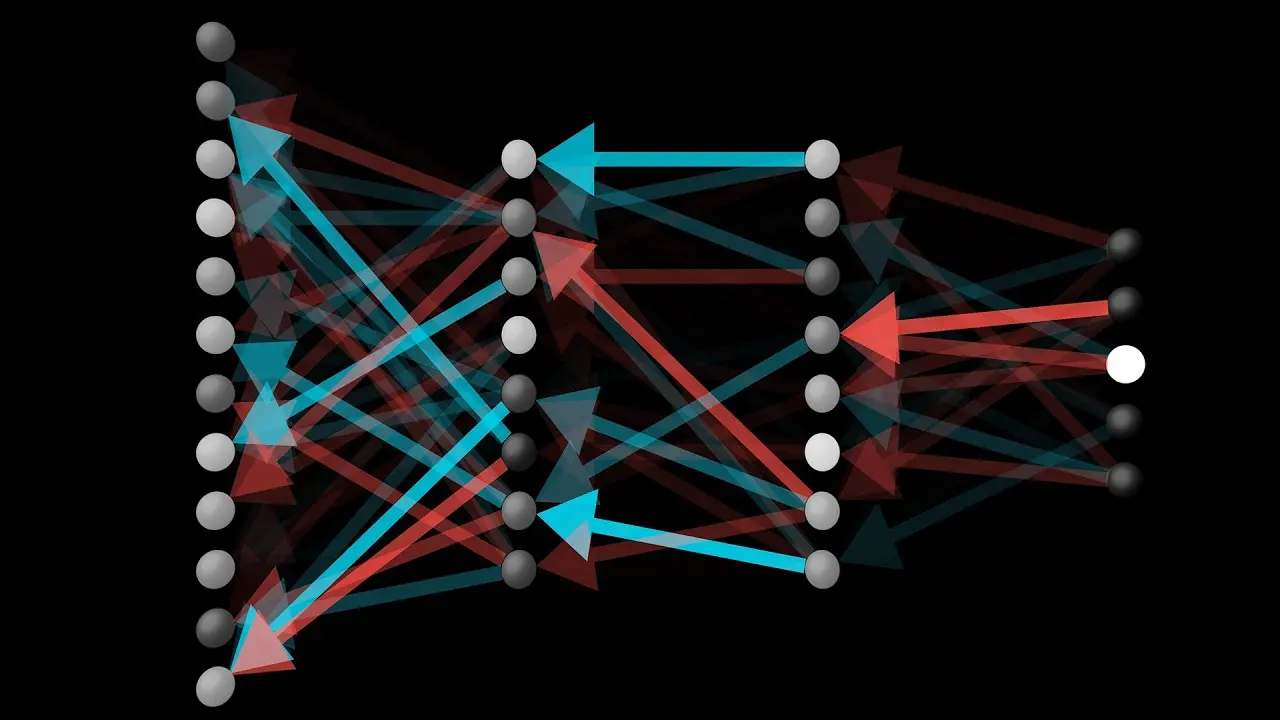
Backpropagation computes the gradient that shows how to change a neural network’s weights and biases to decrease its cost most efficiently. In the handwritten-digit example, 784 input neurons feed two hidden layers of 16 neurons each and an output layer of 10 neurons. The explanation traces how one training example influences each parameter, making it worth reading on for an intuitive view of the algorithm.
Transcript
Here, we tackle backpropagation, the core algorithm behind how neural networks learn. After a quick recap for where we are, the first thing I'll do is an intuitive walkthrough for what the algorithm is actually doing, without any reference to the formulas. Then, for those of you who do want to dive into the math, the next video goes into the calcul... Read More
Key Insights
- Backpropagation is key to how neural networks learn by adjusting weights and biases.
- The algorithm computes the gradient of the cost function to guide weight adjustments.
- Gradient descent seeks to minimize the cost function by adjusting parameters.
- Mini-batches of data enhance computational efficiency during training.
- The sensitivity of the cost function to weight changes determines adjustment magnitude.
- Stochastic gradient descent uses mini-batches for faster, approximate optimization.
- Backpropagation involves propagating errors backward through the network.
- A large amount of labeled training data is crucial for effective learning.
Install to Summarize YouTube Videos and Get Transcripts
Explore YouTube Video Summarizer or Get YouTube Transcript Extractor
Questions & Answers
Q: How does backpropagation work in neural networks?
Backpropagation computes the negative gradient of the cost function, indicating how the network’s weights and biases should change to decrease cost most efficiently. It traces the effects of each training example backward through the network, layering many small parameter adjustments together.
Q: What does the gradient represent in backpropagation?
Each component of the gradient shows how sensitive the cost function is to a particular weight or bias. For example, components of 3.2 and 0.1 mean the cost is 32 times more sensitive to a small change in the first associated weight than to the same change in the second.
Q: How is the neural network’s cost calculated?
For one training example, the network compares its output with the desired output and adds the squared differences between their components. Averaging this result across tens of thousands of training examples gives the network’s total cost.
Q: How does one training example influence backpropagation?
For an image of a 2, the desired effect is to increase the third output value while decreasing the others. The sizes of these changes are proportional to how far each current output is from its target, and backpropagation determines how weights and biases should contribute to those changes.
Q: How can an output neuron’s activation be increased?
Its activation can be increased through three avenues: increasing its bias, increasing relevant weights, or changing activations in the preceding layer. These effects combine before the weighted sum and bias pass through an activation function such as a sigmoid or ReLU.
Q: Why do some weights have more influence than others?
Weights connected to brighter, more active neurons in the preceding layer have greater influence because they are multiplied by larger activation values. For a given training example, increasing one of those weights therefore affects the resulting activation and cost more strongly than increasing a weight connected to a dimmer neuron.
Q: What neural network architecture is used in the handwritten-digit example?
The example feeds pixel values into an input layer containing 784 neurons. It then uses two hidden layers with 16 neurons each and an output layer of 10 neurons representing the digit selected by the network.
Q: Why not use every training example for every gradient descent step?
In principle, each gradient descent adjustment depends on every training example because the total cost averages the individual costs across tens of thousands of examples. The transcript notes that a computational-efficiency trick avoids processing every single example for every step.
Summary & Key Takeaways
-
Backpropagation is an algorithm that calculates how a neural network should adjust its weights and biases to minimize the cost function, thereby improving learning efficiency. It uses the gradient of the cost function to determine optimal changes for each parameter, ensuring the network performs well on training examples.
-
The process involves propagating errors backward through the network, adjusting parameters based on their sensitivity to changes in the cost function. This helps the network learn to classify inputs accurately. Due to computational demands, mini-batches of data are often used instead of the full dataset for faster processing.
-
Understanding backpropagation involves recognizing how each training example influences weight and bias adjustments. By averaging these influences across many examples, the network converges towards a local minimum of the cost function, enhancing its performance on training data.
Read in Other Languages (beta)
Share This Summary 📚
Summarize YouTube Videos and Get Video Transcripts with 1-Click
Try YouTube Summary with ChatGPT & Claude or YouTube Transcript Generator
Explore More Summaries from 3Blue1Brown 📚


Summarize YouTube Videos and Get Video Transcripts with 1-Click
Try YouTube Summary with ChatGPT & Claude or YouTube Transcript Generator