What Is the Relationship Between Area and Slope?
TL;DR
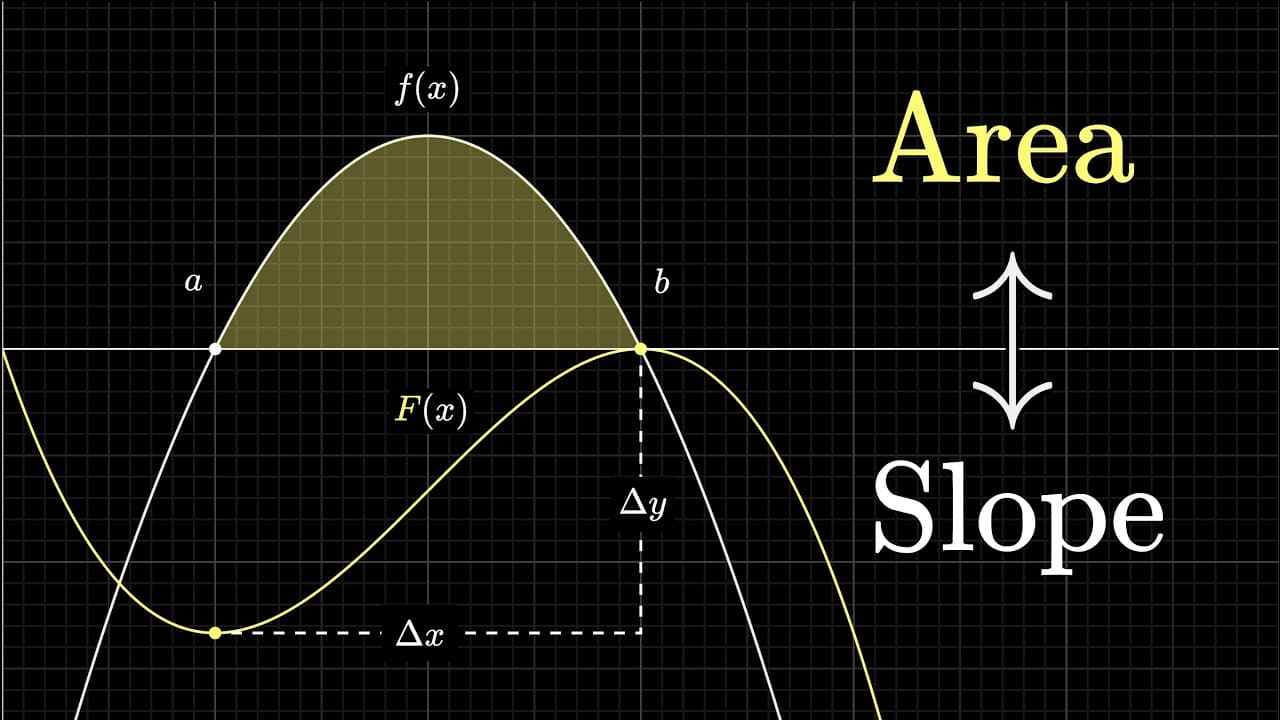
The relationship between area and slope lies in the concept of average value for continuous functions. To find the average height of a function over an interval, divide the integral (area) of the function by the width of the interval. This illustrates how integrals and derivatives are inverses, as the average value reflects the slope of the function between two points.
Transcript
Here, I want to discuss one common type of problem where integration comes up, finding the average of a continuous variable. This is a perfectly useful thing to know in its own right, but what's really neat is that it can give us a completely different perspective for why integrals and derivatives are inverses of each other. To start, take a look a... Read More
Key Insights
- 🧮 Integrals and derivatives are inverses of each other, as demonstrated by finding the average value of a continuous variable.
- ☀️ Many cyclic phenomena, such as the number of hours the sun is up per day, can be modeled using sine wave patterns.
- 📏 Averages are typically computed by adding a finite number of variables and dividing by the total count. This approach cannot be used for infinitely many values.
- 🔢 By using an integral, we can find the average of a continuous variable by approximating it with a finite sum of evenly spaced points.
- 📝 The spacing between points can be determined by dividing the length of the interval by the desired spacing.
- 🔼 The numerator of the average height expression resembles an integral expression, further highlighting the connection between integrals and averages.
- 📐 The average value of a function on an interval is given by the integral of that function divided by the width of the interval.
- 🌊 The average slope of a graph between two points can be viewed as the average value of its derivative, providing another perspective on integrals and derivatives.
Install to Summarize YouTube Videos and Get Transcripts
Explore YouTube Video Summarizer or Get YouTube Transcript Extractor
Questions & Answers
Q: Why is finding the average of a continuous variable important in applications like modeling cyclic phenomena?
Finding the average of a continuous variable allows us to understand the average behavior of cyclic phenomena over a given interval, which is crucial for predicting and analyzing various natural processes.
Q: How can we approach the concept of finding the average of infinitely many values?
When faced with the challenge of finding the average of infinitely many values, the key is to use integrals as a tool to approximate the situation with a finite sum of sampled points.
Q: What is the connection between finding the average of a continuous variable and the concept of integrals?
The average of a continuous variable can be related to the integral of the function by approximating the average through a finite sum of sampled points, which is equivalent to adding up the product of the function value and the spacing between samples.
Q: How does the concept of finding the average of a continuous variable provide a new perspective on integrals and derivatives?
Understanding how to find the average of a continuous variable helps us see that the change in height of an antiderivative graph divided by the change in x represents the average slope of the function, highlighting the connection between integrals and derivatives as inverses of each other.
Summary & Key Takeaways
-
Finding the average of a continuous variable is useful in various applications, such as modeling cyclic phenomena.
-
Although the concept of finding the average of infinitely many values may seem strange, it can be approached by using integrals.
-
By approximating the situation with a finite sum of sampled points, the average of the continuous variable can be calculated and related to the integral of the function.
Read in Other Languages (beta)
Share This Summary 📚
Summarize YouTube Videos and Get Video Transcripts with 1-Click
Try YouTube Summary with ChatGPT & Claude or YouTube Transcript Generator
Explore More Summaries from 3Blue1Brown 📚

Summarize YouTube Videos and Get Video Transcripts with 1-Click
Try YouTube Summary with ChatGPT & Claude or YouTube Transcript Generator