How Do Holograms Create 3D Illusions?
TL;DR
Holograms create 3D illusions by recording the light field of a scene on a special film using lasers, capturing optical details from multiple angles. This technique, discovered by Dennis Gabor in 1947, became practical with lasers and involves capturing the phase of light, allowing for the reconstruction of a 3D scene when illuminated correctly.
Transcript
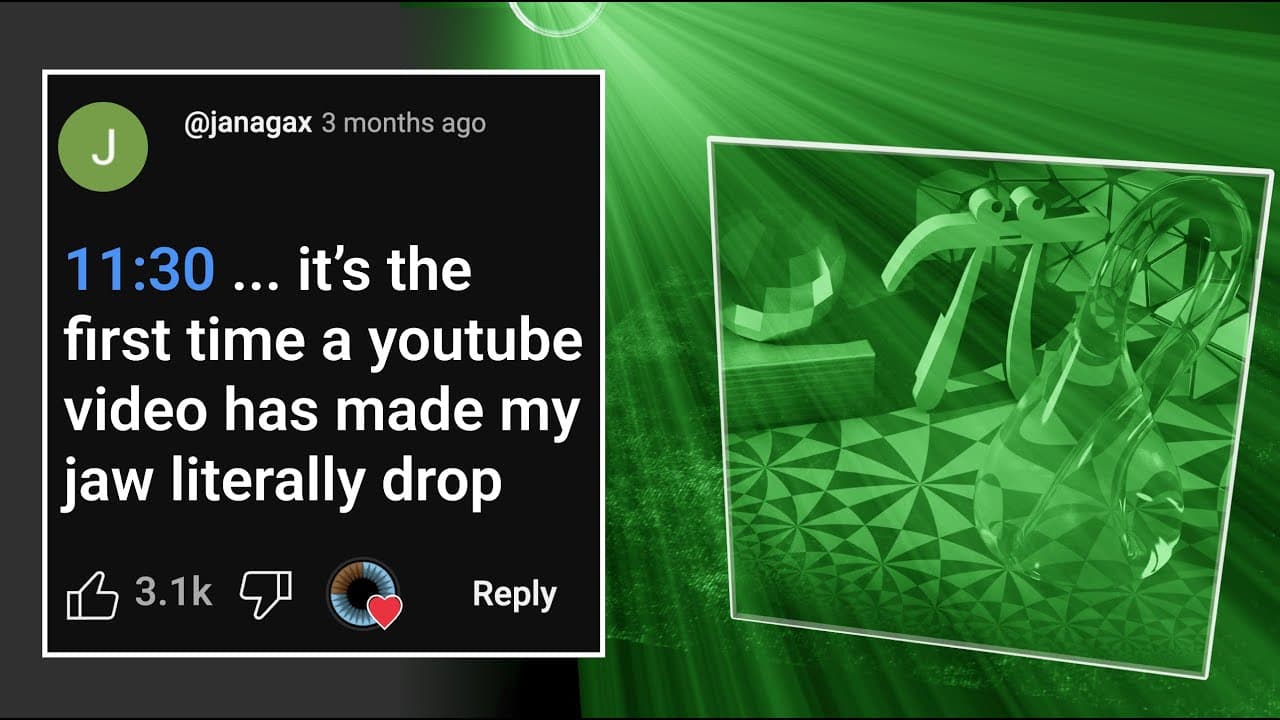
Let me show you something I find completely magical. Behind this piece of glass, there appears to be a three-dimensional scene. You can move around your head and you see the light play off of the objects in different ways. For example, that glass Klein bottle in the front warps what's behind it. But it's an illusion. In reality, al... Read More
Key Insights
- Holograms create the illusion of a 3D scene using a special piece of film exposed in a unique way, allowing different perspectives.
- Unlike photographs, holograms store an entire light field, capturing every optical detail from all viewing angles.
- Dennis Gabor discovered the principle of holography in 1947, but it became practical with the invention of lasers decades later.
- Transmission holograms require a laser for illumination, while reflection holograms can use ordinary light.
- Recording a hologram involves a complex setup with lasers and precise positioning to capture the phase of light.
- The diffraction pattern on holographic film is sensitive to tiny movements, requiring stillness during exposure.
- Holography reproduces a light field, creating a 3D illusion by reconstructing the object wave from the film.
- Advanced holography techniques allow for dynamic changes and computer-generated 3D models to be represented as holograms.
Install to Summarize YouTube Videos and Get Transcripts
Explore YouTube Video Summarizer or Get YouTube Transcript Extractor
Questions & Answers
Q: How does a hologram create the illusion of a 3D scene?
A hologram creates the illusion of a 3D scene by recording the entire light field of the scene on a special film. This film captures all optical details from various angles, allowing viewers to perceive depth and dimensionality as if looking through a window into the scene. The film is exposed using a laser, which stores the phase and amplitude of the light waves, enabling the recreation of the scene when illuminated.
Q: What is the role of lasers in holography?
Lasers play a crucial role in holography by providing coherent light, which is essential for capturing the phase information of light waves. During the recording process, a laser beam is split into two: one part illuminates the scene (object wave), and the other serves as a reference wave. The interference pattern between these waves is recorded on the film, allowing the hologram to recreate the original light field when the reference wave is used during reconstruction.
Q: Who discovered the principle of holography and when?
The principle of holography was discovered by Dennis Gabor in 1947. He was working on methods for electron microscopy when he had the fundamental insight that led to holography. However, practical holography did not become feasible until the invention of lasers in the 1960s, which provided the coherent light necessary for creating holograms. Gabor's work earned him the Nobel Prize in Physics in 1971.
Q: What distinguishes transmission holograms from reflection holograms?
Transmission holograms require a laser to illuminate the film from behind, allowing the viewer to see the 3D scene through the film. In contrast, reflection holograms can be viewed using ordinary white light that reflects off the film. This makes reflection holograms more practical for everyday use, as they do not require special lighting conditions to reveal the holographic image.
Q: How is the holography process similar to and different from photography?
While both holography and photography capture images on film, they differ significantly in the information recorded. Photography captures a scene from a single angle, focusing only on the amplitude of light. Holography, however, records the entire light field, including phase information, from multiple angles. This allows holograms to recreate the depth and dimensionality of a scene, whereas photographs are limited to two-dimensional representations.
Q: What challenges are involved in recording a hologram?
Recording a hologram involves precise control over the setup, including the use of lasers and beam splitters. The process is sensitive to movement, requiring stillness during exposure to prevent blurring of the interference pattern. Additionally, the film used must have extremely high resolution to capture the fine details of the light field, which is essential for accurately reconstructing the 3D scene.
Q: What is a Fresnel zone plate, and how does it relate to holography?
A Fresnel zone plate is a pattern of concentric rings that appears on the holographic film when recording a point source of light. This pattern results from the interference of light waves and encodes the 3D position of the point. During reconstruction, the zone plate acts as a diffraction grating, splitting the reference wave into beams that recreate the original light field, allowing the viewer to perceive the point as if it were still present.
Q: How can holography be used beyond creating visual illusions?
Beyond visual illusions, holography has applications in interferometry, where it measures extremely tiny distances by analyzing wave interference patterns. It also has potential uses in data storage, security, and medical imaging. The ability to record and reproduce entire wavefronts makes holography a valuable tool in scientific research and various technological fields, offering new ways to visualize and analyze complex data.
Summary & Key Takeaways
-
Holograms create a 3D illusion by recording the light field of a scene on a special film using lasers. The film stores optical details from multiple angles, unlike ordinary photographs.
-
Dennis Gabor's discovery of holography in 1947 became practical with lasers, leading to the creation of transmission and reflection holograms, each requiring different light sources for viewing.
-
The holography process involves capturing the phase of light, resulting in a diffraction pattern on the film. This pattern recreates the original light field, allowing the illusion of a 3D scene.
Read in Other Languages (beta)
Share This Summary 📚
Summarize YouTube Videos and Get Video Transcripts with 1-Click
Try YouTube Summary with ChatGPT & Claude or YouTube Transcript Generator
Explore More Summaries from 3Blue1Brown 📚
Summarize YouTube Videos and Get Video Transcripts with 1-Click
Try YouTube Summary with ChatGPT & Claude or YouTube Transcript Generator