How Do Dot Products Relate to Linear Transformations?
TL;DR
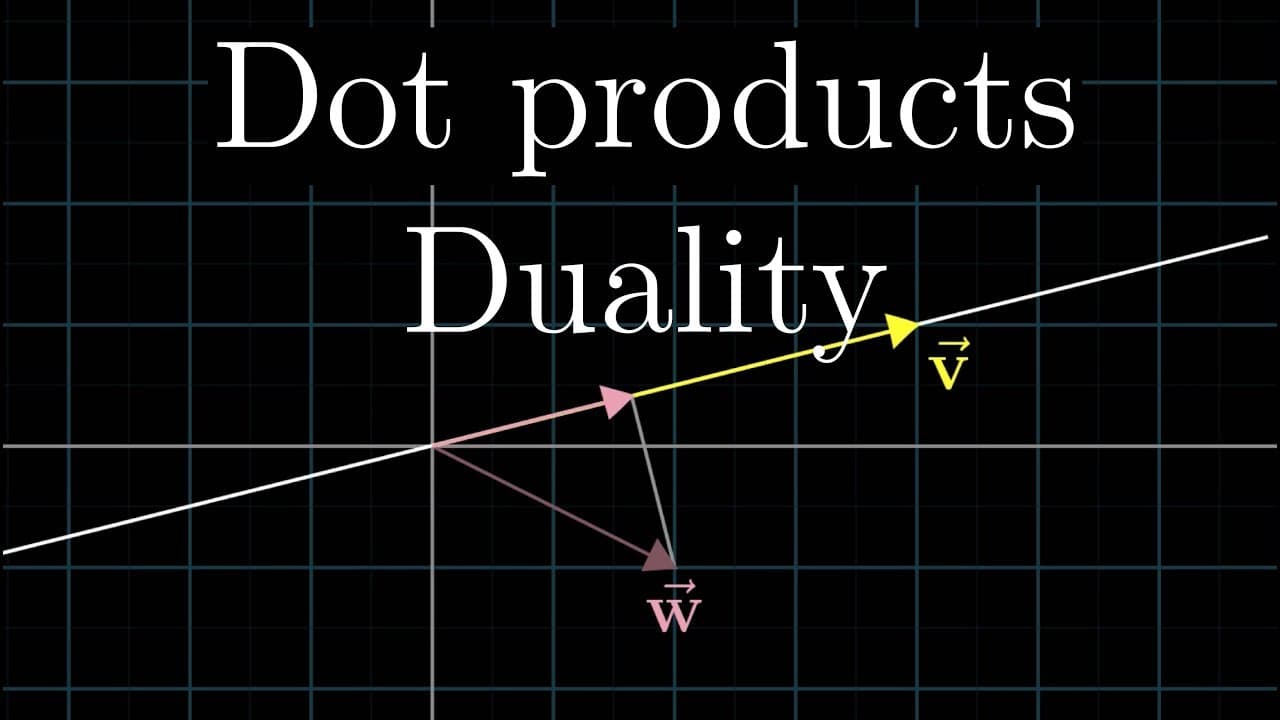
Dot products are introduced as a numerical operation on vectors, but their deeper significance is revealed through their connection to linear transformations and duality. This relationship explains why dot products can be interpreted as projections and highlights their role in translating vectors into transformations.
Transcript
["Ode to Joy", by Beethoven, plays to the end of the piano.] Traditionally, dot products are something that's introduced really early on in a linear algebra course, typically right at the start. So it might seem strange that I've pushed them back this far in the series. I did this because there's a standard way to introduce the topic, which require... Read More
Key Insights
- Dot products are initially taught as a basic operation involving multiplying and summing vector components.
- Geometrically, the dot product of two vectors can be interpreted as the projection of one vector onto another.
- The dot product's sign indicates the relative direction of vectors: positive for same direction, zero for perpendicular, negative for opposite directions.
- Order of vectors in a dot product doesn't affect the result due to the symmetry of projection.
- Scaling a vector affects the dot product proportionally, demonstrating consistency under different interpretations.
- The numerical dot product operation is analogous to matrix-vector multiplication, revealing a deeper connection.
- Duality in math shows a correspondence between vectors and linear transformations, with dot products bridging the two.
- Understanding vectors as transformations offers a new perspective, simplifying complex mathematical concepts.
Install to Summarize YouTube Videos and Get Transcripts
Explore YouTube Video Summarizer or Get YouTube Transcript Extractor
Questions & Answers
Q: How to compute the dot product of two vectors?
To compute the dot product of two vectors, pair up their corresponding coordinates, multiply each pair, and sum the results. For example, the dot product of vectors (1, 2) and (3, 4) is calculated as (13) + (24) = 3 + 8 = 11. This operation is fundamental in linear algebra for various applications.
Q: What is the geometric interpretation of the dot product?
Geometrically, the dot product represents the projection of one vector onto another. It measures how much one vector extends in the direction of another. If vectors point in the same direction, the dot product is positive; if perpendicular, it's zero; and if in opposite directions, it's negative. This interpretation is crucial for understanding vector alignment.
Q: Why does the order of vectors not matter in dot products?
The order of vectors in a dot product doesn't matter due to the symmetric nature of projection. Projecting vector A onto B yields the same result as projecting B onto A. This symmetry ensures that the dot product is commutative, meaning A·B equals B·A, simplifying calculations and interpretations in vector mathematics.
Q: How does scaling a vector affect the dot product?
Scaling a vector affects the dot product proportionally, maintaining consistency across different interpretations. If a vector is scaled by a constant, the dot product with another vector is multiplied by that constant. This property reflects the linear nature of dot products, crucial for understanding transformations and vector operations.
Q: What is the connection between dot products and linear transformations?
Dot products are connected to linear transformations through the concept of duality. A dot product can be seen as a transformation that projects a vector onto another, translating vector operations into transformations. This relationship reveals the deeper mathematical significance of dot products beyond simple vector operations.
Q: What role does duality play in understanding dot products?
Duality in mathematics refers to a correspondence between two seemingly different concepts. In the context of dot products, duality shows the connection between vectors and linear transformations. This perspective allows dot products to be understood as both geometric projections and algebraic operations, providing a richer understanding of vector mathematics.
Q: How can vectors be viewed as transformations?
Vectors can be viewed as transformations by considering their role in linear transformations. Instead of seeing vectors merely as arrows in space, they can represent transformations that map spaces to numbers. This view simplifies complex mathematical concepts, highlighting the dual nature of vectors as both geometric and transformative entities.
Q: Why is understanding dot products important in math?
Understanding dot products is crucial in math because they serve as a fundamental tool for vector operations, projections, and transformations. They provide insight into vector alignment, geometric interpretations, and the connection to linear transformations through duality. This understanding is essential for advanced studies in linear algebra and related fields.
Summary & Key Takeaways
-
Dot products are fundamental in linear algebra, introduced as operations on vectors involving multiplication and addition of components. They have a geometric interpretation as vector projections, which explains their use in determining vector alignment.
-
The video explores the deeper connection between dot products and linear transformations, introducing the concept of duality. This relationship shows that dot products can translate vectors into transformations, highlighting their significance beyond basic computations.
-
Duality provides a framework where vectors and transformations are interrelated, with dot products serving as the link. This perspective allows for a more profound understanding of vectors, emphasizing their role in mathematical transformations.
Read in Other Languages (beta)
Share This Summary 📚
Summarize YouTube Videos and Get Video Transcripts with 1-Click
Try YouTube Summary with ChatGPT & Claude or YouTube Transcript Generator
Explore More Summaries from 3Blue1Brown 📚
Summarize YouTube Videos and Get Video Transcripts with 1-Click
Try YouTube Summary with ChatGPT & Claude or YouTube Transcript Generator