How Does a Derivative Measure Change at a Point?
TL;DR
A derivative is the value that a function’s change ratio approaches as the input change approaches zero. Geometrically, it is the slope of the tangent line at a point, and practically, it gives the best constant approximation for the rate of change around that point without requiring the contradictory idea of change within a single instant.
Transcript
The goal here is simple, explain what a derivative is. The thing is though, there's some subtlety to this topic, and a lot of potential for paradoxes if you're not careful. So a secondary goal is that you have an appreciation for what those paradoxes are and how to avoid them. You see, it's common for people to say that the derivative measures an... Read More
Key Insights
- An instantaneous rate of change is conceptually paradoxical because change requires comparing separate points, while an instant provides only one point. The derivative handles this difficulty by examining what change ratios approach as the separation between two points approaches zero.
- Velocity is calculated from a change in distance divided by a change in time. A single snapshot of a car cannot reveal its velocity because the calculation requires distance measurements from two separate times, even when those times are extremely close together.
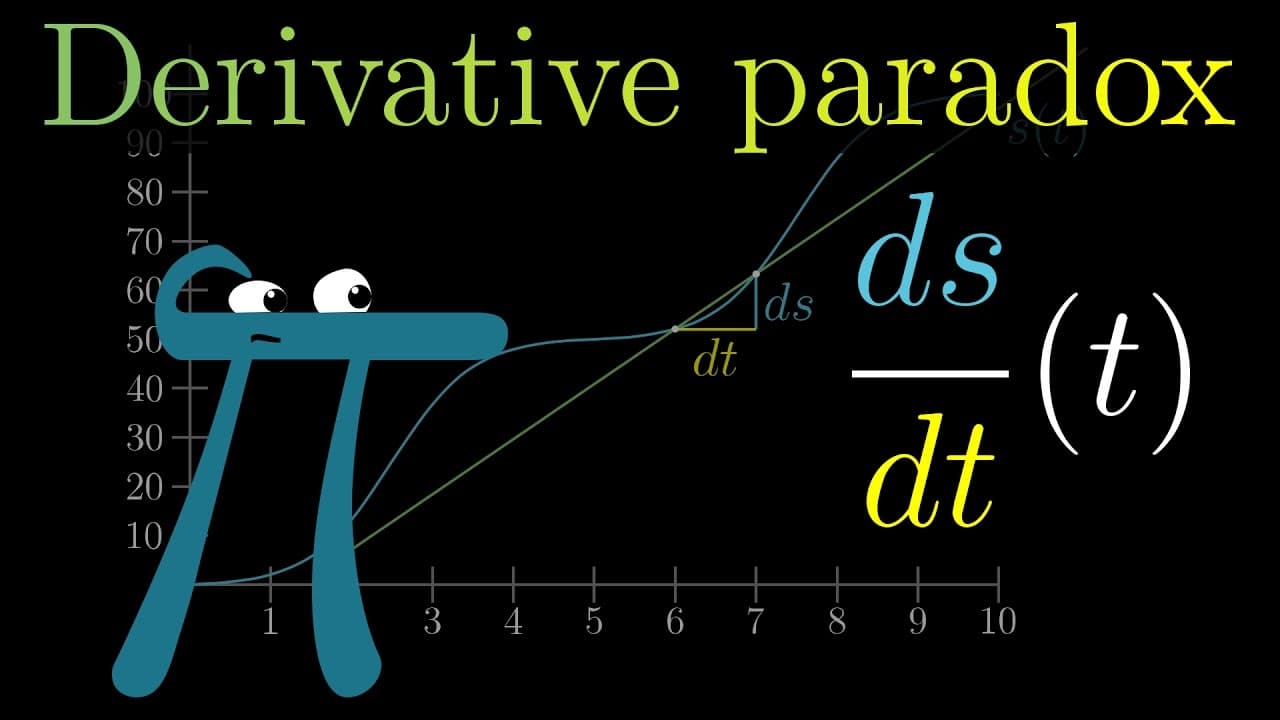
- A distance-versus-time graph encodes motion through its slope. Shallow sections indicate that relatively little distance is covered per unit time, while steeper sections indicate greater distance covered per unit time, connecting the graph’s shape to the car’s velocity.
- A physical speedometer can sidestep the single-instant paradox by measuring motion over a small but concrete interval. In the hypothetical example, it compares the car’s position at 3 seconds with its position at 3.01 seconds and divides by 0.01 seconds.
- The ratio ds divided by dt represents the slope between two nearby points when dt has a concrete, nonzero size. Here, dt is a small horizontal step in time, and ds is the corresponding vertical change in total distance traveled.
- The derivative is the value approached by ds divided by dt as dt approaches zero. It is not merely the ratio produced by one chosen small interval, because different finite interval sizes can produce different approximations of the local rate.
- The derivative is geometrically the slope of the tangent line at the selected point. This tangent slope arises as the slopes of lines through two separate graph points approach a limiting value while those points move closer together.
- The notation ds divided by dt expresses an intention to examine increasingly small changes, although the derivative is not technically an ordinary fraction. A useful interpretation is the best constant approximation for the function’s rate of change around a point.
Install to Summarize YouTube Videos and Get Transcripts
Explore YouTube Video Summarizer or Get YouTube Transcript Extractor
Questions & Answers
Q: What is a derivative in calculus?
A derivative is the value that a function’s change ratio approaches as the change in its input approaches zero. On a graph, it equals the slope of the tangent line at the point being examined. It is not based on substituting zero into the change ratio, and it is not simply the slope between two points separated by one fixed small interval.
Q: Why is instantaneous rate of change a paradox?
Instantaneous rate of change sounds paradoxical because change occurs between separate points, such as two different times, while a single instant contains no interval over which a change can occur. Calculus resolves this tension by comparing two distinct points and asking what their change ratio approaches as their separation approaches zero, without requiring the points to become separated by an actual zero interval.
Q: How does a distance-time graph show velocity?
A distance-versus-time graph shows total distance on its vertical axis and time on its horizontal axis. Velocity is related to the graph’s slope because the slope compares a change in distance with a change in time. A shallow section corresponds to relatively low velocity, a steeper section corresponds to higher velocity, and a section that becomes shallow again represents slowing down.
Q: How can a speedometer estimate velocity at a moment?
A speedometer can estimate velocity by measuring how far a car travels during a very small but nonzero time interval. In the hypothetical example, it compares the distance at 3 seconds with the distance at 3.01 seconds, then divides the distance change by 0.01 seconds. It therefore measures motion around the selected moment rather than change within a literally isolated instant.
Q: What do ds and dt represent in a derivative?
The symbol dt represents a small change in the input time, while ds represents the resulting change in the distance function. When both changes have concrete sizes, ds divided by dt is the rise-over-run slope between two nearby points on the distance graph. Calculus notation also signals an intention to study what this ratio approaches as dt becomes smaller and approaches zero.
Q: Why can’t you plug zero in for dt?
Plugging zero in for dt would not produce the derivative described in the transcript because the change ratio compares values at two separate inputs and divides by their nonzero separation. Instead, dt always has a finite, nonzero size during the comparison. The derivative is determined by the value of the ratio as progressively smaller choices of dt approach zero, not by evaluating the ratio at zero.
Q: How is a tangent line connected to the derivative?
For a specific nonzero dt, the change ratio is the slope of a line passing through two separate points on the graph. As dt approaches zero, those points move closer together, and the slopes of their connecting lines approach the slope of a tangent line at the selected point. That limiting tangent slope is the derivative at that point.
Q: How should beginners interpret a derivative intuitively?
A helpful interpretation is that a derivative gives the best constant approximation for a function’s rate of change around a selected point. This avoids treating change within one isolated instant as a literal physical process. It also preserves the visual meaning of the derivative: nearby secant slopes approach a tangent slope as the input interval becomes smaller and smaller.
Summary & Key Takeaways
-
Velocity can be estimated by comparing a car’s change in distance with a small, nonzero change in time. On a distance-versus-time graph, this ratio is the rise-over-run slope between two nearby points. Steeper portions of the graph correspond to higher velocities, while shallower portions correspond to lower velocities.
-
A mathematical derivative is not the change ratio for one fixed time interval. It is the value approached by that ratio as the interval approaches zero. Throughout this process, the interval remains finite and nonzero, so differentiation does not require plugging zero into a denominator or defining an infinitely small interval.
-
As the two points used for a change ratio approach one another, their connecting line approaches a tangent line. The derivative is the tangent line’s slope at the selected point. It can be understood as the best constant approximation for how the function changes near that point, resolving the apparent instantaneous-change paradox.
Read in Other Languages (beta)
Share This Summary 📚
Summarize YouTube Videos and Get Video Transcripts with 1-Click
Try YouTube Summary with ChatGPT & Claude or YouTube Transcript Generator
Explore More Summaries from 3Blue1Brown 📚
Summarize YouTube Videos and Get Video Transcripts with 1-Click
Try YouTube Summary with ChatGPT & Claude or YouTube Transcript Generator