How to Solve the Putnam Sphere Probability Puzzle
TL;DR
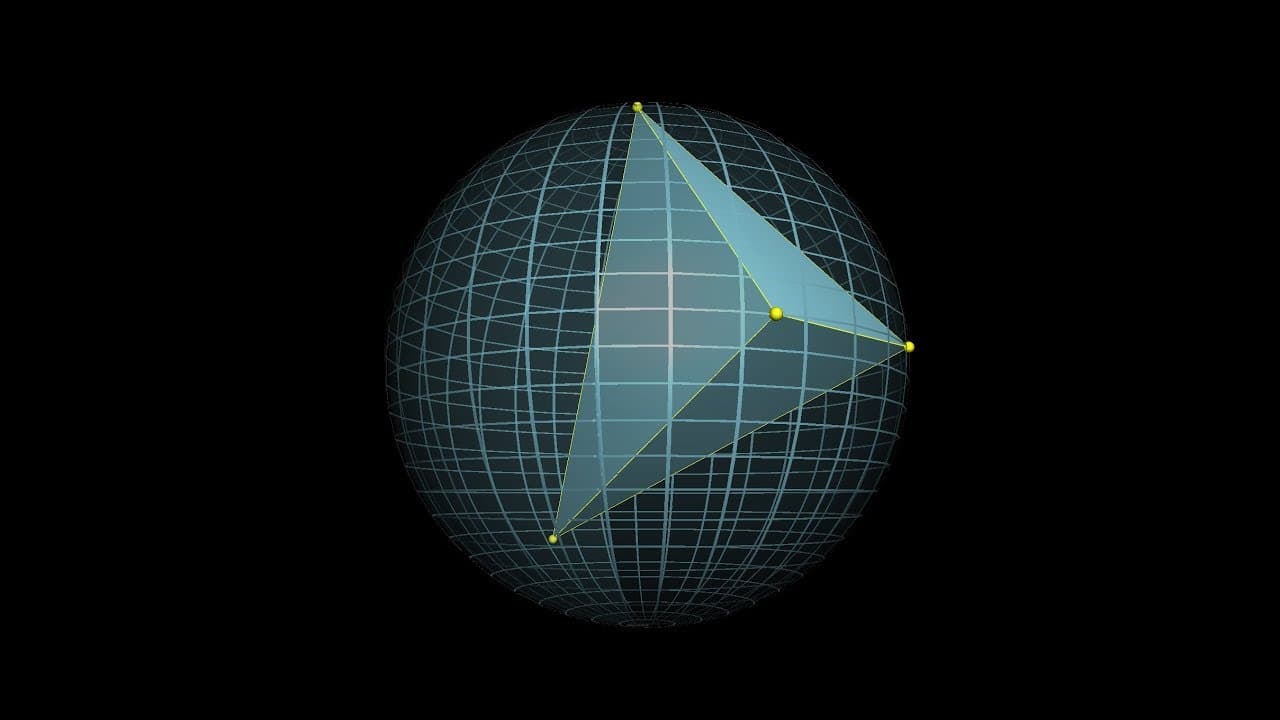
The probability that four random points on a sphere form a tetrahedron containing the sphere’s center is one eighth. Reframe three points as coin-selected endpoints of three random lines through the center, while fixing the fourth point. The three coin flips create eight equally likely configurations, and exactly one places the first three points opposite the fourth in the required way.
Transcript
Do you guys know about the Putnam? It's a math competition for undergraduate students. It's a six-hour long test that just has 12 questions broken up into two different three-hour sessions. And each one of those questions is scored 1 to 10, so the highest possible score would be 120. And yet, despite the fact that the only students taking this thin... Read More
Key Insights
- The Putnam is a six-hour mathematics competition for undergraduate students, consisting of 12 questions divided between two three-hour sessions. Each question is worth 10 points, but the median total score is only around 1 or 2, indicating the test’s exceptional difficulty.
- The sphere problem asks for the probability that four random points produce a tetrahedron containing the sphere’s center. Although it appeared as the sixth question on a Putnam section, its solution becomes short once the random selection process is represented differently.
- The two-dimensional analogue has probability one quarter. After fixing two random points on a circle, the third point must lie in a particular opposite arc, and the average size of that arc is one quarter of the circle’s circumference.
- A random point on a circle can be generated by choosing a random line through the center and flipping a coin to select one of its two endpoints. This equivalent construction exposes a finite collection of equally likely endpoint configurations.
- The circle construction creates four equally likely configurations for the first two points once their lines and the third point are fixed. Exactly one configuration places the first two points opposite the third so that their triangle contains the center.
- The sphere construction uses three random lines through the center and three coin flips to select the first three points. With the fourth point fixed, the flips produce eight equally likely endpoint configurations, exactly one of which gives a center-containing tetrahedron.
- The required probability is one eighth because only one of the eight equally likely coin-flip outcomes places the first three vertices on the opposite side of the center from the fourth vertex in the necessary configuration.
- The central problem-solving method is to study simpler versions until a useful foothold appears. When an added object, such as a line through the center, clarifies the simpler problem, reframing the full question around that object can reveal a general solution.
Install to Summarize YouTube Videos and Get Transcripts
Explore YouTube Video Summarizer or Get YouTube Transcript Extractor
Questions & Answers
Q: What is the probability that a random tetrahedron contains the sphere’s center?
The probability is one eighth. Choose three random lines through the sphere’s center, fix a random fourth point, and independently choose one of the two sphere intersections on each line as the first three vertices. The three choices produce eight equally likely configurations. Exactly one places the first three points opposite the fourth in the arrangement required for the tetrahedron to contain the center.
Q: How can the sphere probability problem be simplified?
Replace the three-dimensional problem with a two-dimensional analogue. Choose three random points on a circle and ask whether their triangle contains the center. Fixing the first two points reveals a particular opposite arc where the third point must lie. This simpler setting makes the geometry visible and leads to a second formulation based on lines through the center and endpoint-selecting coin flips.
Q: What is the probability that three random points on a circle surround its center?
The probability is one quarter. If the first two points are fixed, the third must land in a particular arc on their opposite side. As the first two points vary randomly, the relevant arc ranges from zero to half of the circle, with an average proportion of one quarter. Therefore, the overall probability that the triangle contains the center is one quarter.
Q: Why does the coin-flip method give one quarter in the circle problem?
Choose two random lines through the circle’s center, then fix the third point. Each line has two possible endpoints, and a coin flip selects the endpoint representing each of the first two points. The two flips create four equally likely configurations. Exactly one puts both selected endpoints opposite the third point, causing the resulting triangle to contain the circle’s center.
Q: Why does the coin-flip method give one eighth for the sphere problem?
Three random lines through the sphere’s center each intersect the sphere at two possible vertices. Selecting one endpoint from each line requires three coin flips, creating eight equally likely outcomes. After the fourth point is fixed, exactly one outcome places the first three vertices on the opposite side in the configuration that makes their tetrahedron contain the center. Thus, the probability is one eighth.
Q: Why are random lines useful in solving the Putnam sphere problem?
Lines through the center convert continuous geometric choices into a small set of equally likely endpoint choices. A random point can be viewed as one of the two intersections produced by a random central line, selected by a coin flip. Once the lines and final point are fixed, the containment question reduces to counting successful coin-flip configurations instead of calculating an average spherical area.
Q: Why is directly averaging the spherical region difficult?
Fixing three vertices and drawing their lines through the center divides the sphere into eight spherical-triangle regions. The fourth vertex must fall in the region opposite the first three for the tetrahedron to contain the center. However, the size of that region changes as the three fixed points move, making its average difficult to calculate through a surface integral. The coin-flip reframing avoids that calculation.
Q: What general problem-solving lesson does the Putnam solution demonstrate?
The lesson is to keep asking simpler versions of a difficult question until a useful structure becomes visible. In the circle analogue, lines through the center clarify which configurations contain the center. The next step is to reformulate the entire random process using those lines. That change turns the original sphere problem into a count of eight equally likely outcomes with one successful case.
Summary & Key Takeaways
-
The Putnam is a six-hour undergraduate mathematics competition with 12 questions split into two three-hour sessions. Although each problem is worth 10 points and the maximum score is 120, the median score is around 1 or 2. Its hardest-positioned problems can nevertheless have unexpectedly elegant solutions based on a subtle change in perspective.
-
The sphere problem asks for the probability that a tetrahedron formed from four random points contains the sphere’s center. A simpler two-dimensional version uses three random points on a circle. Fixing two points identifies an opposite arc for the third point, and averaging that arc’s proportion gives a probability of one quarter.
-
A more general argument replaces randomly chosen points with random lines through the center and coin flips selecting their endpoints. In two dimensions, one of four endpoint configurations works. In three dimensions, one of eight works, producing a probability of one eighth and illustrating how a useful added construction can reorganize an entire problem.
Read in Other Languages (beta)
Share This Summary 📚
Summarize YouTube Videos and Get Video Transcripts with 1-Click
Try YouTube Summary with ChatGPT & Claude or YouTube Transcript Generator
Explore More Summaries from 3Blue1Brown 📚

Summarize YouTube Videos and Get Video Transcripts with 1-Click
Try YouTube Summary with ChatGPT & Claude or YouTube Transcript Generator