What Is Convolution and How Is It Used?
TL;DR
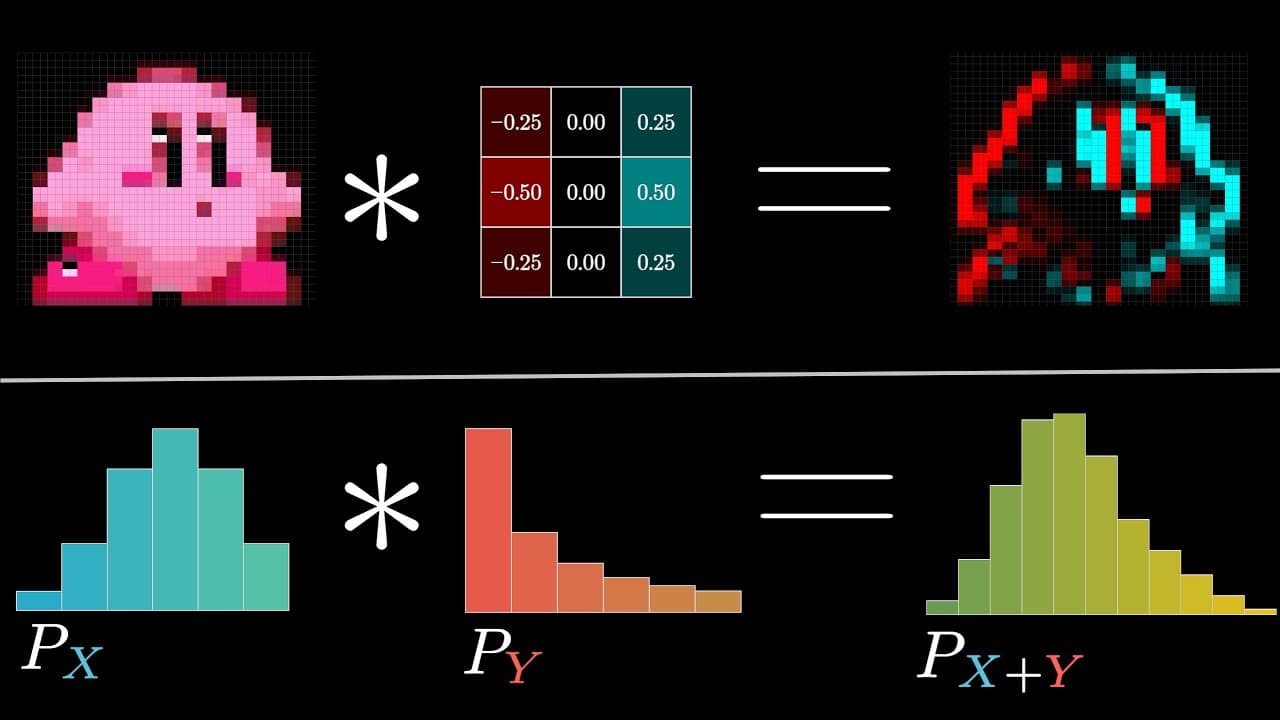
Convolution is a mathematical operation that combines two sequences or functions to produce a new sequence, distinct from simple addition or multiplication. It is widely used in image processing, probability theory, and solving differential equations. Convolution can be visualized as a sliding window operation where corresponding values are multiplied and summed, leading to various applications such as blurring images, detecting edges, and computing probabilities.
Transcript
Suppose I give you two different lists of numbers, or maybe two different functions, and I ask you to think of all the ways you might combine those two lists to get a new list of numbers, or combine the two functions to get a new function. Maybe one simple way that comes to mind is to simply add them together term by term. Likewise with the funct... Read More
Key Insights
- 👉 Convolutions are a fundamental way to combine two lists of numbers or functions, and they are not just limited to simple addition or multiplication, but can provide new insights and operations in various fields such as image processing, probability, solving differential equations, and multiplying polynomials.
- 🧮 Convolution can be visualized as a sliding window operation, where a window is moved across two lists, and the convolution result is obtained by multiplying corresponding values and summing them up.
- 👀 Image processing examples, such as blurring an image or detecting edges, can be achieved through convolutions with specific kernels.
- 🎲 Convolution can be used in probability to determine the chances of getting different sums when rolling dice, and it can also be used to combine two different probability distributions.
- 💻 In computing, convolution operations can be performed efficiently using algorithms like the Fast Fourier Transform (FFT), which significantly reduces the computational complexity from O(n^2) to O(n log n).
- 📊 Convolution can be seen as a pointwise multiplication of coefficients or values, and it can be used to extract information from polynomials or combine them.
- ✨ Convolution opens the doors for faster algorithms and computations in various applications, such as multiplying large numbers or performing large-scale image processing.
- 🔢 Understanding the concept of convolution can provide insights into mathematical operations and their applications in different areas, showcasing the interconnectedness of mathematics across disciplines.
Install to Summarize YouTube Videos and Get Transcripts
Explore YouTube Video Summarizer or Get YouTube Transcript Extractor
Questions & Answers
Q: How does convolution differ from standard addition or multiplication of lists or functions?
Convolution is a distinct operation that combines two lists or functions by point-wise multiplication and summation, resulting in a new list or function that represents a weighted combination of the original inputs.
Q: What are some examples of real-world applications of convolution?
Convolution is used in various fields such as image processing, where it is used for blurring, edge detection, and other effects. It is also a core concept in probability theory for combining probability distributions and in solving differential equations.
Q: Can convolution be visualized as a sliding window operation?
Yes, visualization of convolution as a sliding window operation involves aligning two lists or functions at different offset values, multiplying corresponding values, and adding up the products.
Q: How does convolution relate to multiplying two polynomials?
Convolution can be thought of as expanding and collecting like terms of the product of two polynomials. The coefficients of the resulting polynomial are the convolutions of the coefficients of the original polynomials.
Q: What is the significance of the fast Fourier transform (FFT) algorithm in computing convolutions?
The FFT algorithm allows for faster computation of convolutions by leveraging the redundancy in computations and reducing the number of operations required from O(n^2) to O(n log n), where n is the size of the lists or functions being convolved.
Q: Can convolution be applied to continuous functions?
Yes, convolution can be applied to continuous functions in a similar way as in the discrete case, with some additional considerations due to the infinite range of inputs.
Summary & Key Takeaways
-
Convolution is a fundamental operation that combines two lists or functions to create a new list or function, distinct from addition or multiplication.
-
Convolution is widely used in various fields, including image processing, probability theory, and solving differential equations.
-
Convolution can be visualized as a sliding window operation, point-wise multiplication followed by summation, or expanding polynomials and collecting like terms.
Read in Other Languages (beta)
Share This Summary 📚
Summarize YouTube Videos and Get Video Transcripts with 1-Click
Try YouTube Summary with ChatGPT & Claude or YouTube Transcript Generator
Explore More Summaries from 3Blue1Brown 📚



Summarize YouTube Videos and Get Video Transcripts with 1-Click
Try YouTube Summary with ChatGPT & Claude or YouTube Transcript Generator