How Does Bayes' Theorem Use Geometry to Change Beliefs?
TL;DR
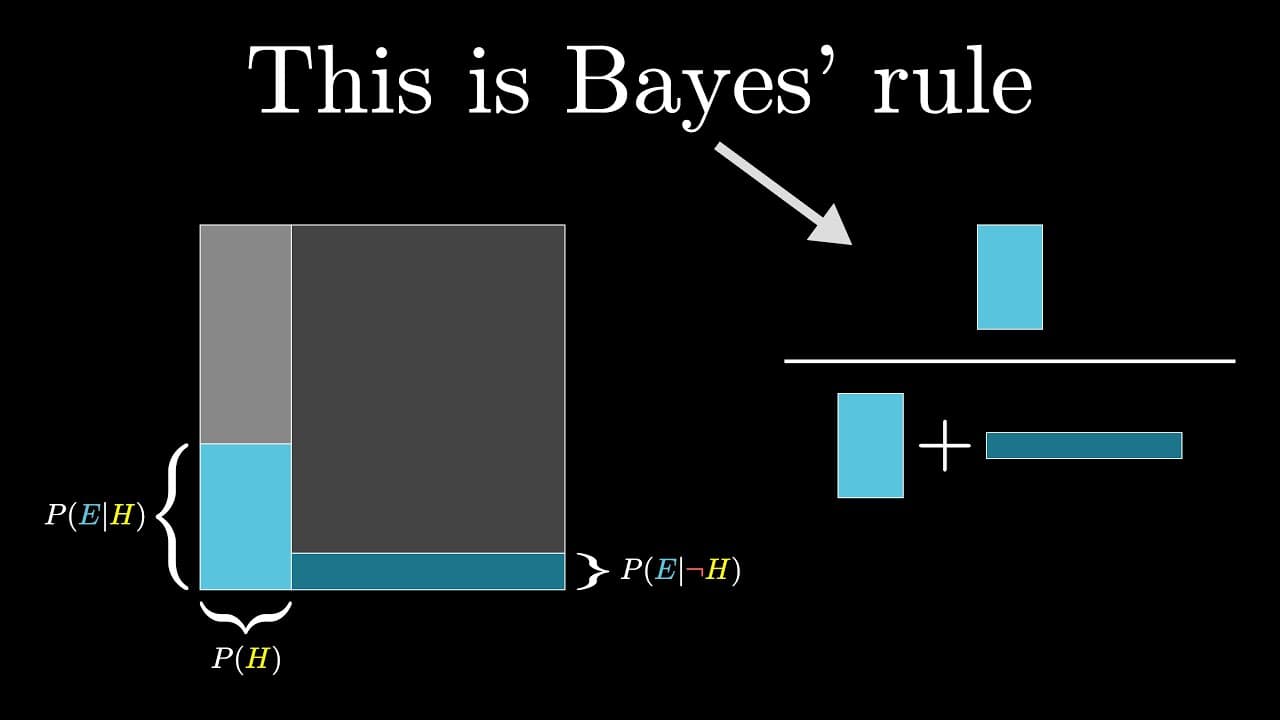
Bayes' theorem changes beliefs by combining a prior probability with new evidence instead of treating that evidence in isolation. In the Steve example, a representative sample of 200 farmers and 10 librarians yields 20 matching farmers and 4 matching librarians, making the probability that Steve is a librarian 4 out of 24, or 16.7%. Read on to see how representative samples and geometric diagrams make this reasoning intuitive.
Transcript
The goal is for you to come away from this video understanding one of the most important formulas in all of probability, Bayes' theorem. This formula is central to scientific discovery, it's a core tool in machine learning and AI, and it's even been used for treasure hunting, when in the 1980s a small team led by Tommy Thompson, and I'm not mak... Read More
Key Insights
- Bayes' theorem is central to scientific discovery and machine learning.
- The key to Bayes' theorem is updating prior beliefs with new evidence.
- Rationality involves recognizing relevant facts, not just knowing them.
- Bayes' theorem helps quantify belief updates in scientific models and AI.
- Thinking with representative samples aids in understanding probability.
- Geometric representations can make probability concepts more intuitive.
- The theorem's value lies in systematizing belief changes quantitatively.
- Reframing probability problems can improve intuitive understanding.
Install to Summarize YouTube Videos and Get Transcripts
Explore YouTube Video Summarizer or Get YouTube Transcript Extractor
Questions & Answers
Q: How does Bayes' theorem update beliefs based on new evidence?
Bayes' theorem starts with the probability of a hypothesis before considering new evidence, called the prior. It then restricts attention to possibilities where the evidence holds and calculates how much of that restricted set supports the hypothesis.
Q: When should you use Bayes' theorem?
Use Bayes' theorem when you have a hypothesis, observe new evidence, and want the probability that the hypothesis holds given that evidence. The Steve example asks for the probability that Steve is a librarian given a description of him as meek and tidy.
Q: What does the Steve librarian-or-farmer example demonstrate?
The example shows that evidence matching a stereotype should not be considered without the underlying population ratio. Although Steve's description may seem more typical of a librarian, the roughly 20-to-1 ratio of farmers to librarians can make farmer the more likely answer.
Q: How is the 16.7% probability calculated in the Steve example?
The example begins with 200 farmers and 10 librarians, then estimates that 10% of farmers and 40% of librarians fit the description. That produces 20 matching farmers and 4 matching librarians, so the probability of a librarian among the 24 matches is 4 out of 24, or 16.7%.
Q: Why are prior probabilities important in Bayes' theorem?
A prior represents the probability that a hypothesis holds before new evidence is considered. In the Steve example, the librarian prior is 1 out of 21 because the assumed population contains about 20 farmers for every librarian.
Q: Why is the description alone insufficient to decide whether Steve is a librarian?
New evidence does not determine beliefs in a vacuum; it should update prior beliefs. Even if librarians are estimated to be four times as likely as farmers to fit Steve's description, the much larger number of farmers can outweigh that evidence.
Q: How do representative samples make Bayes' theorem easier to understand?
A representative sample turns abstract probabilities into countable groups. By picturing 200 farmers and 10 librarians and then counting who fits the description, the relevant conditional probability becomes a simple ratio of 4 librarians among 24 matching people.
Q: Why is Bayes' theorem considered important?
The transcript describes Bayes' theorem as central to scientific discovery and a core tool in machine learning and AI. It also recounts how Tommy Thompson's team used Bayesian search tactics in the 1980s to help find a ship carrying what amounted to $700 million in gold.
Summary & Key Takeaways
-
Bayes' theorem is a fundamental concept in probability, widely used in scientific discovery and machine learning. It involves updating prior beliefs based on new evidence, helping to quantify and systematize changes in beliefs. Understanding the components of Bayes' theorem, such as prior probability and likelihood, is crucial for applying it effectively.
-
The video uses examples like the Steve scenario to illustrate how human judgments can be irrational when not considering relevant probabilities. By visualizing probability problems with geometric diagrams or representative samples, one can enhance intuition and comprehension of Bayes' theorem, making it easier to apply in various contexts.
-
Bayes' theorem's significance extends beyond academia, influencing artificial intelligence and personal decision-making. It reframes how we think about evidence and belief, encouraging a mathematical approach to understanding and updating our views. This video emphasizes the importance of grasping the theorem's principles for practical applications.
Read in Other Languages (beta)
Share This Summary 📚
Summarize YouTube Videos and Get Video Transcripts with 1-Click
Try YouTube Summary with ChatGPT & Claude or YouTube Transcript Generator
Explore More Summaries from 3Blue1Brown 📚




Summarize YouTube Videos and Get Video Transcripts with 1-Click
Try YouTube Summary with ChatGPT & Claude or YouTube Transcript Generator