How to Solve Towers of Hanoi Using Binary
TL;DR
The Towers of Hanoi puzzle can be efficiently solved by counting in binary, where each bit flip corresponds to a specific disk move. This method not only provides a solution but does so in the most efficient way possible. The process of binary counting mirrors the recursive nature of the puzzle, offering a unique perspective on its solution.
Transcript
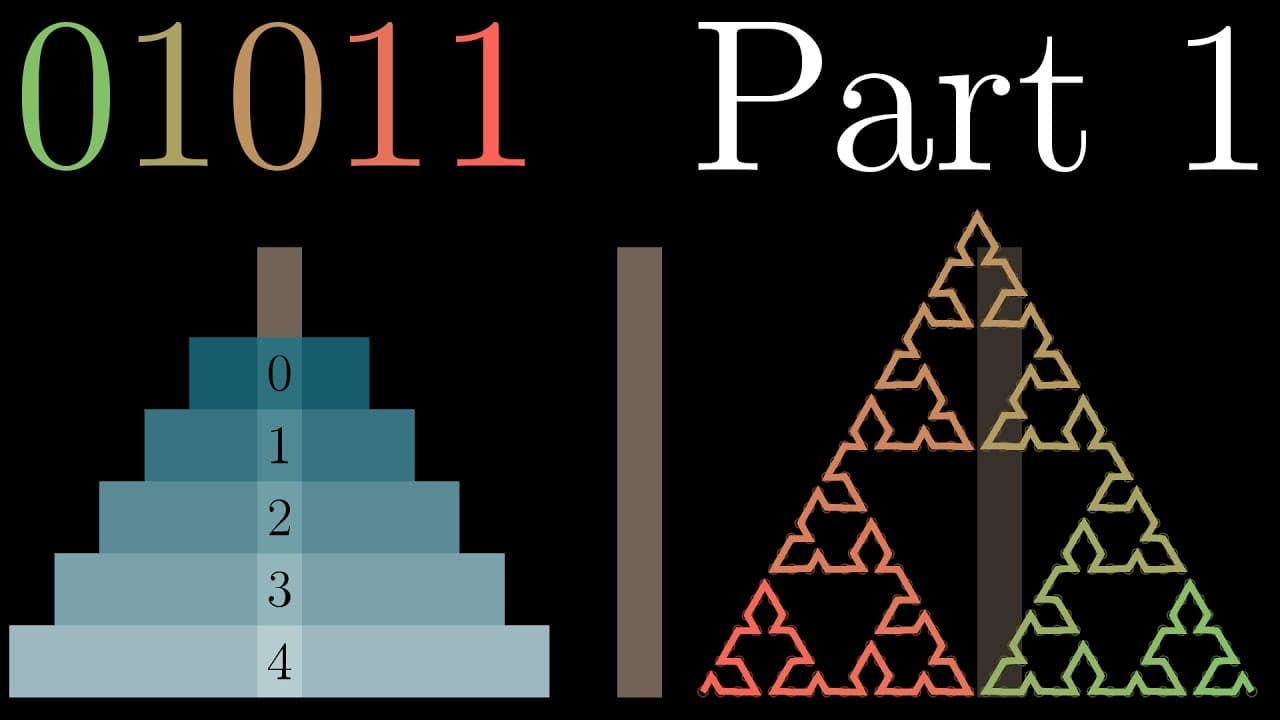
Today, I want to share with you a neat way to solve the Towers of Hanoi puzzle just by counting in a different number system. And surprisingly, this stuff relates to finding a curve that fills Sierpinski's triangle. I learned about this from a former CS lecturer of mine, his name's Keith Schwartz, and I've gotta say, this man is one of the best edu... Read More
Key Insights
- The Towers of Hanoi puzzle involves moving disks between pegs under specific rules.
- Binary counting can be used to solve the Towers of Hanoi puzzle efficiently.
- Each bit flip in binary counting corresponds to a specific disk move in the puzzle.
- The recursive nature of the puzzle is mirrored by the pattern of binary counting.
- The solution using binary is the most efficient, requiring the minimum number of moves.
- The method involves solving subproblems, moving larger disks, and solving subproblems again.
- This approach highlights the self-similar nature of both binary counting and the puzzle.
- The video hints at a connection between this method and Sierpinski's triangle, explored in a follow-up video.
Install to Summarize YouTube Videos and Get Transcripts
Explore YouTube Video Summarizer or Get YouTube Transcript Extractor
Questions & Answers
Q: How does binary counting solve the Towers of Hanoi?
Binary counting solves the Towers of Hanoi by associating bit flips with specific disk movements. Each bit in the binary sequence represents a disk, and when a bit flips, it indicates a move for the corresponding disk. This mirrors the recursive nature of the puzzle, providing an efficient and systematic solution.
Q: What is the Towers of Hanoi puzzle?
The Towers of Hanoi puzzle involves moving a stack of disks from one peg to another, using a third peg as an auxiliary. The rules are that only one disk can be moved at a time, and no larger disk can be placed on top of a smaller disk. The objective is to move the entire stack to another peg, following these rules.
Q: Why is the binary method efficient for Towers of Hanoi?
The binary method is efficient because it mirrors the recursive structure of the Towers of Hanoi puzzle. Each bit flip corresponds to a necessary disk move, ensuring that the solution is achieved in the minimum number of moves. This method systematically breaks down the problem into smaller subproblems, aligning with the puzzle's recursive nature.
Q: What is the recursive perspective on the Towers of Hanoi?
The recursive perspective on the Towers of Hanoi views the problem as a series of smaller subproblems. Each larger disk requires the smaller disks above it to be moved before it can be relocated. Once moved, the smaller disks need to be repositioned on top, effectively solving a smaller version of the same problem repeatedly.
Q: How does the binary counting pattern relate to the puzzle?
The binary counting pattern relates to the puzzle through its self-similar structure. Counting in binary involves rolling over digits in a way that mirrors the recursive process of solving the Towers of Hanoi. Each bit flip represents a necessary action in the puzzle, making the binary counting process a direct parallel to the solution strategy.
Q: What does self-similarity mean in this context?
In this context, self-similarity refers to the repeating pattern found in both binary counting and the Towers of Hanoi solution. At any scale, whether counting up in binary or solving the puzzle with more disks, the process involves repeating a sequence of actions: solving a subproblem, performing a move, and solving the subproblem again.
Q: Is there a more efficient way to solve the Towers of Hanoi?
There is no more efficient way to solve the Towers of Hanoi than the binary counting method described. This method requires the minimum number of moves necessary to solve the puzzle, as it strictly follows the recursive structure and rules, ensuring that each move is both necessary and sufficient for the solution.
Q: What connection does the video make to Sierpinski's triangle?
The video hints at a connection between the binary solution to the Towers of Hanoi and Sierpinski's triangle. While the full explanation is reserved for a follow-up video, the implication is that the self-similar and recursive nature of the binary counting method may also relate to the geometric properties of Sierpinski's triangle, suggesting a deeper mathematical link.
Summary & Key Takeaways
-
The video explains how binary counting can solve the Towers of Hanoi puzzle by associating bit flips with disk movements. This method mirrors the recursive structure of the puzzle, providing an efficient solution. The process involves solving smaller subproblems, moving larger disks, and repeating, reflecting the self-similar nature of both the puzzle and binary counting.
-
Binary counting serves as an algorithm for the Towers of Hanoi, where each bit flip dictates a disk move, ensuring the puzzle is solved in the least number of steps. The recursive nature of the puzzle aligns with the binary counting process, demonstrating a unique and efficient solution method that is further linked to Sierpinski's triangle.
-
The video introduces a surprising method to solve the Towers of Hanoi using binary counting, offering an efficient and recursive approach. The counting rhythm dictates disk movements, aligning with the puzzle's structure. This solution not only efficiently resolves the puzzle but also connects to Sierpinski's triangle, to be explored in a subsequent video.
Read in Other Languages (beta)
Share This Summary 📚
Summarize YouTube Videos and Get Video Transcripts with 1-Click
Try YouTube Summary with ChatGPT & Claude or YouTube Transcript Generator
Explore More Summaries from 3Blue1Brown 📚

Summarize YouTube Videos and Get Video Transcripts with 1-Click
Try YouTube Summary with ChatGPT & Claude or YouTube Transcript Generator