What Is a Taylor Series and How Does It Work?
TL;DR
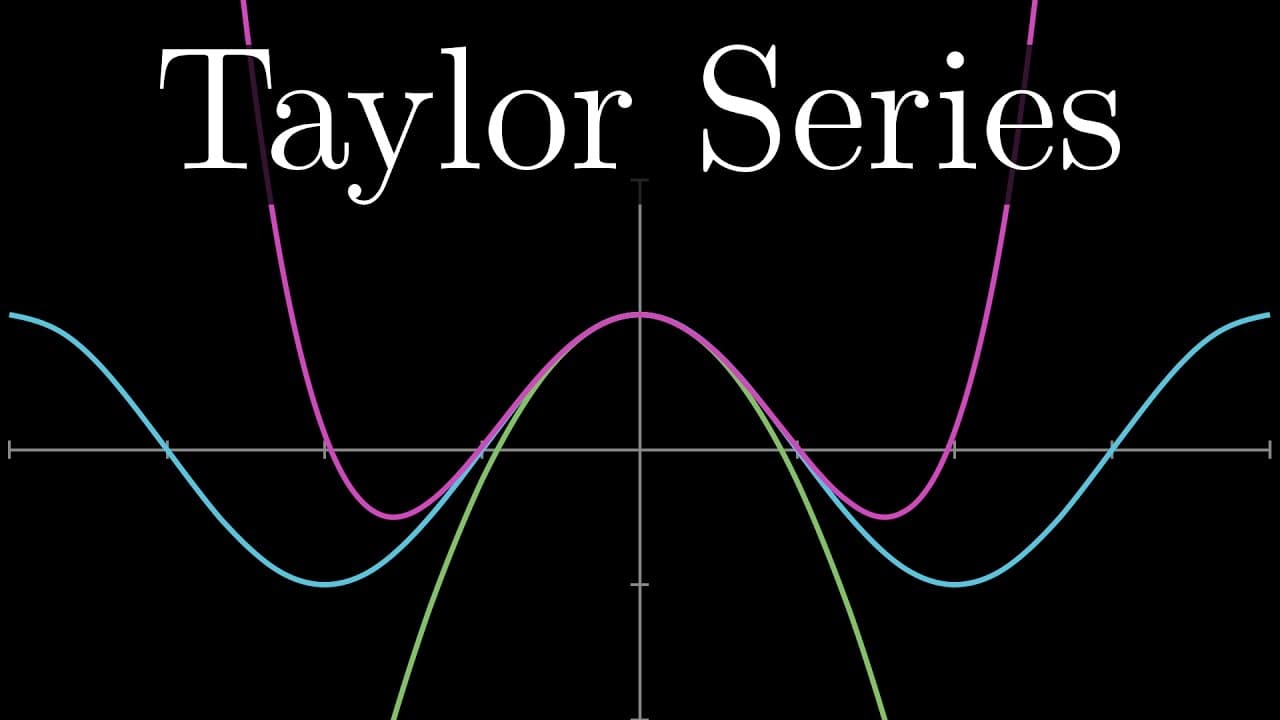
A Taylor series approximates non-polynomial functions using polynomials that match their behavior near a specific input. The coefficients are determined by the derivatives of the function at that input, divided by factorials. This series can converge or diverge depending on the radius of convergence, allowing for increasingly accurate approximations as more terms are added.
Transcript
When I first learned about Taylor series, I definitely didn’t appreciate how important they are. But time and time again they come up in math, physics, and many fields of engineering because they’re one of the most powerful tools that math has to offer for approximating functions. One of the first times this clicked for me as a student was not in a... Read More
Key Insights
- 🧪 Taylor series are powerful tools in math, physics, and engineering for approximating functions, making problem-solving easier.
- 🔢 Polynomials are easier to work with than non-polynomial functions, which is why Taylor series focus on finding polynomials that approximate functions near a specific input.
- 📈 The coefficients of the Taylor polynomials are determined by the values of the function's derivatives at the chosen input, divided by the appropriate factorials.
- ✨ Taylor series provide increasingly accurate approximations as more terms are added, converging to the original function at certain inputs.
- 🔄 Taylor polynomials can be used to approximate functions at different inputs by using (x-a) instead of x in the polynomial, where a is the point of interest.
- 🌐 The Taylor series may only converge within a certain range or radius of convergence around the chosen input, depending on the function.
- 📊 Adding more terms to the Taylor series gives a closer approximation, but also increases the complexity of the polynomial.
- 📚 Understanding Taylor series provides a foundation for learning more about calculus and its applications in various fields.
Install to Summarize YouTube Videos and Get Transcripts
Explore YouTube Video Summarizer or Get YouTube Transcript Extractor
Questions & Answers
Q: How does the Taylor series approximation work for functions other than cosine?
The Taylor series can be used to approximate functions other than cosine by calculating their derivatives at a specific input and using the derivative values to determine the coefficients of the polynomial. The more derivatives are taken into account, the closer the approximation will be to the original function.
Q: What is the significance of the coefficient of each term in the Taylor polynomial?
Each coefficient represents the value of the corresponding derivative of the function at the chosen input, divided by the factorial of the term's order. These coefficients determine the behavior of the polynomial and how closely it matches the function's behavior near the input.
Q: What happens if more terms are added to the Taylor polynomial?
Adding more terms to the Taylor polynomial improves the accuracy of the approximation, as the polynomial can capture more of the function's behavior near the input. However, the polynomial becomes more complex as more terms are added.
Q: What is the radius of convergence in Taylor series?
The radius of convergence defines the range of inputs for which the Taylor series converges to a specific value. If the input is outside the radius of convergence, the series may diverge and fail to approach the desired value. The radius of convergence depends on the function and is determined by the behavior of its higher derivatives.
Summary & Key Takeaways
-
Taylor series are used to approximate non-polynomial functions by finding polynomials that closely match their behavior near a given input.
-
The coefficients of the polynomial are determined by the values of the function's derivatives at the input, divided by the appropriate factorials.
-
Adding more terms to the polynomial improves the accuracy of the approximation, but increases complexity, and the series may converge or diverge depending on the radius of convergence.
Read in Other Languages (beta)
Share This Summary 📚
Summarize YouTube Videos and Get Video Transcripts with 1-Click
Try YouTube Summary with ChatGPT & Claude or YouTube Transcript Generator
Explore More Summaries from 3Blue1Brown 📚
Summarize YouTube Videos and Get Video Transcripts with 1-Click
Try YouTube Summary with ChatGPT & Claude or YouTube Transcript Generator