How Did Rome Conquer Greece and Macedon?
TL;DR
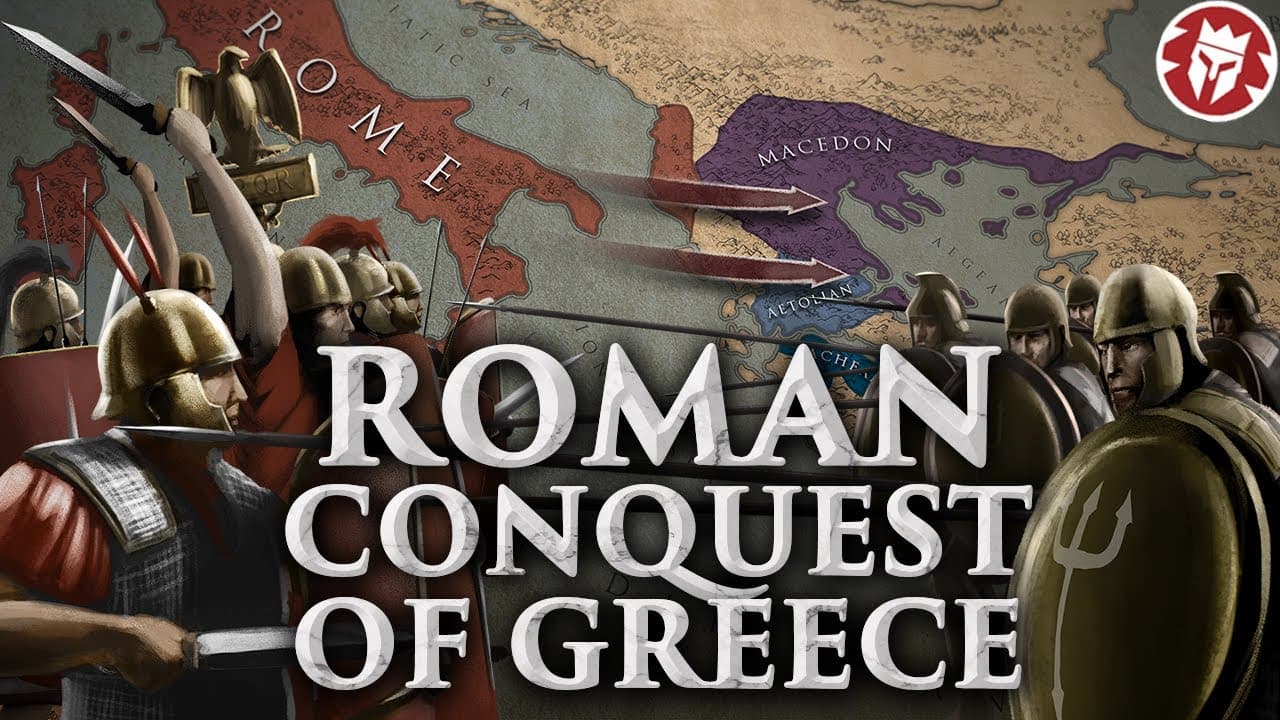
Rome conquered Greece through a prolonged sequence of interventions that began with campaigns against Illyrian piracy and expanded into wars involving Macedon, the Seleucid Empire, the Aetolian League, and the Achaean League. Roman naval strength, large expeditionary forces, diplomatic pressure, and informal client relationships gradually transformed limited Adriatic security operations into decisive control over the Greek world.
Transcript
History of the human race has thousands of different conquests across ages, regions, and cultures, but it is difficult to find one that played such a decisive role in the future events as the conquest of Greece by the Roman Republic, as its effects echoed through the millennia. Welcome to our video that will cover the first Roman involvement in the... Read More
Key Insights
- Roman intervention in the Greek world began with Adriatic security concerns rather than an immediate campaign to conquer Greece. Illyrian piracy, territorial expansion, complaints from Roman merchants, and the economic effects of maritime raiding prompted the Senate to send diplomats to Queen Teuta in 230 BC.
- The First Illyrian War was triggered immediately by the death of a Roman envoy, but its deeper cause was Rome's opposition to a powerful Adriatic rival. In 229 BC, Rome deployed 22,000 troops and 200 ships, defeated Teuta's forces, and compelled her to accept peace.
- Roman friendship functioned as a form of informal political control. After Teuta's defeat, Rome withdrew its troops but imposed a settlement that divided her kingdom, restricted piracy in the southern Adriatic, and left supposedly friendly states operating as de facto Roman clients.
- Demetrius of Pharos rose through cooperation with Rome before becoming its enemy. Rome rewarded his defection from Teuta with an independent principality, but his marriage to Triteuta made him regent and effectively restored much of the Illyrian power that the earlier settlement had dismantled.
- The Second Illyrian War demonstrated Rome's willingness to punish former partners who violated its arrangements. After Demetrius conducted raids and led 90 light galleys on a piracy expedition in 220 BC, Roman forces captured Dimallum in seven days and defeated him at Pharos.
- Macedon's revival created the major eastern power that Rome would confront. Antigonus Doson expelled Illyrians, defeated the Aetolian League, stabilized Macedon, preserved Philip V's right to inherit, and achieved the first seizure of Sparta by a foreign army before dying in 221 BC.
- Demetrius of Pharos connected Rome's Adriatic conflicts to Macedonian politics. After escaping defeat at Pharos, he reached Philip V's fleet at Actium, received a warm welcome, and became a key adviser while Rome again withdrew its soldiers from the region.
- Rome's conquest of Greece developed through an extended series of separate conflicts. The account encompasses four Macedonian Wars, the Seleucid War, the Aetolian War, and the Achaean War, including battles at Pydna, Cynoscephalae, Aous, Magnesia, Thermopylae, and Callinicus.
Install to Summarize YouTube Videos and Get Transcripts
Explore YouTube Video Summarizer or Get YouTube Transcript Extractor
Questions & Answers
Q: Why did Rome first intervene east of the Adriatic?
Rome first intervened because Illyrian piracy had grown into a serious Mediterranean problem. Raiding harmed Roman merchants and produced an economic impact on the Republic, while the expanding power of the Ardiaei created a broader geopolitical concern. Rome did not want a strong rival dominating the Adriatic, so commercial protection and strategic containment combined to drive its involvement.
Q: What caused the First Illyrian War in 229 BC?
The immediate cause was the murder of a Roman envoy after Rome demanded that Queen Teuta stop Illyrian piracy. Teuta had rejected the demand, possibly because she could not control decentralized tribal allies or because she refused to submit. The deeper cause was the expansion of Ardiaean power, which Rome regarded as a threat to its interests in the Adriatic.
Q: How did Rome defeat Queen Teuta's Illyrian kingdom?
Rome sent a force of 22,000 troops and 200 ships against the Illyrians late in the campaigning season of 229 BC. Demetrius of Pharos, Teuta's governor on Corcyra, quickly defected to Rome, and her other forces were defeated. By spring 228 BC, Teuta accepted a treaty that fragmented her kingdom and prohibited piracy in the southern Adriatic.
Q: What did becoming a friend of Rome mean for another state?
Roman friendship, described by the term amicitia, sounded like a relationship between independent partners but carried stronger practical conditions. In the Illyrian settlement, Rome withdrew its troops while leaving political arrangements that weakened Teuta's kingdom and constrained its actions. The transcript characterizes such friends as informal client states subject to de facto Roman influence without permanent Roman military occupation.
Q: Why did Demetrius of Pharos turn against Rome?
Demetrius initially benefited from Rome because his defection during the First Illyrian War earned him a small independent principality. He later married Triteuta, became regent for the young Ardiaean king, and reconstructed a powerful Illyrian kingdom. He then raided Roman-allied tribes and interpreted Rome's temporary lack of response during the Roman-Gallic War as evidence that further defiance might succeed.
Q: How did Rome defeat Demetrius of Pharos?
Rome acted in 219 BC after Demetrius violated the earlier treaty by leading 90 light galleys on a major piracy expedition in 220 BC. His defensive plan relied on the fortresses of Dimallum and Pharos. Roman forces captured Dimallum in only seven days, while a rash sortie cost Demetrius control of Pharos and forced him to escape by hidden galleys.
Q: How did Macedon recover before its wars with Rome?
Macedon recovered under Antigonus Doson after the death of Demetrius II left the future Philip V too young to rule. Doson expelled Illyrian forces, defeated the Aetolian League, secured the borders, and renounced claims south of Thermopylae to consolidate the kingdom. He accepted the royal title while formally preserving Philip's succession and left him a stable, increasingly powerful state.
Q: Which conflicts formed Rome's conquest of Greece?
Rome's conquest unfolded across a long sequence of wars rather than a single campaign. The account includes Rome's first intervention in Greek affairs, four Macedonian Wars, the Seleucid War, the Aetolian War, and the Achaean War. It also highlights major engagements at Pydna, Cynoscephalae, Aous, Magnesia, Thermopylae, and Callinicus, involving Roman, Macedonian, Seleucid, and Greek powers.
Summary & Key Takeaways
-
Rome first became involved east of the Adriatic after Illyrian expansion and piracy harmed merchants and challenged Roman interests. The killing of a Roman envoy triggered war in 229 BC. A force of 22,000 troops and 200 ships defeated Teuta, restricted piracy, fragmented her kingdom, and established Roman friendship as informal dominance.
-
Demetrius of Pharos benefited from Rome's settlement but later rebuilt Illyrian power and violated the agreement through raids and piracy. Rome returned in 219 BC, captured Dimallum in seven days, and defeated him at Pharos. His escape to Philip V of Macedon connected the Illyrian conflicts with the approaching Roman struggle against Macedon.
-
Macedon recovered under Antigonus Doson, who defeated Illyrian and Aetolian enemies, stabilized the kingdom, and preserved Philip V's succession. After Philip became king, Demetrius joined his court while the Second Punic War drew Mediterranean attention. Subsequent Roman expansion involved four Macedonian Wars, the Seleucid, Aetolian, and Achaean Wars.
Read in Other Languages (beta)
Share This Summary 📚
Summarize YouTube Videos and Get Video Transcripts with 1-Click
Try YouTube Summary with ChatGPT & Claude or YouTube Transcript Generator
Explore More Summaries from Kings and Generals 📚



Summarize YouTube Videos and Get Video Transcripts with 1-Click
Try YouTube Summary with ChatGPT & Claude or YouTube Transcript Generator