How to Automate Marketing with Claude and Higgsfield
TL;DR
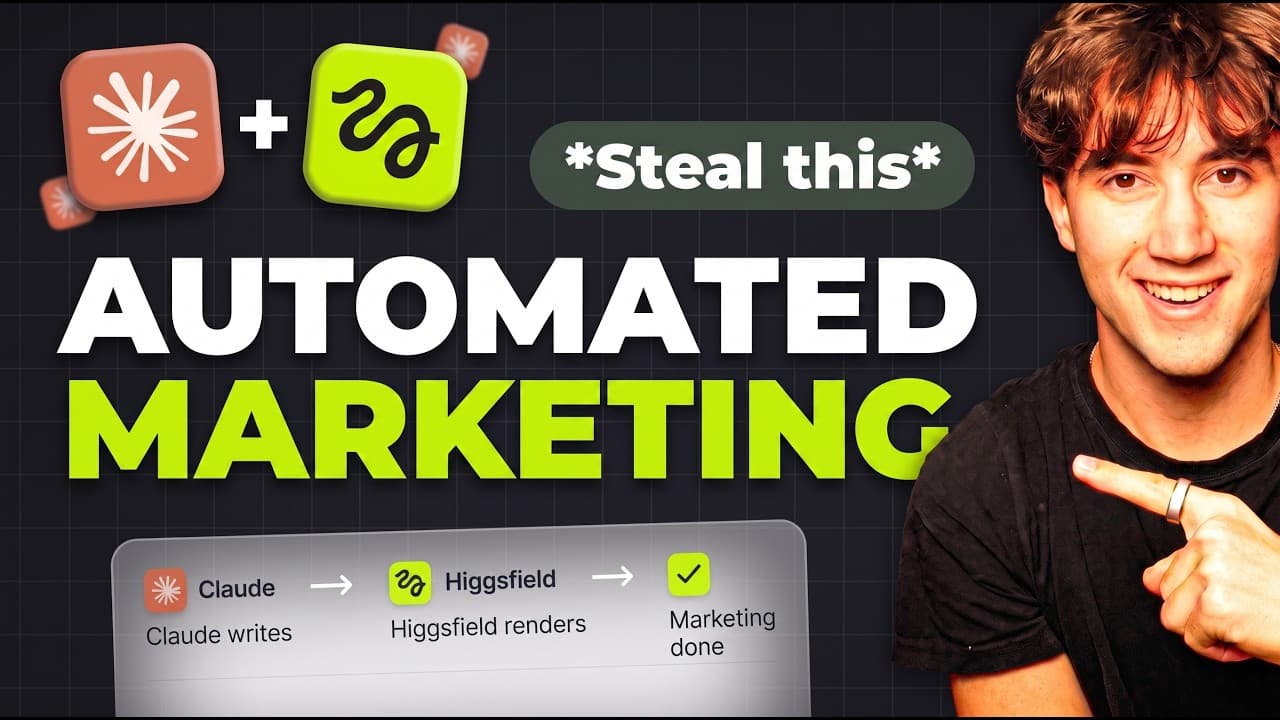
Connect Higgsfield to Claude through its MCP URL, then build the workflow around four elements: structure, context, templates, and skills. Claude translates natural-language requests into model-specific prompts, while Higgsfield provides image and video models, enabling repeatable production of thumbnails, graphics, videos, metadata, chapters, and email campaigns.
Transcript
The thumbnail you clicked on to open this video was created by Claude and Higsfield. The title, description, tags, and chapters, those were created by Claude. And tomorrow morning, an email about this video goes out to my list of over 40,000 which Claude drafted. Now, there's an image inside of that email blast that was created by Higsfield. I didn... Read More
Key Insights
- Claude is the reasoning layer in the workflow, converting informal creative requests into detailed prompts that use terminology suited to Higgsfield's image and video models. This allows users to describe the desired result naturally without mastering every model or writing a polished generation prompt themselves.
- Higgsfield is a single platform that provides access to multiple image and video models, each suited to different creative tasks. Claude can select a model based on the request, such as GPT Image 2 for accurate text rendering or Kling 3.0 for the demonstrated title-slide animation.
- The connector setup requires copying the Higgsfield MCP URL, opening Claude's Customize area, selecting Connectors, and adding a custom connector. After naming it, pasting the URL, and approving authentication, Higgsfield's image and video generation capabilities become available within Claude conversations.
- Reference images are optional but can communicate specific visual qualities that may be difficult to describe, including grid backgrounds, metallic lettering, worn edges, and grunge effects. Claude analyzes those characteristics and incorporates them into a new prompt while following requested changes to text and accent colors.
- Image generation is iterative rather than automatically final, because the first output may still need changes or additional variations. Higgsfield's inline controls support downloading, animating, editing, and recreating prompts, allowing users to refine a chosen concept without rebuilding the entire workflow from the beginning.
- Video generation can use an approved still image as its source asset, with Claude designing motion around the requested purpose. In the example, the goal is a five-second, 16:9 title slide with an entrance and exit animation that can be placed over a YouTube video.
- Natural-language feedback is sufficient for revising generated media, including requests to reduce lightning, remove spinning orbs, make effects subtler, and improve transitions. Claude translates that feedback into updated generation instructions, so creative direction can focus on observable results instead of model-specific syntax.
- Marketing automation is organized around four elements: structure, context, templates, and skills. A folder hierarchy gives Claude Code a working home, context documents preserve voice and perspective, templates capture reusable prompts, and skills turn recurring deliverables into commands that can also run as scheduled routines.
- More videos from this channel:
- More from this channel: AI Foundations
Install to Summarize YouTube Videos and Get Transcripts
Explore YouTube Video Summarizer or Get YouTube Transcript Extractor
Questions & Answers
Q: How do you connect Higgsfield to Claude?
Open the Higgsfield MCP page from the provided link and copy its MCP URL. In Claude, open Customize from the left sidebar, choose the Connectors tab, select Add, and then choose Add custom connector. Name the connector Higgsfield, paste the copied URL, and select Add. Finally, choose Connect, sign in to Higgsfield if required, and approve the authorization request.
Q: What roles do Claude and Higgsfield play in the workflow?
Claude acts as the brain of the workflow by interpreting rough ideas, building structured prompts, and choosing an image or video model that suits the request. Higgsfield provides access to the generation models and produces the media. Together, they let users request assets conversationally while still benefiting from detailed prompts and model selection tailored to each task.
Q: How can Claude and Higgsfield automate marketing work?
The system can handle recurring deliverables such as YouTube thumbnails, titles, descriptions, tags, chapters, email newsletters, advertisements, email graphics, images, and videos. The workflow combines a structured folder home base, documents describing voice and perspective, reusable creative templates, and one-command skills. These components can also be placed on routines so marketing tasks run on a schedule.
Q: Why should you provide reference images to Claude?
A reference image helps Claude identify visual details that might be omitted from a short written request, such as a subtle grid, metallic text, scratches, worn edges, gradients, or grunge effects. Claude can use those traits when constructing a new prompt while changing the wording, colors, and other requested elements. References are helpful for directing style, but they are not required.
Q: How do you turn a generated image into a video?
Download the preferred generated image, add it back to the Claude conversation, and ask Claude to animate it for the intended use. The demonstration requests a title slide with a clean entrance and exit so it can work as an overlay. Higgsfield uploads the image as an asset, and Claude selects a video model, writes the motion prompt, and starts generation.
Q: How do you improve a Higgsfield video that is too visually busy?
Describe the unwanted elements and the desired correction in ordinary language. In the example, the feedback asks for less lightning, fewer prominent or spinning orbs, subtler effects, and better entrance and exit transitions because the text appears too suddenly. Claude converts that critique into revised instructions, and Higgsfield generates another version for review and further iteration.
Q: What are the four parts of the marketing automation system?
The four parts are structure, context, templates, and skills. Structure provides a clear folder hierarchy where Claude Code can work. Context documents define the creator's voice, point of view, and stories. Templates preserve prompts for repeatable assets such as thumbnails and email graphics. Skills package recurring workflows into commands, including a thumbnail generator that creates three variations from a title.
Q: How does the system make AI marketing content sound consistent?
Consistency comes from supplying Claude with context documents that describe the creator's voice, point of view, and stories. Those files give the system material to follow when drafting assets such as email newsletters, reducing generic output. Reusable templates reinforce visual consistency, while skills standardize the production steps and can include sub-agents that review newsletter copy before it is used.
Summary & Key Takeaways
-
Claude serves as the reasoning layer that converts rough creative ideas into structured prompts, while Higgsfield supplies access to multiple image and video models. After adding the Higgsfield MCP as a custom Claude connector and authorizing the account, users can generate, download, animate, edit, or recreate visual assets directly from the conversation.
-
The demonstrated creative workflow begins with a reference image or a natural-language description. Claude identifies visual details, writes a stronger prompt, and selects an appropriate model. Generated images can become source assets for videos, with users refining motion, transitions, lighting, and other elements through conversational feedback until the result fits the intended use.
-
The broader automation system uses four components: a structured folder hierarchy, context documents, reusable templates, and executable skills. Voice, point-of-view, and story files help content sound consistent, while templates preserve successful visual prompts. Skills can turn recurring jobs, including thumbnails, newsletters, titles, descriptions, tags, and chapters, into repeatable commands and scheduled routines.
Read in Other Languages (beta)
Share This Summary 📚
Summarize YouTube Videos and Get Video Transcripts with 1-Click
Try YouTube Summary with ChatGPT & Claude or YouTube Transcript Generator
Explore More Summaries from AI Foundations 📚




Summarize YouTube Videos and Get Video Transcripts with 1-Click
Try YouTube Summary with ChatGPT & Claude or YouTube Transcript Generator