How Does Mixture of Experts Improve AI Inference?
TL;DR
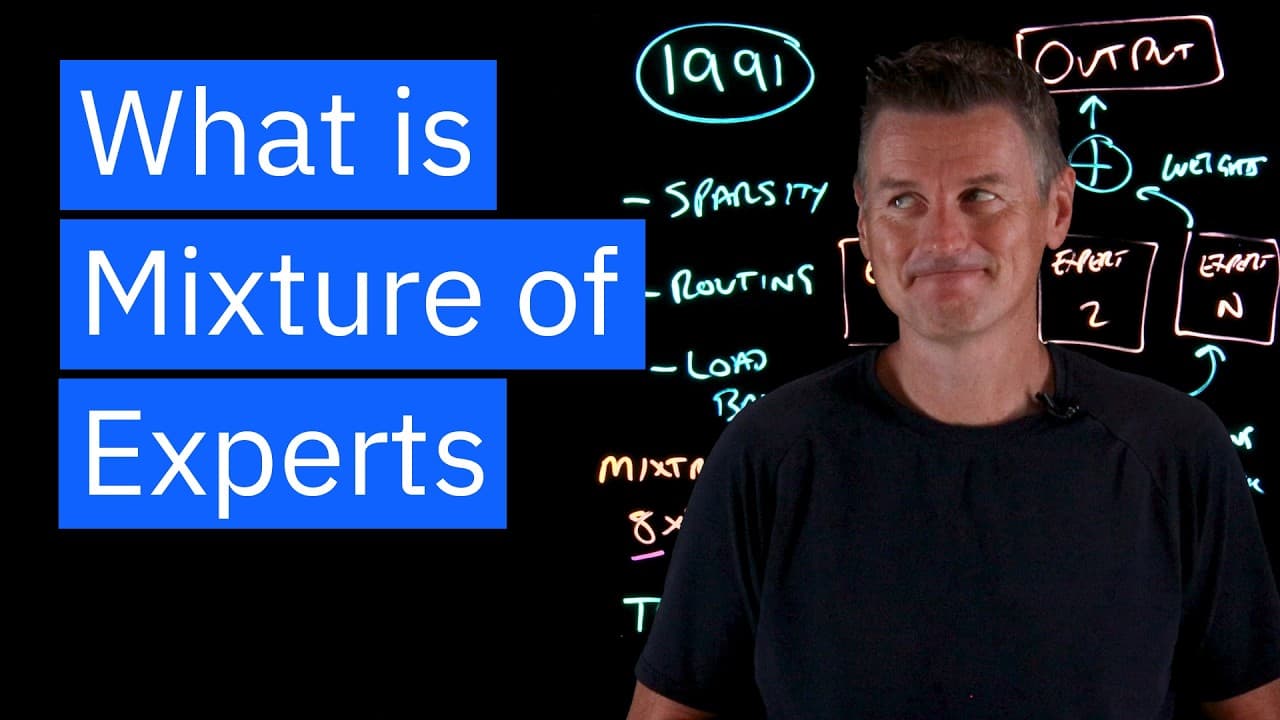
Mixture of Experts splits a model into multiple specialized subnetworks called experts and uses a gating network to activate the right ones for each input. This selective routing, combined with sparse activation, reduces compute and allows specialized processing. Challenges include routing efficiency and load balancing, addressed by techniques like noisy top-k gating.
Transcript
In deep learning, neural networks, including large language models, can be big. Very big. Like hundreds of billions of parameters big. And running them at inference time is usually a very compute intensive operation. So enter Mixture of Experts, which is a machine learning approach that divides an AI model into separate subnetworks, or "experts". E... Read More
Key Insights
- Mixture of Experts splits a model into separate subnetworks called experts.
- A gating network selects which experts to activate for each input.
- Sparsity means only a subset of experts are active at a time.
- Top-k routing in Mixtral selects the best k experts per task.
- Load balancing is a challenge in MoE, as some experts may be overused.
- Noisy top-k gating introduces noise to improve distribution of expert activation.
- MoE reduces compute and enables specialized processing but increases model complexity.
- Real-world MoE models like Mixtral demonstrate practical efficiency gains.
- More videos from this channel:
- More from this channel: IBM Technology
Install to Summarize YouTube Videos and Get Transcripts
Explore YouTube Video Summarizer or Get YouTube Transcript Extractor
Questions & Answers
Q: A real search query question about the video (How to or What is) 1
What is the basic idea behind Mixture of Experts and how does it reduce computation in large AI models? The core concept is to divide a model into multiple experts and use a gating network to activate only the most relevant ones for a given input. This sparsity means that instead of running all parameters, only a subset is utilized, which lowers compute costs while preserving or enhancing performance. This approach is particularly beneficial for large language models where different inputs require different kinds of processing, enabling more efficient inference.
Q: Question 2
How does the gating network function within an MoE architecture and what role does it play in routing inputs to experts? The gating network acts like a traffic cop, deciding which experts should handle each input. It assigns weights to experts based on predicted usefulness, and the final output is a weighted combination of the selected experts. This routing determines both the quality of results and the computational efficiency of the model.
Q: Question 3
What does sparsity mean in the context of MoE, and why is it important for processing high dimensional data like language? Sparsity means that only a small subset of all experts is activated for any given input. This is important because language data often requires different kinds of analysis, such as idiom detection or complex grammar parsing, which can be handled by specialized experts without engaging the entire network.
Q: Question 4
What is top-k routing and how is it used in Mixtral 8x7B to select experts? Top-k routing selects the best k experts per layer based on the gating network’s predictions. In Mixtral 8x7B, the router selects the top 2 experts out of eight for each token, and their outputs are combined to produce the next layer input. This method balances performance with efficiency.
Q: Question 5
What is load balancing in MoE and what problem does it address? Load balancing ensures that all experts are used effectively rather than letting a few become over trained and dominant. If the gating network overuses a subset of experts, others become underutilized, reducing overall model capacity and wasting computational resources.
Q: Question 6
How does noisy top-k gating help with MoE training and expert utilization? Noisy top-k gating introduces Gaussian noise to the predicted probabilities for each expert during selection, encouraging more even activation across experts. This mitigates the risk of a small set of experts dominating training and helps utilize the full capacity of the model more evenly.
Q: Question 7
What are the trade-offs of using Mixture of Experts in large models? MoE offers efficiency and specialized processing by activating only relevant experts, which lowers compute and can improve performance on diverse inputs. However, it adds architectural and training complexity, requires careful routing and load balancing, and may complicate optimization and debugging.
Q: Question 8
Can you name a real-world example of MoE and describe how it is implemented in practice? Mixtral 8x7B is a real-world example where each layer contains eight experts, each with 7 billion parameters. A router selects the top two experts per token, combines their outputs, and passes the result to the next layer, demonstrating both sparsity and routing in an open-source LLM context.
Summary & Key Takeaways
-
MoE architecture divides a neural network into several experts and uses a gating network to decide which experts to use for a given input, enabling sparse, task-specific computation.
-
In practice, models like Mixtral 8x7B use a top-2 routing strategy to select two experts per layer, then combine their outputs to form the final result, boosting efficiency.
-
While MoE offers efficiency and specialization, it introduces extra complexity in training and routing, requiring careful tuning to avoid underutilized or overburdened experts.
Read in Other Languages (beta)
Share This Summary 📚
Summarize YouTube Videos and Get Video Transcripts with 1-Click
Try YouTube Summary with ChatGPT & Claude or YouTube Transcript Generator
Explore More Summaries from IBM Technology 📚





Summarize YouTube Videos and Get Video Transcripts with 1-Click
Try YouTube Summary with ChatGPT & Claude or YouTube Transcript Generator