How to implement firewall rules and NAT in networks
TL;DR
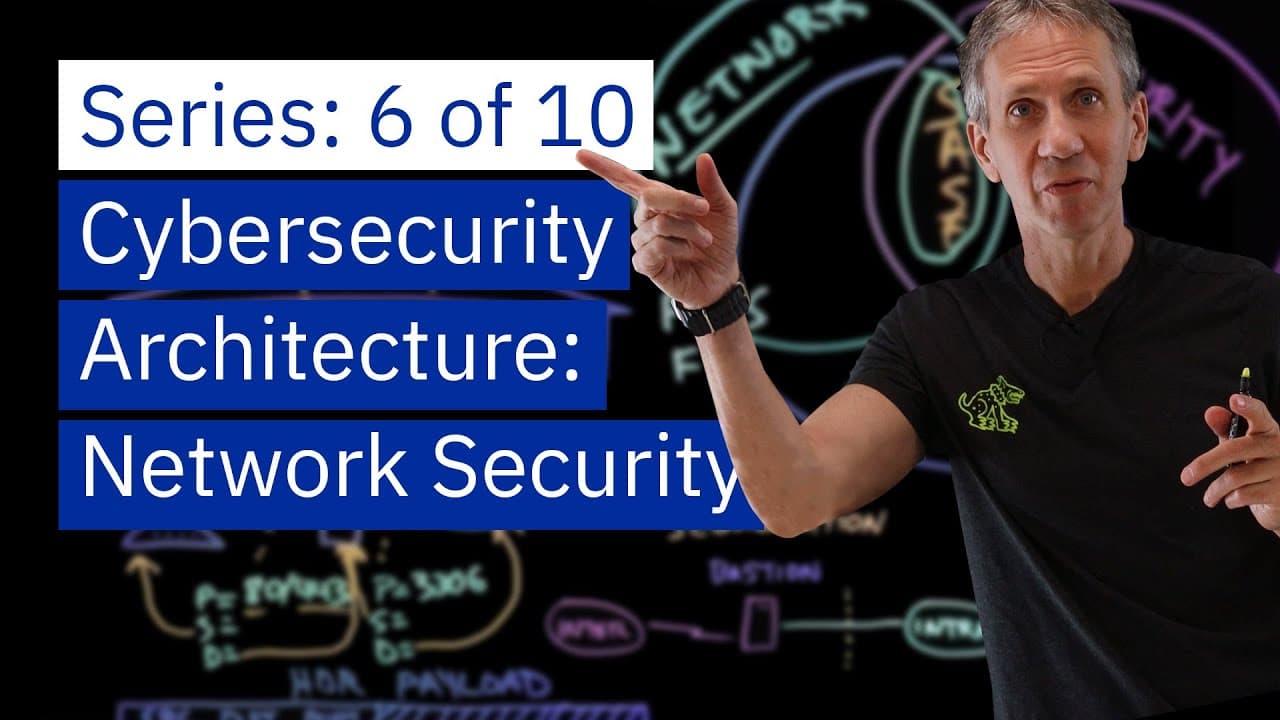
Firewall basics and NAT are used to isolate and protect network segments. The video explains packet filtering, stateful inspection, proxies, and NAT translation, showing how two firewalls control traffic between the Internet, web servers, and databases. It also introduces segmentation and future topics like proxies and application firewalls.
Transcript
Welcome back to the Cybersecurity Architecture Series. In the previous two videos, I talked about identity management and endpoint security, and now we're going to focus on the network. The network security involves a lot of different elements, and we're going to talk about each of these-- --about firewalls, which are a fundamental component of thi... Read More
Key Insights
- Firewalls create isolation and protection by filtering traffic between network segments based on packet header data such as source, destination, and port.
- Stateful packet inspection enhances security by analyzing the sequence and context of packets, not just individual packets, to enforce dynamic security policies.
- Proxies can act as intermediaries to inspect and enforce security policies on traffic before it reaches back end servers, enabling virus checks and privacy controls.
- Network segmentation uses firewall rules to limit traffic paths, reducing exposure and allowing targeted monitoring of specific network zones.
- Two-firewall designs (external and internal) provide layered defense, constraining traffic to trusted pathways and reducing direct access to critical resources.
- Network address translation NAT conserves IP addresses by mapping many internal addresses to a single external address, while masking internal topology from the outside.
- NAT prevents direct external access to internal devices, as private address spaces are not routable on the public Internet, enhancing basic exposure protection.
- The talk positions firewalls, NAT, proxies, and stateful inspection as a cohesive toolkit for building scalable and defendable network architectures.
- More videos from this channel:
- More from this channel: IBM Technology
Install to Summarize YouTube Videos and Get Transcripts
Explore YouTube Video Summarizer or Get YouTube Transcript Extractor
Questions & Answers
Q: How to set up firewall filtering at the edge of a network to block spoofed addresses
To set up edge firewall filtering you start by allowing common traffic types such as port 80 for HTTP and encrypted TLS traffic while blocking traffic from outside that claims to originate from inside. You enforce rules that the source address must be within the external Internet range and that the destination address must be limited to the intended web server. This creates a barrier that prevents spoofed internal addresses from gaining access and helps you detect and block anomalous traffic at the perimeter.
Q: What is stateful packet inspection and how does it differ from simple packet filtering
Stateful packet inspection looks beyond individual packets to understand the context and sequence of communications. It tracks sessions so that only responses that follow established connections are allowed, preventing certain types of attacks that would slip through with basic packet filtering. This approach adds a deeper layer of validation by considering the flow of data, not just isolated headers, which makes it harder for malicious traffic to masquerade as legitimate.
Q: How does a proxy contribute to network security according to the video
A proxy sits between the client and the back end server, effectively becoming the intermediary that all traffic passes through. It can inspect traffic for viruses or policy violations before allowing it to reach the internal network. Proxies also enable privacy by masking the original source, so external observers see the proxy rather than the end user, and can enforce centralized security controls more consistently.
Q: What role does NAT play in protecting internal networks
NAT translates internal private addresses to a routable external address so devices behind a NAT router cannot be reached directly from the Internet. This hides internal topology and reduces exposure, while allowing outbound connections. NAT also conserves public IP addresses by enabling many devices to share a single external address, which supports scalable network design.
Q: Why are two firewalls recommended in basic network segmentation
Having two firewalls—one Internet facing and one internal—creates a layered defense that restricts traffic more strictly. The external firewall filters traffic entering the network and enforces that only allowed traffic can reach the internal firewall. The internal firewall then enforces tighter controls between the web server and the database, ensuring that even if external access is compromised, internal resources remain protected.
Q: What is the difference between filtering by header data and deeper content inspection
Header data filtering looks at the envelope information such as source, destination, and port, which is faster and blocks obviously dangerous or misrouted traffic. Deeper content inspection, like application level analysis, examines the payload to detect threats that do not violate header rules but may execute malicious actions once inside the network. Together they provide layered security from outer to inner network edges.
Q: How does network segmentation improve monitoring and policy enforcement
Segmentation isolates different parts of the network so security policies can be tailored to each segment. It makes monitoring more focused because traffic between segments can be tightly controlled and logged. This structure allows security teams to implement specific rules for web servers, databases, and internal workstations, improving detection and response when anomalies occur.
Q: What are the practical implications of NAT for device reachability
NAT makes internal devices unreachable directly from the Internet by design, which reduces exposure to external threats. It requires translation for outbound traffic and can complicate inbound connections, so services often rely on properly configured port forwarding or application gateways. This design choice supports both security and scalability in typical corporate networks.
Summary & Key Takeaways
-
Firewall concepts are introduced by comparing physical firewalls to network isolation and protection from dangerous events. The explanation covers placing two firewalls, one Internet facing and one internal, to filter traffic and enforce security policies. The talk then expands into stateful packet inspection, proxies, and NAT to illustrate layered defense.
-
Segmentation is presented as applying firewall rules to separate network zones, with examples of limiting direct access from the outside to internal resources. The discussion emphasizes restricting origins, destinations, and ports to reduce exposure and enable focused monitoring and control.
-
NAT is described as translating internal addresses to externally routable ones and vice versa, conserving IP addresses and preventing direct external access to internal devices. The speaker underscores how NAT contributes to security by hiding internal topology and controlling reachability.
Read in Other Languages (beta)
Share This Summary 📚
Summarize YouTube Videos and Get Video Transcripts with 1-Click
Try YouTube Summary with ChatGPT & Claude or YouTube Transcript Generator
Explore More Summaries from IBM Technology 📚




Summarize YouTube Videos and Get Video Transcripts with 1-Click
Try YouTube Summary with ChatGPT & Claude or YouTube Transcript Generator