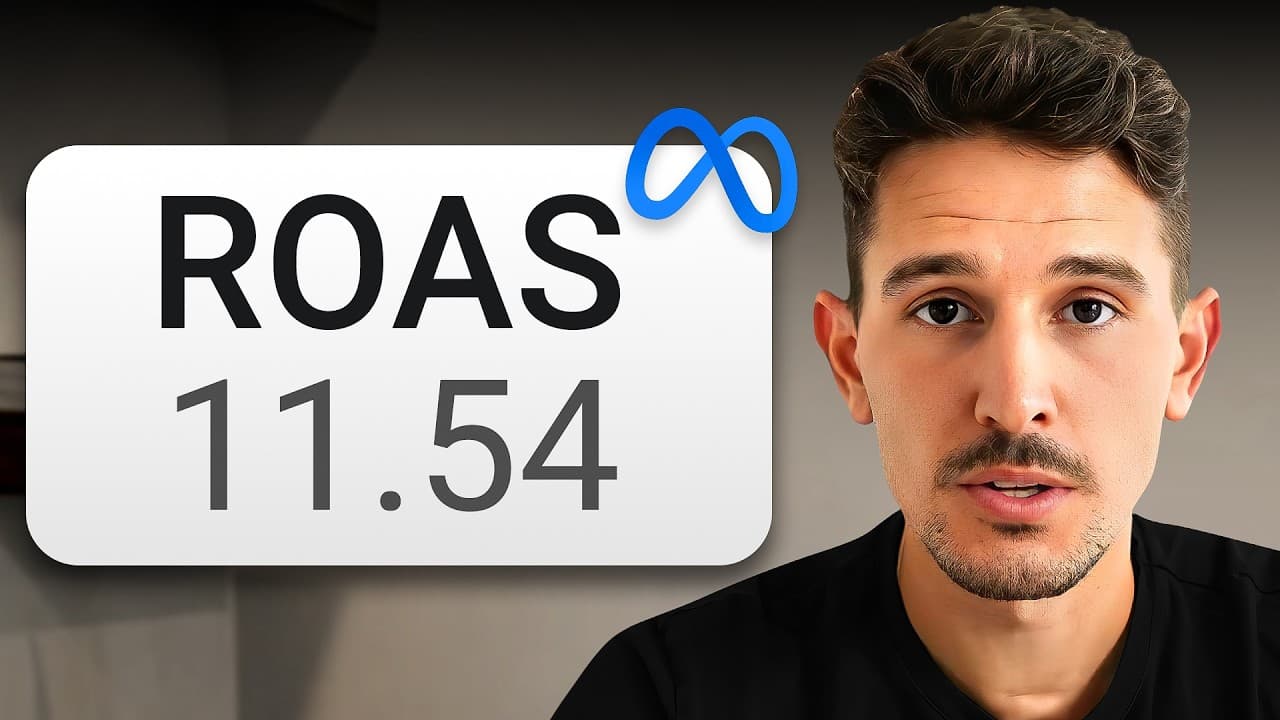
How to Boost Facebook Ads ROAS by 176%
TL;DR
To significantly improve your Facebook Ads return on ad spend (ROAS), implement a structured approach using a prospecting CBO campaign for testing, a scaling mechanism for top creatives, and distinct swim lanes for prospecting, retargeting, and retention. Monitor performance by adjusting spend based on high-performing days and ensure that you are targeting the right audience segments.
Transcript
give me the next few minutes and I guarantee you that you will learn something that can dramatically improve your return on ad spend in Facebook ads after generating over half a billion dollars in Facebook ads over the last 11 years I've basically boiled down advertising to a science and I found that there are four main strategies that you can use ... Read More
Key Insights
- Prospecting CBO campaigns are essential for minimizing wasted ad spend and testing new ad creatives effectively.
- Scaling mechanisms help promote top-performing ads to maximize their reach and impact within ad campaigns.
- Swim lanes structure ad accounts into prospecting, retargeting, and retention to optimize targeting and performance.
- Audience segment reporting should be set up to differentiate between engaged and existing audiences.
- Facebook's algorithm is highly effective at allocating budget to top-performing ads, reducing the need for manual adjustments.
- Adset spending limits can be used cautiously to ensure adequate exposure for specific ads without overspending.
- Performance analysis should include cross-referencing data from Facebook Ads, Google Ads, and Shopify to identify trends.
- Adjusting ad spend based on high-performing days and platforms can lead to better overall ROAS and campaign efficiency.
Install to Summarize YouTube Videos and Get Transcripts
Explore YouTube Video Summarizer or Get YouTube Transcript Extractor
Questions & Answers
Q: How to set up a prospecting CBO campaign?
To set up a prospecting CBO campaign, create a campaign with a campaign budget optimization (CBO) setting. Include multiple adsets with new ad creatives, termed as 'packs', and ensure the campaign settings are optimized for broad targeting. Monitor the campaign to allow Facebook's algorithm to allocate budget to the best-performing ads.
Q: What is a scaling mechanism in Facebook Ads?
A scaling mechanism in Facebook Ads is a strategy used to promote top-performing ad creatives into a dedicated campaign with minimal adsets. This approach helps to maximize the reach and efficiency of proven ads by allowing them to continue performing well without being paused or overshadowed by new tests.
Q: Why are swim lanes important in ad accounts?
Swim lanes are important as they create clear divisions between prospecting, retargeting, and retention campaigns. This structure ensures targeted strategies for acquiring new customers, re-engaging visitors, and retaining existing customers, leading to optimized ad spend and improved return on ad spend (ROAS).
Q: How can adset spending limits be used effectively?
Adset spending limits can be used to ensure specific ads receive adequate exposure without overspending. Set a daily minimum spend cautiously, typically around $10, to avoid negatively impacting other adsets. This approach helps maintain control over budget allocation while allowing certain ads to gain traction.
Q: What role does audience segment reporting play in ad campaigns?
Audience segment reporting helps differentiate between engaged and existing audiences, allowing for more precise targeting. By setting up these segments, advertisers can tailor their campaigns to reach the right audience, improving ad relevance and performance while minimizing wasted ad spend.
Q: How to adjust ad spend based on performance data?
Adjust ad spend by analyzing performance data from Facebook Ads, Google Ads, and Shopify. Identify high-performing days and platforms, then increase budgets on those days while reducing spend on lower-performing days. This data-driven approach helps optimize ad spend for better ROAS.
Q: What is the benefit of cross-referencing data from multiple platforms?
Cross-referencing data from multiple platforms, such as Facebook Ads, Google Ads, and Shopify, provides a comprehensive view of campaign performance. This holistic approach allows advertisers to identify trends, validate findings, and make informed decisions to optimize ad spend and improve ROAS.
Q: How to determine when to graduate an ad to a scaling campaign?
To determine when to graduate an ad, review the prospecting CBO campaign's performance by sorting ads by spend over a set period, such as the last 14 days. Identify top-performing ads with a return on ad spend above the required threshold and high spend, then duplicate these ads into the scaling campaign.
Summary & Key Takeaways
-
Implement a prospecting CBO campaign to reduce ad spend on testing and ensure that only top-performing ads receive significant exposure. This approach helps in minimizing wasted ad spend and allows the best ads to rise to the top over time.
-
Utilize a scaling mechanism to graduate high-performing creatives into a broad campaign with minimal adsets. This ensures that proven ads continue to perform well while new creatives are tested in a separate environment.
-
Establish clear swim lanes in your ad account to separate prospecting, retargeting, and retention efforts. This structure allows for better targeting and budget allocation, ensuring that different audience segments are reached effectively.
Read in Other Languages (beta)
Share This Summary 📚
Summarize YouTube Videos and Get Video Transcripts with 1-Click
Try YouTube Summary with ChatGPT & Claude or YouTube Transcript Generator
Explore More Summaries from Sam Piliero 📚




Summarize YouTube Videos and Get Video Transcripts with 1-Click
Try YouTube Summary with ChatGPT & Claude or YouTube Transcript Generator