How Does Implicit Differentiation Find Slopes?
TL;DR
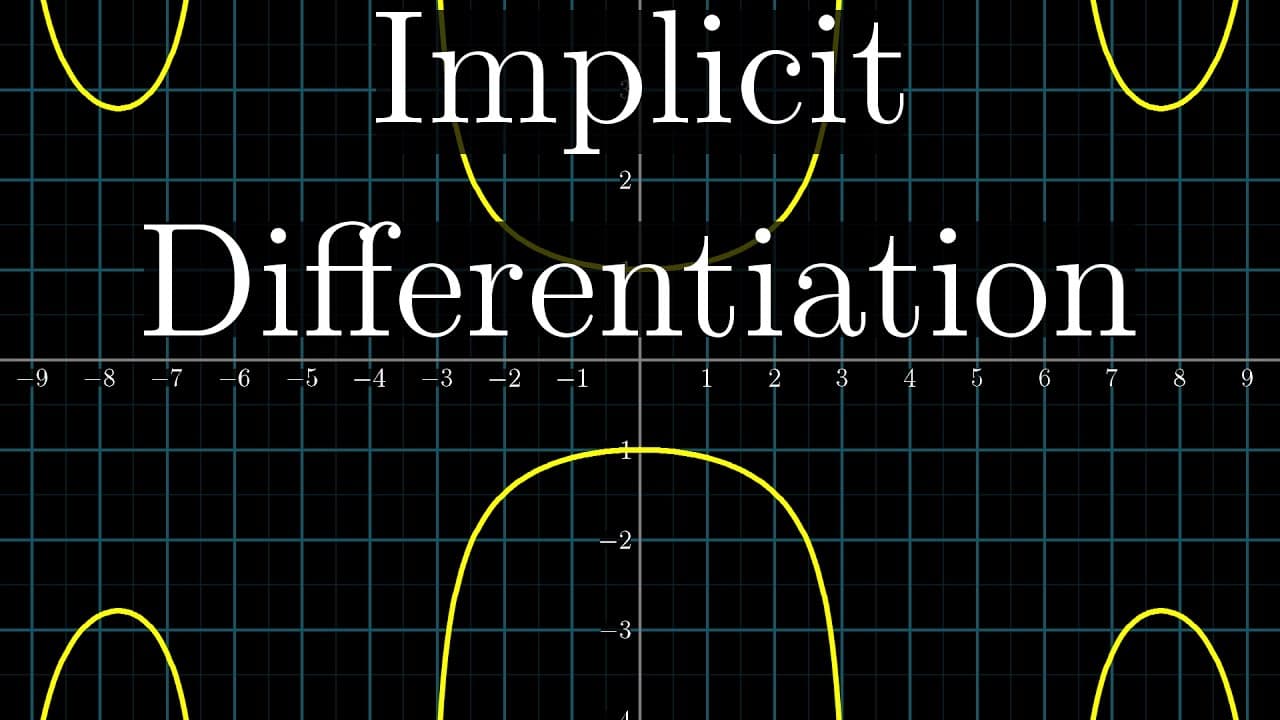
Implicit differentiation finds a curve’s tangent slope by differentiating both sides of its defining equation and solving for dy/dx. The differentials describe how each expression changes under a tiny step in x and y, while requiring the original equation to remain true identifies steps along the tangent line. For the circle x² + y² = 25, this gives dy/dx = -x/y.
Transcript
Let me share with you something I found particularly weird when I was a student first learning calculus. Let's say you have a circle with radius 5 centered at the origin of the xy plane. This is something defined with the equation x2 plus y2 equals 5 squared, that is, all the points on the circle are a distance 5 from the origin as encapsulated by ... Read More
Key Insights
- An implicit curve is the set of all points (x, y) satisfying an equation in two interdependent variables. Because x is not simply an input and y is not simply an output, its tangent slope cannot always be found by directly differentiating an explicit function y = f(x).
- The tangent slope of x² + y² = 25 is found from 2x dx + 2y dy = 0. Rearranging this differential relationship gives dy/dx = -x/y, so the slope at the point (3, 4) is -3/4.
- Implicit differentiation works by describing how both sides of an equation change under a tiny step with components dx and dy. Requiring those changes to agree preserves the equation and identifies the relationship between dx and dy for a tangent direction.
- A related-rates problem makes the chain rule explicit because x and y are written as functions of time. Differentiating x(t)² + y(t)² = 25 gives 2x(dx/dt) + 2y(dy/dt) = 0, which connects their rates of change.
- The bottom of the 5-meter ladder moves away from the wall at 4/3 meters per second when x = 3 meters, y = 4 meters, and the top drops at 1 meter per second. The negative sign belongs to dy/dt because the height decreases.
- The differential ds = 2x dx + 2y dy is a recipe for approximating how s = x² + y² changes. It depends on both the starting point (x, y) and the components of the tiny step, dx and dy.
- The condition ds = 0 describes a step along the tangent line to a level curve of s. It only approximates a step along the curve itself, but the approximation becomes increasingly accurate as dx and dy become smaller.
- The equation sin(x)y² = x can be differentiated using the product rule. The left side changes by sin(x)2y dy + y²cos(x) dx, while the right side changes by dx, and equating them enforces the original relationship along the tangent direction.
Install to Summarize YouTube Videos and Get Transcripts
Explore YouTube Video Summarizer or Get YouTube Transcript Extractor
Questions & Answers
Q: What is implicit differentiation?
Implicit differentiation is a method for finding relationships between tiny changes in variables that are connected by an equation rather than an explicit input-output rule. Each side of the equation is differentiated, with dx and dy recording changes in x and y. The resulting equation can then be rearranged to find dy/dx, which represents the tangent slope.
Q: How do you find the tangent slope of x² + y² = 25?
Differentiate both sides of x² + y² = 25 to obtain 2x dx + 2y dy = 0, since the constant 25 does not change. Rearranging gives 2y dy = -2x dx, and dividing by 2y dx gives dy/dx = -x/y. At (3, 4), the tangent slope is therefore -3/4.
Q: Why do dx and dy appear in implicit differentiation?
The symbols dx and dy represent the components of a tiny step in the xy-plane. For s = x² + y², the expression 2x dx + 2y dy approximates how much s changes during that step. When the step follows the tangent direction of the curve s = 25, the change ds must equal zero because s remains constant.
Q: How is implicit differentiation connected to related rates?
Both methods differentiate an equation that constrains two changing quantities. In the ladder problem, x and y are explicitly functions of time, so differentiating x(t)² + y(t)² = 25 produces 2x(dx/dt) + 2y(dy/dt) = 0. Implicit differentiation uses the same change relationship without requiring the shared variable, such as time, to remain visible.
Q: How fast does the bottom of the ladder move away from the wall?
At the initial moment, the 5-meter ladder forms distances x = 3 meters and y = 4 meters. The top drops at 1 meter per second, so dy/dt = -1. Substituting these values into 2x(dx/dt) + 2y(dy/dt) = 0 and solving gives dx/dt = 4/3 meters per second.
Q: What does setting ds equal to zero mean geometrically?
Setting ds = 0 means choosing a tiny step that produces no first-order change in the value of the function defining a level curve. For s = x² + y², it means the step preserves the value 25 to the derivative approximation. More precisely, this condition keeps the step on the tangent line rather than exactly on the circle.
Q: Why is implicit differentiation only an approximation for tiny steps?
A derivative captures the locally linear change of an expression. The equation 2x dx + 2y dy = 0 therefore describes directions along the tangent line, not finite movements that remain exactly on the curved circle. As dx and dy become smaller, the circle looks increasingly like its tangent line, so the approximation becomes increasingly accurate.
Q: How do you differentiate sin(x)y² = x implicitly?
Apply the product rule to the left side. The change is sin(x)2y dy + y²cos(x) dx because y² changes by 2y dy and sin(x) changes by cos(x) dx. The right side changes by dx. Equating these expressions preserves the original equation along the tangent direction and provides an equation that can be solved for dy/dx.
Summary & Key Takeaways
-
A circle defined by x² + y² = 25 is an implicit curve because x and y are interdependent rather than designated as input and output. Differentiating both sides gives 2x dx + 2y dy = 0, so its tangent slope is dy/dx = -x/y, which equals -3/4 at (3, 4).
-
A related-rates ladder problem gives the same equation a time-based interpretation. For a 5-meter ladder with x(t)² + y(t)² = 25, differentiating with respect to time relates dx/dt and dy/dt. When x = 3, y = 4, and dy/dt = -1 meter per second, dx/dt = 4/3 meters per second.
-
The expression s = x² + y² can be viewed as a function assigning a number to every point in the plane. Its differential, ds = 2x dx + 2y dy, approximates the change caused by a tiny step. Setting ds = 0 selects steps tangent to a level curve where s remains constant.
Read in Other Languages (beta)
Share This Summary 📚
Summarize YouTube Videos and Get Video Transcripts with 1-Click
Try YouTube Summary with ChatGPT & Claude or YouTube Transcript Generator
Explore More Summaries from 3Blue1Brown 📚


Summarize YouTube Videos and Get Video Transcripts with 1-Click
Try YouTube Summary with ChatGPT & Claude or YouTube Transcript Generator