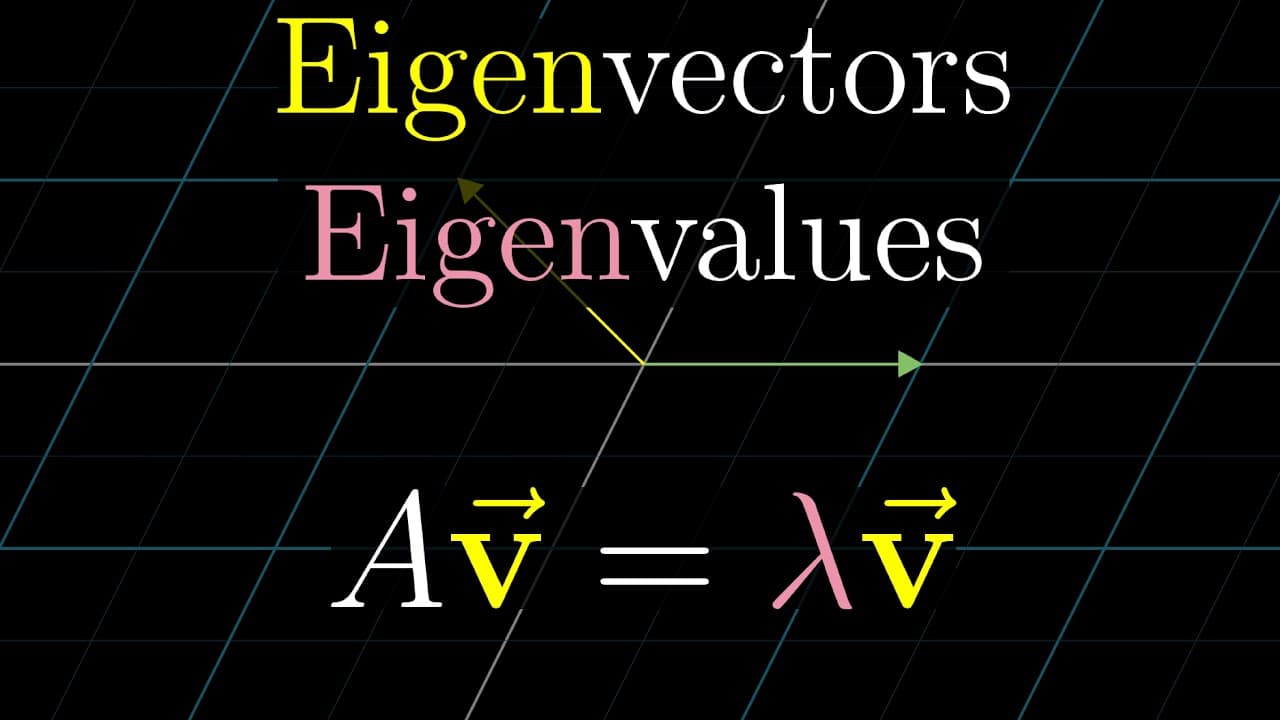
What Are Eigenvectors and Eigenvalues? | Essence of Linear Algebra, Chapter 14
TL;DR
Eigenvectors are nonzero vectors that remain on their own span during a linear transformation, while eigenvalues are the factors by which those vectors are stretched, squished, or flipped. They satisfy Av = λv, and eigenvalues are found by solving det(A − λI) = 0. The chapter’s visual examples, including factors of 3 and 2, make these coordinate-independent ideas worth exploring further.
Transcript
Eigenvectors and eigenvalues is one of those topics that a lot of students find particularly unintuitive. Questions like, why are we doing this and what does this actually mean, are too often left just floating away in an unanswered sea of computations. And as I've put out the videos of this series, a lot of you have commented about looking forward... Read More
Key Insights
- An eigenvector is a vector that remains on its own span during a linear transformation, meaning the matrix only stretches or squishes it like a scalar rather than rotating it off its line.
- An eigenvalue is the factor by which an eigenvector gets stretched or squished during the transformation. Eigenvalues can be negative, such as negative one half, which flips and squishes the vector.
- Confusion about eigenvectors usually comes from a shaky foundation in prerequisite topics like matrices as linear transformations, determinants, linear systems of equations, and change of basis, rather than the eigen-concepts themselves.
- The eigenvector equation is A times v equals lambda times v, meaning the matrix-vector product gives the same result as simply scaling the eigenvector v by the eigenvalue lambda.
- Finding eigenvalues comes down to solving det(A minus lambda times the identity) equals zero, because a non-zero vector can only be sent to zero when the transformation squishes space into a lower dimension.
- For a 3D rotation, an eigenvector reveals the axis of rotation, and its eigenvalue must be 1 since rotations never stretch or squish, so the vector's length stays the same.
- A 2D transformation does not have to have eigenvectors. A 90-degree rotation has none because it rotates every vector off its span, yielding the polynomial lambda squared plus 1 whose only roots are imaginary.
- A single eigenvalue can correspond to more than a line of eigenvectors. A matrix that scales everything by 2 has only eigenvalue 2, yet every vector in the plane is an eigenvector.
Install to Summarize YouTube Videos and Get Transcripts
Explore YouTube Video Summarizer or Get YouTube Transcript Extractor
Questions & Answers
Q: What is an eigenvector in linear algebra?
An eigenvector is a nonzero vector that remains on its own span during a linear transformation. Instead of being rotated off its line, it is only stretched, squished, or flipped.
Q: What is an eigenvalue?
An eigenvalue is the scalar factor by which a corresponding eigenvector is changed. For example, an eigenvalue of negative one half means the vector is flipped and squished by a factor of one half while remaining on its span.
Q: What does the eigenvector equation Av = λv mean?
The equation says that applying matrix A to eigenvector v produces the same result as scaling v by the number λ. Here, λ is the eigenvalue associated with v.
Q: How do you find the eigenvalues of a matrix?
Rewrite Av = λv as (A − λI)v = 0, where I is the identity matrix. Then solve det(A − λI) = 0 to find the possible values of λ.
Q: Why must det(A − λI) equal zero?
The eigenvector v must be nonzero, yet (A − λI)v must equal the zero vector. That can happen only when the transformation represented by A − λI squishes space into a lower dimension, which corresponds to a zero determinant.
Q: What are the eigenvectors and eigenvalues in the chapter’s 2D example?
For the matrix whose columns are (3, 0) and (1, 2), vectors on the x-axis are eigenvectors with eigenvalue 3. Vectors on the diagonal line spanned by (−1, 1) are eigenvectors with eigenvalue 2, while other vectors are rotated off their spans.
Q: Why are eigenvectors useful for understanding linear transformations?
Eigenvectors and eigenvalues reveal directions that a transformation preserves and how it scales those directions. This can describe the heart of a transformation in a way that is less dependent on the chosen coordinate system than reading a matrix’s columns alone.
Q: How do eigenvectors describe a three-dimensional rotation?
An eigenvector of a 3D rotation identifies its axis of rotation because it remains on its own span. Its eigenvalue is 1, since the rotation does not stretch or squish the vector and its length remains unchanged.
Summary & Key Takeaways
-
Most vectors get knocked off their span during a linear transformation, but some special vectors remain on their own span and are only stretched or squished by a scalar. These are eigenvectors, and the scalar factor is the associated eigenvalue. For the matrix with columns 3,0 and 1,2, the x-axis stretches by 3 and the diagonal by 2.
-
Rather than reading a matrix's columns as landing spots for basis vectors, finding eigenvectors and eigenvalues gets at the heart of what a transformation does, less dependent on the coordinate system. A 3D rotation is easier understood through its axis of rotation (an eigenvector) and angle than through its full 3x3 matrix.
-
To compute eigenvalues, rewrite A times v equals lambda times v as (A minus lambda times identity) times v equals zero, then find lambda making the determinant zero so space squishes to a lower dimension. Rotations can yield imaginary roots (no eigenvectors), while shears and scaling matrices show other patterns.
Read in Other Languages (beta)
Share This Summary 📚
Summarize YouTube Videos and Get Video Transcripts with 1-Click
Try YouTube Summary with ChatGPT & Claude or YouTube Transcript Generator
Explore More Summaries from 3Blue1Brown 📚



Summarize YouTube Videos and Get Video Transcripts with 1-Click
Try YouTube Summary with ChatGPT & Claude or YouTube Transcript Generator