What Is the Monster Group and Why Is It Special?
TL;DR
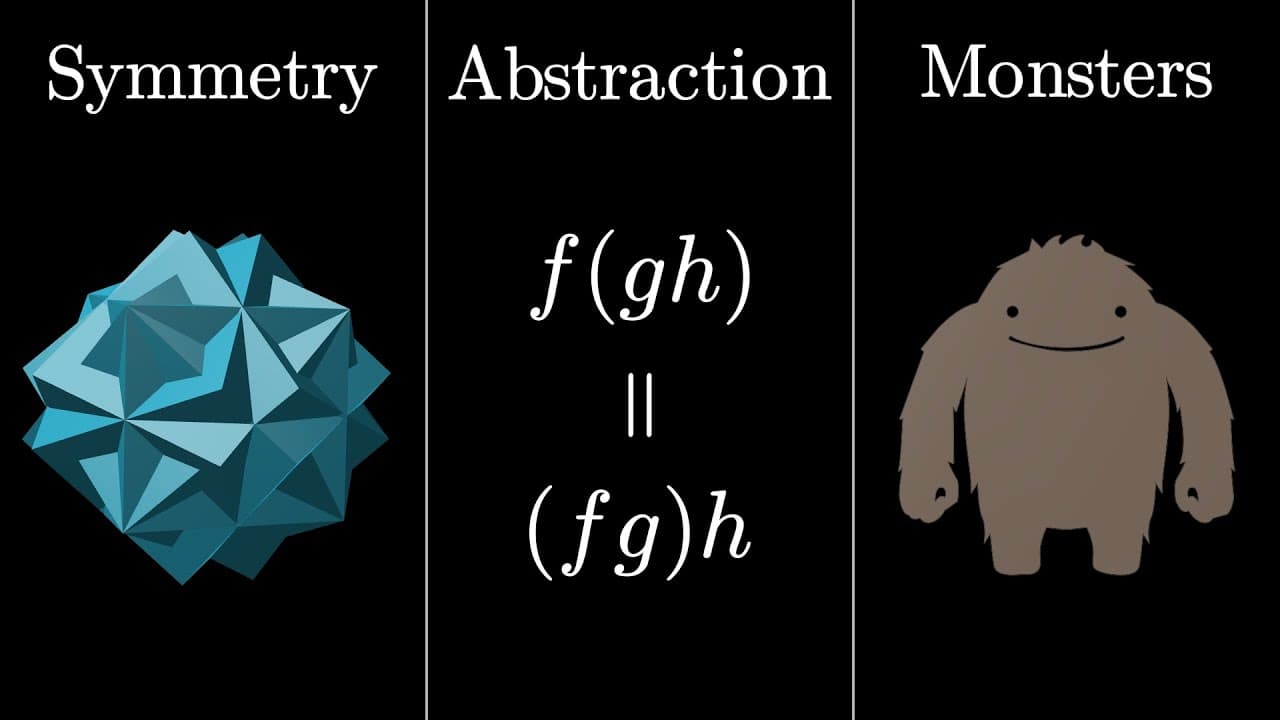
The monster is a group of roughly 8 × 10^53 elements associated with 196,883 dimensions, and its remarkable size emerges from the classification of abstract symmetries. Group theory studies how symmetry actions combine, revealing structures that explain geometric transformations, the impossibility of a general radical formula for quintics, and conservation laws in physics.
Transcript
Today, many members of the YouTube math community are getting together to make videos about their favorite numbers over 1 million, and we're encouraging you, the viewers, to do the same. Take a look at the description for details. My own choice is considerably larger than a million, roughly 8x10 to the 53. For a sense of scale, that's around the nu... Read More
Key Insights
- A group is a collection of elements equipped with a rule for combining them, modeled concretely by performing one symmetry action after another. The do-nothing action is always included, and the complete combination rules determine the group's internal structure.
- The symmetry group of a snowflake has 12 elements because it includes rotations, reflections, and the do-nothing action. This group is called D6, while the simpler two-element symmetry group associated with reflecting a face is called C2.
- The structure being preserved determines which transformations count as symmetries. A cube admits 24 rotations, but allowing reflections increases the total to 48 because orientation is no longer treated as part of the structure that every action must preserve.
- Permutation groups describe every possible rearrangement of a collection of objects. Six objects have 6!, or 720, permutations, while 12 objects have about 479 million, showing that sheer group size alone does not make a group mathematically exceptional.
- The group S5 reveals why no general formula using arithmetic and radicals can solve every degree 5 polynomial. Although the roots can have numerical approximations, their exact values cannot always be constructed from the coefficients with those permitted operations.
- Noether's theorem connects every conservation law to a form of symmetry. Conservation of momentum and conservation of energy therefore correspond to groups of transformations that can be applied to a physical setup without changing the governing laws.
- An abstract group preserves the rules for combining elements while removing dependence on any particular geometric object or physical action. This abstraction is analogous to treating 3 as a number in itself rather than as one specific collection of three things.
- The monster has roughly 8 × 10^53 elements and is associated with 196,883 dimensions. Its significance is tied to the broader effort to classify groups, not merely to largeness, since ordinary permutation groups can become vastly larger with little difficulty.
Install to Summarize YouTube Videos and Get Transcripts
Explore YouTube Video Summarizer or Get YouTube Transcript Extractor
Questions & Answers
Q: What is a group in group theory?
A group is an abstract collection of elements together with a binary operation that specifies how any two elements combine. In concrete symmetry examples, the elements are actions and the operation means performing one action after another. The do-nothing action is included, and the resulting multiplication rules capture the structure independently of any particular object being transformed.
Q: How do symmetry actions form a group?
Symmetry actions form a group when they can be combined by applying one transformation after another, with every combination producing another allowed transformation. For example, flipping a snowflake about one axis and then rotating it by 60 degrees can equal a different single reflection. Recording every such result creates a multiplication table that defines the group's internal structure.
Q: Why does the structure being preserved affect group size?
A symmetry is defined relative to the structure that transformations must preserve. A cube has 24 allowed rotations when orientation matters, but it has 48 transformations when reflections are also permitted. If its faces can additionally rotate or be shuffled, many more actions become possible. Looser preservation requirements therefore produce a larger and more complicated group.
Q: What is the difference between a group and a group action?
A group action describes specific transformations applied to a particular object, such as rotations of a cube or permutations of polynomial roots. An abstract group keeps only the elements and their rules of combination. The relationship is like the relationship between the abstract number 3 and a concrete triplet: the abstraction retains structure without requiring one physical interpretation.
Q: Why are permutation groups important in group theory?
Permutation groups contain all possible rearrangements of specified objects and, in a certain sense described in the transcript, encompass all other groups. They also demonstrate that size alone is not especially meaningful. Six objects already yield 720 permutations, 12 yield about 479 million, and shuffling 101 objects produces roughly 9 × 10^159 possible actions.
Q: How does group theory explain why there is no general quintic formula?
Group theory studies how the roots of a polynomial can be permuted while respecting their algebraic relationships. The internal structure of the permutation group S5 shows that no general degree 5 formula can express every root using only coefficients, the four basic arithmetic operations, and radicals. Numerical approximations may exist even when such exact radical expressions cannot.
Q: How is group theory connected to conservation laws in physics?
Noether's theorem states that every conservation law corresponds to a kind of symmetry and therefore to a group. Conservation of momentum and conservation of energy are examples. The relevant group consists of transformations that can be applied to a physical setup while leaving the laws governing that setup unchanged, linking physical invariance with abstract mathematical structure.
Q: What makes the monster group mathematically notable?
The monster is notable as an exceptionally large object arising within the classification of groups. It has roughly 8 × 10^53 elements and is associated with 196,883 dimensions. Its importance cannot be reduced to size, because permutation groups can easily be much larger. Instead, it reflects the unexpectedly complicated patterns found when mathematicians classify abstract forms of symmetry.
Summary & Key Takeaways
-
Groups formalize symmetry by collecting transformations that preserve some chosen structure. A snowflake has 12 symmetries, while a cube has 24 rotational symmetries or 48 symmetries when reflections are included. Loosening the preserved structure permits more actions, so the resulting group becomes larger and more complicated.
-
Abstract groups retain the multiplication rules governing how elements combine while discarding the particular objects on which those elements act. This resembles treating the number 3 as an abstract symbol instead of a specific triplet. Multiplication tables can therefore reveal when apparently different systems of symmetry share the same internal structure.
-
Group theory connects symmetry to major mathematical and physical results. The structure of S5 explains why a general quintic cannot be solved using arithmetic and radicals, while Noether's theorem connects conservation laws with symmetries. The monster shows that classifying these natural abstract structures eventually leads to an exceptionally large 196,883-dimensional object.
Read in Other Languages (beta)
Share This Summary 📚
Summarize YouTube Videos and Get Video Transcripts with 1-Click
Try YouTube Summary with ChatGPT & Claude or YouTube Transcript Generator
Explore More Summaries from 3Blue1Brown 📚
Summarize YouTube Videos and Get Video Transcripts with 1-Click
Try YouTube Summary with ChatGPT & Claude or YouTube Transcript Generator