How Can You Take the Logarithm of an Image?
TL;DR
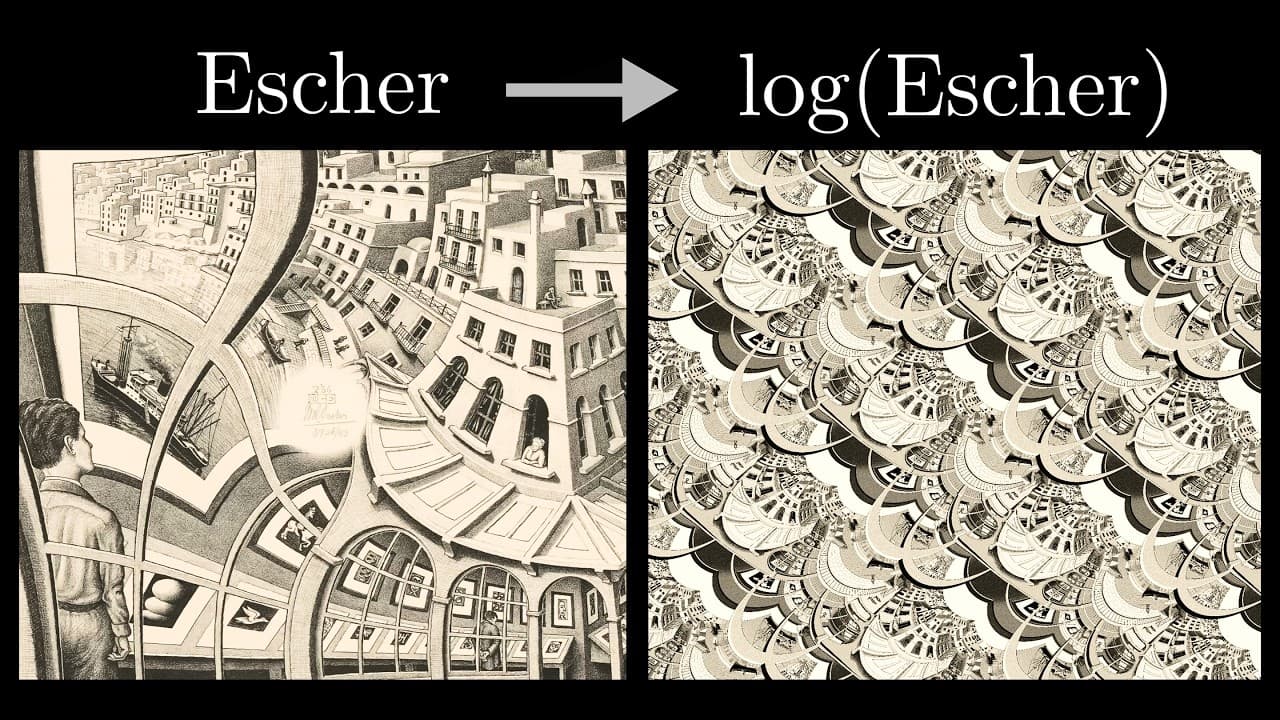
Taking the logarithm of Escher’s Print Gallery means reverse engineering its warped geometry into a straight, self-similar reference image. A specially constructed grid distributes repeated scaling around the picture, while complex exponential and logarithmic functions explain how circular movement through the finished artwork corresponds to continuous zooming through the original scene.
Transcript
Whenever I'm making one of these videos, there's sometimes a special moment where the act of animating involves solving a whole bunch of little technical puzzlers, and then the underlying math I'm trying to explain clicks for me in a way that it hadn't before once I see it alive on screen. The best versions of those moments often tell me when a vid... Read More
Key Insights
- Print Gallery is a 1956 lithograph in which a young man studies a print that indirectly contains the gallery and the young man again. This self-contained visual loop led Escher to call it the most peculiar thing he had ever done.
- The Droste effect is a self-similar image in which a picture contains a smaller copy of itself. Escher’s reference structure uses an unusually deep nesting, with the repeated copy scaled down by a factor of 256.
- Escher’s central insight is that continuous zooming can be represented as movement around a loop. As the viewer’s gaze travels through the warped composition, the depicted scene grows progressively until it reconnects with its smaller self-similar copy.
- The scaling factor is distributed across the four corners of the composition. A 16-fold self-similar example requires a factor of two between consecutive corners, while Escher’s 256-fold structure requires a factor of four from one corner to the next.
- The warped grid encodes changes in scale throughout the image. Following selected grid boundaries toward another corner reveals larger enclosed squares, so transferring an ordinary picture onto the grid automatically enlarges its contents by the intended factor.
- The image-transfer process works by matching small squares in a regular grid with corresponding squares in the warped grid. At this local scale, an artist can copy relatively undistorted details piece by piece instead of attempting to draw the complete warped scene directly.
- The construction closes smoothly only when the source image has the required self-similarity. After the warped transfer proceeds around the entire composition, the enlarged scene must join the smaller nested copy at precisely the correct scale.
- The complex logarithm provides a way to straighten geometry involving cyclic rotation and repeated scaling. The description frames the reverse engineering of Escher’s original artwork as taking its logarithm, with the complex exponential providing the complementary mathematical transformation.
Install to Summarize YouTube Videos and Get Transcripts
Explore YouTube Video Summarizer or Get YouTube Transcript Extractor
Questions & Answers
Q: What does it mean to take the logarithm of an image?
Taking the logarithm of an image means applying the geometric idea behind the complex logarithm to straighten a picture whose structure combines rotation and scaling. In the analysis of Print Gallery, this process reverse engineers the warped circular composition into a self-similar reference image. The phrase therefore describes a transformation of coordinates, not taking separate numerical logarithms of the picture’s colors or individual pixels.
Q: How does Escher’s Print Gallery create a visual loop?
Print Gallery begins conceptually with a man looking at a picture containing a harbor, a town, a print gallery, and eventually the same man again. Escher warps this nested scene so that the zoom happens implicitly as the viewer’s gaze moves around the composition. The scene continuously enlarges along that path and ultimately reconnects with the smaller copy contained inside itself.
Q: What is the Droste effect in Escher’s Print Gallery?
The Droste effect is a self-similar arrangement in which an image contains a smaller version of itself, allowing the nesting to continue repeatedly. In Escher’s underlying reference image, the harbor contains a town, the town contains a gallery, and the gallery contains the observer and picture again. The nested copy is 256 times smaller than the original scene.
Q: Why does Escher’s construction use a warped grid?
The warped grid turns a difficult drawing problem into a sequence of manageable transfers. An artist first places a normal square grid over the straight reference image, then copies the contents of each small square into its matching distorted square. Because the warped grid already encodes the necessary changes in size and direction, the accumulated transfers create the overall visual distortion automatically.
Q: How is scaling distributed around the four corners?
The total zoom between an image and its nested copy is divided among four successive corners. In the simplified example, the repeated image is 16 times smaller, so each transition applies a factor of two, since four such transitions produce the required overall scaling. Escher’s image uses a 256-fold difference, corresponding to a factor of four from one corner to the next.
Q: Why must the original image be self-similar?
Self-similarity is required because the warped transfer must close after traveling around the composition. During that journey, the scene is progressively enlarged according to the grid’s scaling. At the end, it needs to join the same imagery at a different size without a discontinuity. The simplified construction therefore requires a 16-fold nested copy, while Escher’s construction uses a 256-fold copy.
Q: What belongs in the blank center of Print Gallery?
The blank center is surrounded by incompatible-seeming parts of the scene. Approaching from the upper right suggests buildings in the village, approaching from the left suggests the picture frame, and approaching from below suggests the gallery. The mathematical analysis treats this ambiguity as part of the warped coordinate structure and argues that there is one completion that fits the surrounding transformation as the correct puzzle piece.
Q: How do complex exponential and logarithmic functions relate to the artwork?
The artwork combines two geometric behaviors: movement around a circular path and repeated enlargement of the depicted scene. The complex exponential and complex logarithm provide the mathematical language for moving between this warped cyclic geometry and a straightened representation. The exponential supports the construction of the key transformation, while the logarithm describes the reverse engineering that recovers the underlying self-similar image.
Summary & Key Takeaways
-
Escher’s Print Gallery depicts a young man viewing a print whose harbor, town, gallery, and observer form a self-contained loop. Its blank central circle compresses conflicting visual interpretations into one region. De Smit and Lenstra analyzed the mathematical structure and reverse engineered a straightened, self-similar version of the scene.
-
The construction begins with a Droste image containing a smaller copy of itself. Escher used a copy 256 times smaller, distributing that scaling across four corners by a factor of four per corner. A simpler example uses a 16-fold nested copy and a factor of two between consecutive corners.
-
A warped grid provides a practical bridge between the straight reference image and the finished composition. Content from each small square of an ordinary grid is copied into its corresponding distorted square. Complex functions, especially the exponential and logarithm, explain the resulting combination of rotation, scaling, and continuous cyclic zooming.
Read in Other Languages (beta)
Share This Summary 📚
Summarize YouTube Videos and Get Video Transcripts with 1-Click
Try YouTube Summary with ChatGPT & Claude or YouTube Transcript Generator
Explore More Summaries from 3Blue1Brown 📚
Summarize YouTube Videos and Get Video Transcripts with 1-Click
Try YouTube Summary with ChatGPT & Claude or YouTube Transcript Generator