What Are Limits, L'Hôpital's Rule, and Epsilon-Delta Definitions in Calculus? | Chapter 7, Essence of Calculus
TL;DR
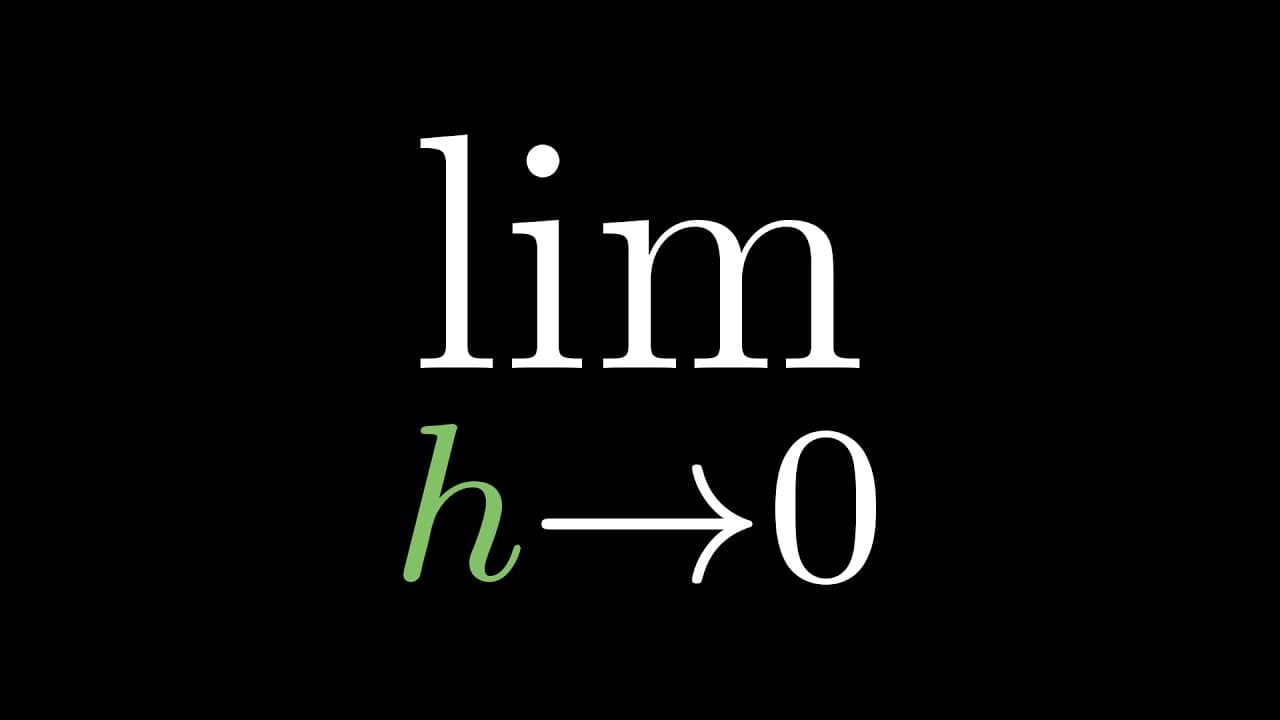
A limit describes the value an expression approaches as its input gets closer to a chosen point. It makes the derivative rigorous without requiring infinitely small changes: h remains a non-zero, finitely small nudge, while the difference quotient for x cubed at x equals 2 approaches 12 as h approaches 0. Read on to understand derivative notation, missing function values, epsilon-delta reasoning, and when limits fail to exist.
Transcript
The last several videos have been about the idea of a derivative, and before moving on to integrals I want to take some time to talk about limits. To be honest, the idea of a limit is not really anything new. If you know what the word approach means you pretty much already know what a limit is. You could say it's a matter of assigning fancy notatio... Read More
Key Insights
- A limit is nothing conceptually new: if you know what the word approach means, you already know what a limit is. It is a matter of assigning fancy notation to the intuitive idea of one value getting closer to another.
- The derivative is not the ratio df/dx itself but whatever that ratio approaches as dx approaches 0. The ratio is the rise-over-run slope between the starting point on the graph and the nudged point, which is almost, but not exactly, the derivative.
- Inside a limit expression you almost never see lowercase-d terms like dx. The standard is a different variable such as delta x, or commonly h, because terms with a lowercase d already have the limiting process built into them.
- The value h in the formal definition is the exact same thing as dx: a nudge to the input of f with some non-zero, finitely small size like 0.001. The definition analyzes what happens for arbitrarily small choices of h.
- The expression (2+h) cubed minus 2 cubed, all divided by h, is what pops out of the derivative definition for x cubed at x equals 2. It is undefined at h equals 0, giving 0 divided by 0, so its graph has a hole there, yet the limit is 12.
- A limit exists when shrinking the range of input values around the limiting point forces the corresponding range of output values to close in on one value, and that output range can be made as small as you want.
- A limit fails to exist when the function approaches different values from each side. In the counterexample that jumps at 0, approaching from the right gives 2 and from the left gives 1, so the output range never shrinks smaller than 1.
- The function sin(pi times x) divided by (x squared minus 1) is undefined at x equals 1, since sin of pi is 0 and the denominator is 0. Plugging in 1.00001 approximates the limit as a number around negative 1.57.
Install to Summarize YouTube Videos and Get Transcripts
Explore YouTube Video Summarizer or Get YouTube Transcript Extractor
Questions & Answers
Q: What is a limit in calculus, and how does it work?
A limit assigns notation to the intuitive idea of one value getting closer to another. It asks what a function's output approaches as its input approaches a chosen point, even when the function is undefined at that exact point.
Q: What is the formal definition of a derivative using a limit?
The derivative is the limit, as h approaches 0, of f at the starting input plus h minus f at the starting input, all divided by h. The fraction is the rise-over-run slope between the starting point and a nearby point, while the derivative is the value that slope approaches.
Q: Why is h used instead of dx in the derivative definition?
The variable h represents the same kind of input nudge as dx: an ordinary, non-zero, finitely small number such as 0.001. Using h makes the limiting process explicit and avoids suggesting that the calculation depends on an infinitely small quantity.
Q: How do limits let calculus avoid infinitely small changes?
A limit considers ordinary non-zero changes and asks what happens as their size approaches 0. In the derivative definition, h can be chosen arbitrarily small, but it remains a finite number rather than an infinitesimal.
Q: What is the epsilon-delta definition of a limit?
For every distance epsilon around the proposed limiting output, no matter how small, there must be a distance delta around the limiting input such that every input within delta produces an output within epsilon. This gives a rigorous meaning to the word “approach.”
Q: How can a limit exist when a function is undefined at the limiting input?
A limit depends on nearby outputs rather than the function's value at the exact input. For ((2+h) cubed minus 2 cubed) divided by h, substituting h equals 0 gives undefined 0 divided by 0, but the outputs approach 12 from both sides.
Q: How do you know when a limit does not exist?
A limit does not exist when nearby function values fail to approach one unambiguous output. In the jump example at 0, the function approaches 2 from the right and 1 from the left, so an epsilon such as 0.4 defeats every possible delta.
Q: What happens to sin(pi times x) divided by (x squared minus 1) as x approaches 1?
The expression is undefined at x equals 1 because both its numerator and denominator are 0 there. Evaluating it at 1.00001 indicates that its limit is around negative 1.57.
Summary & Key Takeaways
-
The formal definition of the derivative writes df/dx as the limit, as h approaches 0, of the quantity f at the starting input plus h minus f at the starting input, all divided by h. Terms with a lowercase d already have the idea of a limit built into them, so df/dx is shorthand for that fuller expression.
-
Nothing in the formal definition references an infinitely small change, and the whole point of limits is to avoid that paradoxical idea. The variable h is the exact same thing as dx, a non-zero finitely small nudge; a new variable name is introduced only to make clear these are ordinary numbers, not infinitesimals.
-
The epsilon-delta definition says a limit exists when, for any distance epsilon around the limiting output no matter how small, you can find some distance delta around the limiting input so every input within delta maps to an output within epsilon. When no limit exists, some epsilon like 0.4 defeats every delta.
Read in Other Languages (beta)
Share This Summary 📚
Summarize YouTube Videos and Get Video Transcripts with 1-Click
Try YouTube Summary with ChatGPT & Claude or YouTube Transcript Generator
Explore More Summaries from 3Blue1Brown 📚

Summarize YouTube Videos and Get Video Transcripts with 1-Click
Try YouTube Summary with ChatGPT & Claude or YouTube Transcript Generator