What Are Linear Transformations and How Are They Represented?
TL;DR
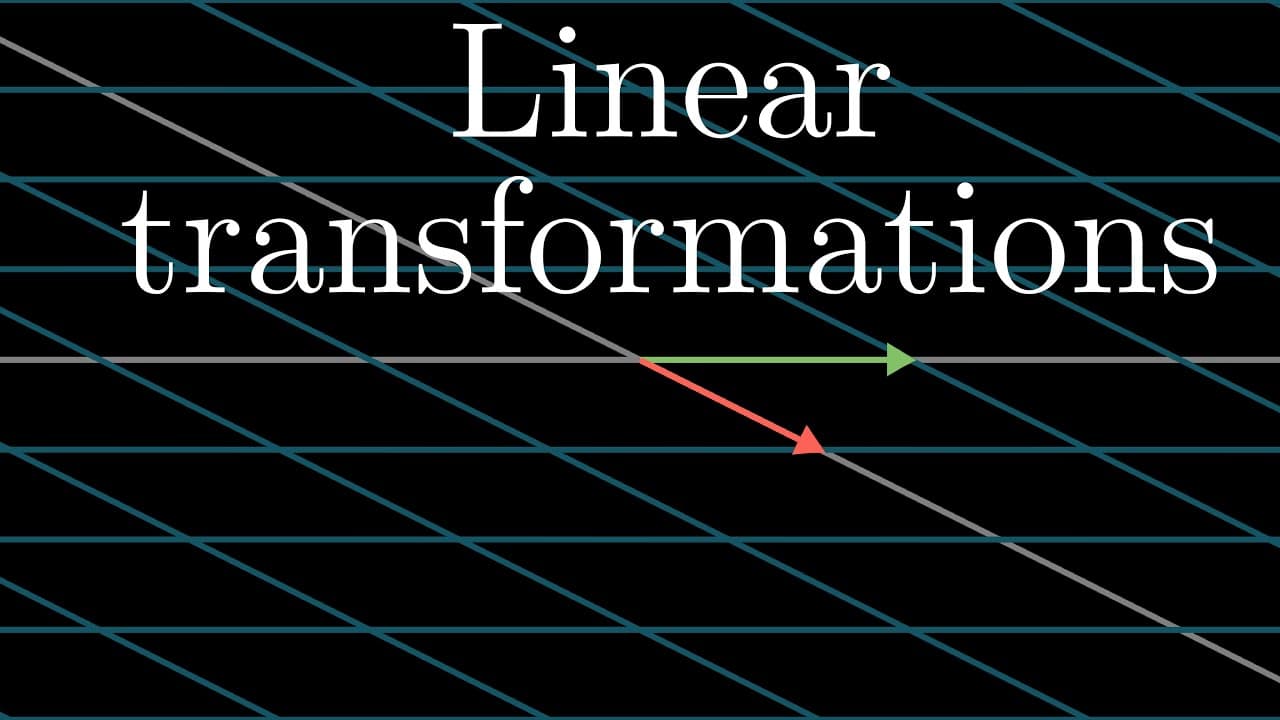
Linear transformations are functions that map input vectors to output vectors while keeping lines straight and fixing the origin. In two dimensions, they can be represented by 2x2 matrices, where each column indicates the final position of the basis vectors. Matrix-vector multiplication is used to calculate the output vector based on these transformations.
Transcript
Hey everyone! If I had to choose just one topic that makes all of the others in linear algebra start to click, and which too often goes unlearned the first time a student takes linear algebra, it would be this one. The idea of a linear transformation and its relation to matrices. For this video, I'm just going to focus on what these trans... Read More
Key Insights
- Linear transformations are functions that map input vectors to output vectors, maintaining lines as lines and fixing the origin.
- Visualizing transformations involves imagining vectors moving from input to output, using points on a grid to simplify visualization.
- Linear transformations in two dimensions can be described using a 2x2 matrix, where columns represent where basis vectors land.
- Matrix-vector multiplication helps determine where a vector lands after a transformation, using the coordinates of basis vector landings.
- Understanding linear transformations as movements of space helps in grasping complex linear algebra concepts like matrix multiplication and eigenvalues.
- A matrix's columns correspond to the transformed versions of basis vectors, providing a numerical description of the transformation.
- Rotations, shears, and other transformations can be represented by matrices, with specific entries describing the effect on basis vectors.
- Recognizing matrices as transformations of space is crucial for a deep understanding of linear algebra and its applications.
Install to Summarize YouTube Videos and Get Transcripts
Explore YouTube Video Summarizer or Get YouTube Transcript Extractor
Questions & Answers
Q: What is a linear transformation in the context of linear algebra?
A linear transformation in linear algebra is a function that maps input vectors to output vectors while maintaining specific properties. These include keeping lines straight and the origin fixed. Such transformations can be visualized as movements of vectors in space, ensuring that grid lines remain parallel and evenly spaced.
Q: How can linear transformations be visualized?
Linear transformations can be visualized by imagining vectors moving from their input positions to their output positions. Instead of viewing vectors as arrows, they are conceptualized as points on a grid. This approach helps in understanding the transformation by observing the movement of points across the grid.
Q: How are linear transformations related to matrices?
Linear transformations in two dimensions are described using 2x2 matrices. The matrix's columns represent where the basis vectors land after the transformation. This numerical description allows for the use of matrix-vector multiplication to determine the resulting position of any vector subjected to the transformation.
Q: What is the significance of matrix-vector multiplication in linear transformations?
Matrix-vector multiplication is significant as it provides a method to calculate the resulting position of a vector after a linear transformation. By multiplying the vector's coordinates by the corresponding columns of the matrix, one can determine where the vector lands, reflecting the transformation's effect numerically.
Q: Why is it important to understand matrices as transformations of space?
Understanding matrices as transformations of space is crucial for grasping complex linear algebra concepts, such as matrix multiplication, determinants, and eigenvalues. This perspective provides an intuitive understanding of how matrices function and interact within the broader context of linear transformations and vector spaces.
Q: What are some examples of linear transformations represented by matrices?
Examples of linear transformations represented by matrices include rotations and shears. For instance, a 90-degree counterclockwise rotation can be represented by a matrix with columns [0, 1] and [-1, 0]. A shear transformation might have the first column as [1, 0] and the second as [1, 1], indicating how basis vectors are moved.
Q: How does the video suggest deducing where vectors land after a transformation?
The video suggests deducing where vectors land by using the positions of basis vectors i-hat and j-hat after the transformation. By expressing a vector as a linear combination of these basis vectors, one can calculate its new position using the matrix that describes the transformation, without directly observing the transformation.
Q: What is the role of the 2x2 matrix in describing two-dimensional transformations?
The 2x2 matrix plays a crucial role in describing two-dimensional transformations by packaging the coordinates of where the basis vectors land. Each column of the matrix corresponds to the transformed position of a basis vector, allowing for a concise numerical representation of the transformation and facilitating matrix-vector multiplication.
Summary & Key Takeaways
-
The video explains linear transformations, emphasizing their role as functions that map input vectors to output vectors while maintaining certain properties like fixed origin and straight lines.
-
It introduces the concept of visualizing transformations using grids and points, simplifying the understanding of how vectors move in space during transformations.
-
The explanation covers how linear transformations in two dimensions are represented by 2x2 matrices, with matrix-vector multiplication used to determine vector landings.
Read in Other Languages (beta)
Share This Summary 📚
Summarize YouTube Videos and Get Video Transcripts with 1-Click
Try YouTube Summary with ChatGPT & Claude or YouTube Transcript Generator
Explore More Summaries from 3Blue1Brown 📚

Summarize YouTube Videos and Get Video Transcripts with 1-Click
Try YouTube Summary with ChatGPT & Claude or YouTube Transcript Generator