How did the Virginia Plan vs New Jersey Plan shape the Constitution?
TL;DR
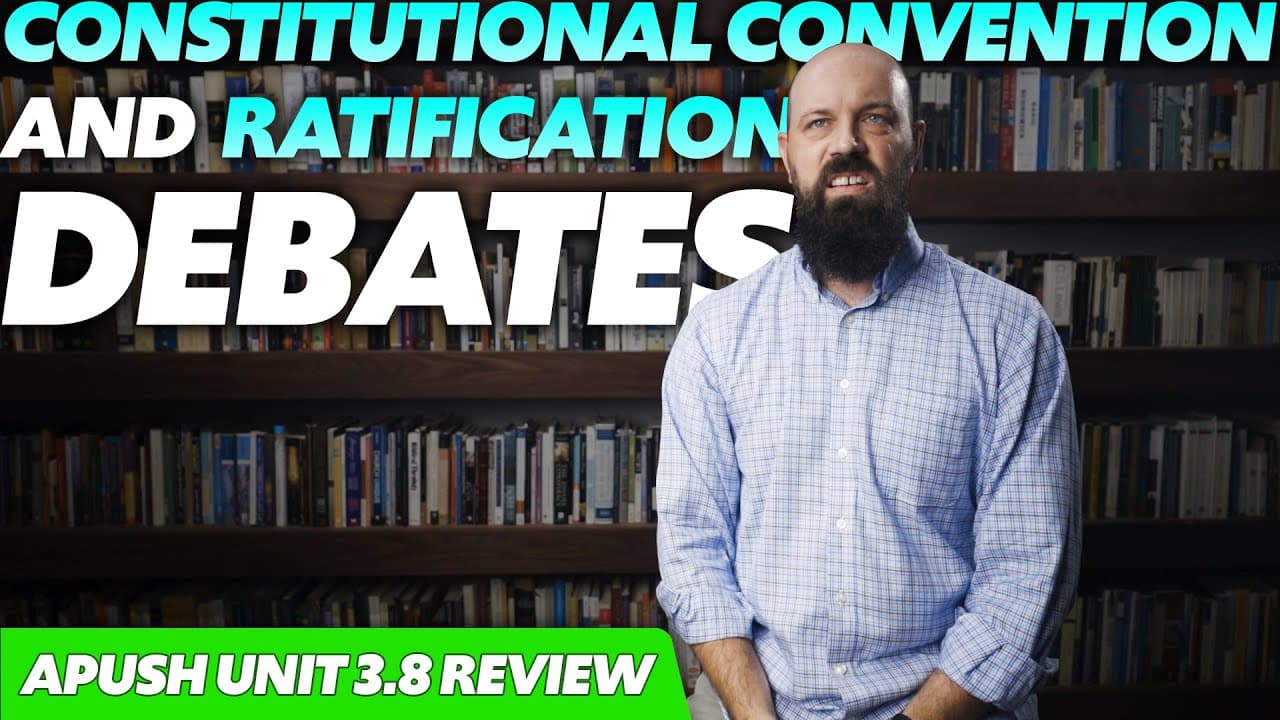
The Virginia Plan proposed representation by population in a bicameral Congress, while the New Jersey Plan favored equal representation for each state in a unicameral legislature. The Great Compromise blended these ideas into a two-house Congress, and the Three-Fifths Compromise addressed counting enslaved people for representation. Federalists ultimately ratified with the promise of a Bill of Rights.
Transcript
Well hey there and welcome back to Heimler’s History. We’ve been going through unit 3 of the AP U.S. History curriculum, and in the last video we looked at the first constitution of the United States, which is to say, the Articles of Confederation. We ended with the failure of that document and so in this video and the next we’re going to look ... Read More
Key Insights
- The Constitutional Convention convened with the goal of improving the weak Articles of Confederation.
- The Virginia Plan favored representation by population in a bicameral Congress, benefiting larger states.
- The New Jersey Plan proposed equal representation for all states in a unicameral legislature.
- The Great Compromise created a bicameral legislature with proportional House representation and equal Senate representation.
- The Three-Fifths Compromise counted enslaved people as three-fifths of a person for representation.
- The president would be elected via an Electoral College rather than direct popular vote.
- The system aimed to balance popular input with safeguards against majority tyranny.
- Federalists supported ratification with a promise to add a Bill of Rights to protect individual liberties.
- More videos from this channel:
- More from this channel: Heimler's History
Install to Summarize YouTube Videos and Get Transcripts
Explore YouTube Video Summarizer or Get YouTube Transcript Extractor
Questions & Answers
Q: What was the main purpose of the Constitutional Convention and how did it relate to the Articles of Confederation?
The Constitutional Convention was convened to address the weaknesses of the Articles of Confederation and decide whether to revise the existing framework or create a completely new Constitution. Delegates debated how the new government should be structured, ultimately opting for a new constitution that granted the federal government more power while seeking to stabilize the fledgling nation.
Q: What did the Virginia Plan propose regarding representation in Congress?
The Virginia Plan proposed representation in Congress based on population in a bicameral legislature, meaning larger states would have more representatives and influence. This plan favored big states because their greater populations would yield more seats, aligning power with demographic weight in the new national government.
Q: What did the New Jersey Plan propose regarding representation in Congress?
The New Jersey Plan proposed a unicameral legislature with equal representation for each state, regardless of population. This approach favored small states by ensuring that every state would have the same number of votes, thereby countering the advantage held by larger states under population-based representation.
Q: What was the Great Compromise and what did it establish?
The Great Compromise established a bicameral Congress combining elements of both plans. The House of Representatives would represent states by population, while the Senate would give each state equal representation with two votes. This arrangement balanced the interests of both large and small states in the new government.
Q: How was enslaved labor counted for representation under the compromise process?
The Three-Fifths Compromise determined that three fifths of the enslaved population would be counted for purposes of representation in the House of Representatives. This compromise sought to reconcile southern demands for greater political power with northern objections about slavery’s humanity and moral status.
Q: How were members of the House and Senate chosen, and how was the president to be elected?
Members of the House of Representatives would be elected directly by the people for two-year terms, while members of the Senate would be chosen by state legislatures for six-year terms. The president would be elected through an Electoral College system, a group that would select the executive rather than direct popular vote.
Q: What were the primary arguments of the Federalists and Anti-Federalists during ratification?
Federalists argued for ratification by emphasizing a stronger centralized government and the need for a stable framework, while Anti-Federalists pressed for greater protections for individual liberties and states. The Federalists eventually conceded by promising to add a Bill of Rights after ratification to address those concerns and secure support from the states.
Q: What was the ultimate outcome of the ratification process and its consequence for rights protection?
By mid-1788, nine states had ratified the Constitution, establishing it as the governing document. The outcome included the agreed addition of a Bill of Rights to protect individual liberties and limit federal overreach, thereby addressing Anti-Federalist concerns and securing broad support for the new constitutional framework.
Summary & Key Takeaways
-
The video explains that the Constitutional Convention aimed to fix the weak Articles of Confederation and choose between existing plans or a new framework, leading to the Great Compromise and Three-Fifths Compromise. It also covers the two-house legislature, the Electoral College, and the ratification process.
-
The Federalists and Anti-Federalists debated powers and rights, with the former advocating ratification and the latter seeking safeguards through a Bill of Rights, which helped secure approval by the states by mid-1788.
-
The overall outcome was a new Constitution ratified by nine states, establishing a stronger central government while promising a Bill of Rights to protect individual liberties and states from federal overreach.
Read in Other Languages (beta)
Share This Summary 📚
Summarize YouTube Videos and Get Video Transcripts with 1-Click
Try YouTube Summary with ChatGPT & Claude or YouTube Transcript Generator
Explore More Summaries from Heimler's History 📚




Summarize YouTube Videos and Get Video Transcripts with 1-Click
Try YouTube Summary with ChatGPT & Claude or YouTube Transcript Generator