How Did Absolute Monarchs Consolidate Power?
TL;DR
Absolutism transferred political power from the nobility and church to monarchs, who strengthened their control through centralized bureaucracies, religious policies, economic management, and military expansion. Louis XIV successfully subordinated French nobles, while Peter the Great westernized Russian institutions, but English constitutional limits defeated James I's absolutist ambitions and costly wars weakened other monarchies.
Transcript
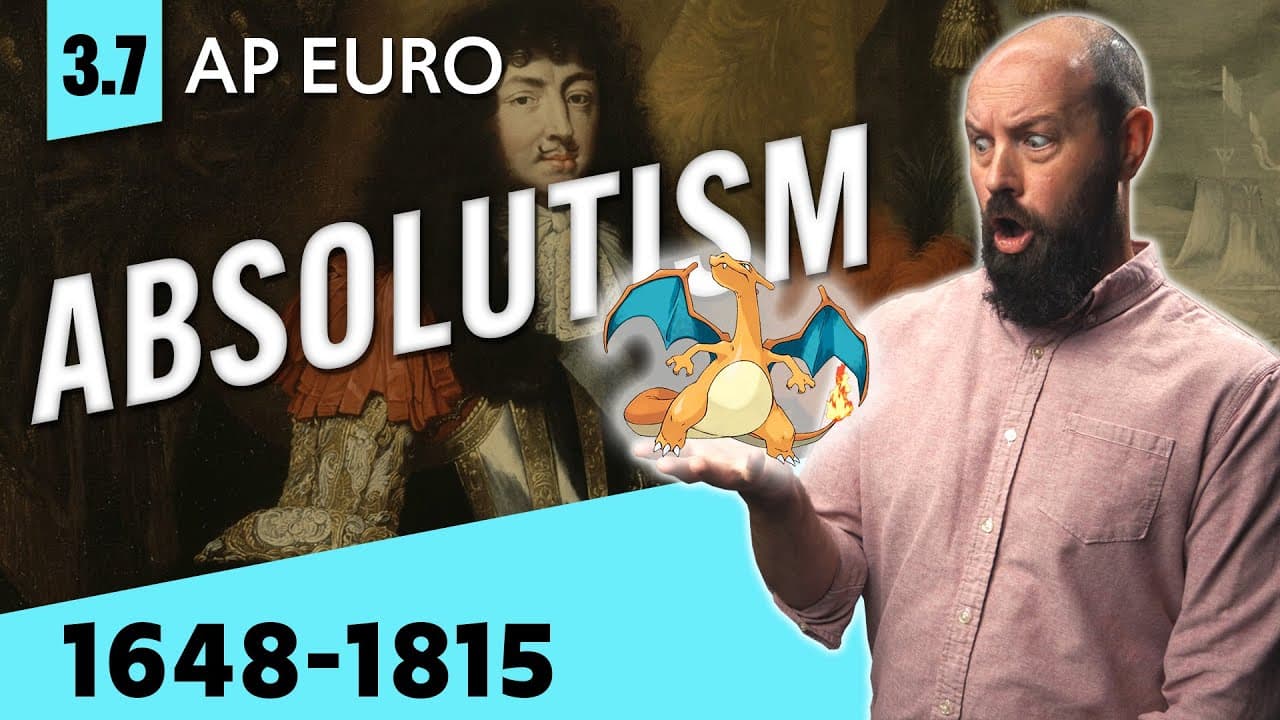
we've talked about everything in this unit except the rise of absolutist rulers in the period 1648 to 1850. so let me put it this way if the kings of the Middle Ages were like Charmander and the new monarchs of the 16th and 17th centuries were like Charmeleon than the kings of this period are like the first edition shadowless holographic Charizard ... Read More
Key Insights
- Absolutism is the process by which political power moved away from the nobility and church and toward the monarch. In an absolute state, the ruler held most political authority and used centralized institutions to reduce the independence of traditional competing powers.
- Religious change helped absolutism emerge because the Catholic Church's influence weakened as Protestant practice gained acceptance. After the Peace of Westphalia, declining interest in religious warfare also created conditions in which monarchs could concentrate more authority within the state.
- Expanding merchant classes supported absolute monarchs in some measure because centralized rulers could provide economic and political stability during a period of global trade. This support helped monarchs strengthen governments while commercial activity and state administration expanded together.
- Centralized bureaucracy weakened nobles by transferring administrative responsibilities to officials who answered directly to the monarch. Unlike powerful nobles, royal bureaucrats depended on the ruler's authority, allowing monarchs to enforce policies more consistently across their territories.
- James I's absolutist ambitions failed because England's political traditions limited royal authority. His belief in divine right encouraged him to spend money without parliamentary approval, but Parliament resisted, and England ultimately fought a civil war that established limited monarchical power.
- Louis XIV controlled French nobles through Versailles and elaborate court rituals. Requiring nobles to live there for part of each year allowed him to observe them, while competition for proximity and royal favor redirected their ambitions toward court status and cooperation.
- Religious uniformity under Louis XIV involved revoking the Edict of Nantes in 1685 and removing protections for Huguenots. Hundreds of thousands migrated to more tolerant states, depriving France of a substantial portion of its merchant class.
- Peter the Great westernized Russia by reshaping political, cultural, and religious institutions. He placed nobles in military or administrative service, promoted officials through ranks, imposed Western appearance standards, replaced the Orthodox patriarch with the Holy Synod, and tripled taxes to fund the transformation.
Install to Summarize YouTube Videos and Get Transcripts
Explore YouTube Video Summarizer or Get YouTube Transcript Extractor
Questions & Answers
Q: What is absolutism in European history?
Absolutism is the process through which political authority shifted away from the nobility and church and toward the monarch. Absolute rulers sought to hold most power within their states. They commonly strengthened centralized administration, made officials answerable directly to the crown, restricted rival institutions, and used religious, economic, cultural, or military policies to enforce royal authority.
Q: Why did absolutism rise after the Peace of Westphalia?
Absolutism rose partly because the Catholic Church's influence had weakened amid growing acceptance and tolerance of Protestant practice. After the Peace of Westphalia, Europeans also showed less interest in continued religious warfare. At the same time, rapidly expanding merchant classes sometimes favored monarchs who could offer the political and economic stability needed during a period of global trade.
Q: How did royal bureaucracies weaken the nobility?
Royal bureaucracies took over administrative work that nobles had previously performed in many European states. The crucial difference was accountability: bureaucrats answered directly to the king, while nobles were less firmly under royal control. By appointing large numbers of dependent officials, monarchs could enforce policies throughout their kingdoms and reduce the political independence of local aristocratic authorities.
Q: Why did James I fail to establish absolutism in England?
James I embraced divine right, the belief that royal authority came from God and that a king was answerable only to God. He therefore attempted to spend money without Parliament's approval. England, however, had the Magna Carta, ratified in 1215, which officially limited monarchical power. Parliamentary resistance persisted, and civil war eventually established a limited monarchy.
Q: How did Louis XIV use Versailles to control nobles?
Louis XIV required French nobles to reside at Versailles for at least part of each year, allowing him to observe their conduct closely. He also established elaborate court rituals that encouraged nobles to compete for proximity to the king and for royal favor benefiting themselves and their regions. This competition redirected aristocratic ambition and helped secure noble loyalty and cooperation.
Q: How did Louis XIV enforce religious uniformity in France?
Louis XIV pursued Catholic uniformity by revoking the Edict of Nantes in 1685. That edict had provided an unusual degree of tolerance and protection for France's Protestant Calvinist minority, the Huguenots. Once those protections disappeared, hundreds of thousands migrated to more tolerant states. Their departure deprived France of a healthy portion of its merchant class.
Q: How did mercantilism support Louis XIV's rule?
Louis XIV's finance minister, Jean-Baptiste Colbert, organized the French economy according to mercantilist policy to support the king's wars and state power. These measures decreased French debt, revived domestic industries, expanded colonial holdings, and created a favorable balance of trade. However, Louis's repeated wars of conquest cost enormous sums and undid much of Colbert's financial work.
Q: How did Peter the Great westernize Russia?
Peter the Great required nobles to serve in the army or civil administration and created ranks through which capable experts could advance. He ordered nobles to shave their beards and wear Western clothing, while allowing beards through a tax. He also replaced the Orthodox patriarch with a compliant Holy Synod and tripled taxes, making his reforms unpopular among peasants.
Summary & Key Takeaways
-
Absolutism emerged as monarchs acquired authority previously exercised by nobles and churches. The Catholic Church weakened as Protestant practice gained acceptance and enthusiasm for religious warfare declined after the Peace of Westphalia. Expanding merchant classes also supported rulers who could offer the economic and political stability needed during a period of global trade.
-
Louis XIV centralized France through intendants, Versailles, religious uniformity, and wars of expansion. Intendants enforced royal policy and weakened local authorities, while court life at Versailles made nobles compete for royal favor. Revoking protections for Huguenots advanced Catholic uniformity but drove hundreds of thousands away, including many members of the merchant class.
-
Peter the Great sought to westernize a Russia still organized according to medieval standards. He required nobles to serve in the military or civil administration, created a hierarchy of ranks, imposed Western clothing and grooming practices, reorganized the Orthodox Church under the Holy Synod, and tripled taxes to finance his reforms.
-
Key Insights
-
Q_and_A
Read in Other Languages (beta)
Share This Summary 📚
Summarize YouTube Videos and Get Video Transcripts with 1-Click
Try YouTube Summary with ChatGPT & Claude or YouTube Transcript Generator
Explore More Summaries from Heimler's History 📚

Summarize YouTube Videos and Get Video Transcripts with 1-Click
Try YouTube Summary with ChatGPT & Claude or YouTube Transcript Generator