AP Euro Unit 1 Review: How Did Renaissance Ideas Transform Europe?
TL;DR
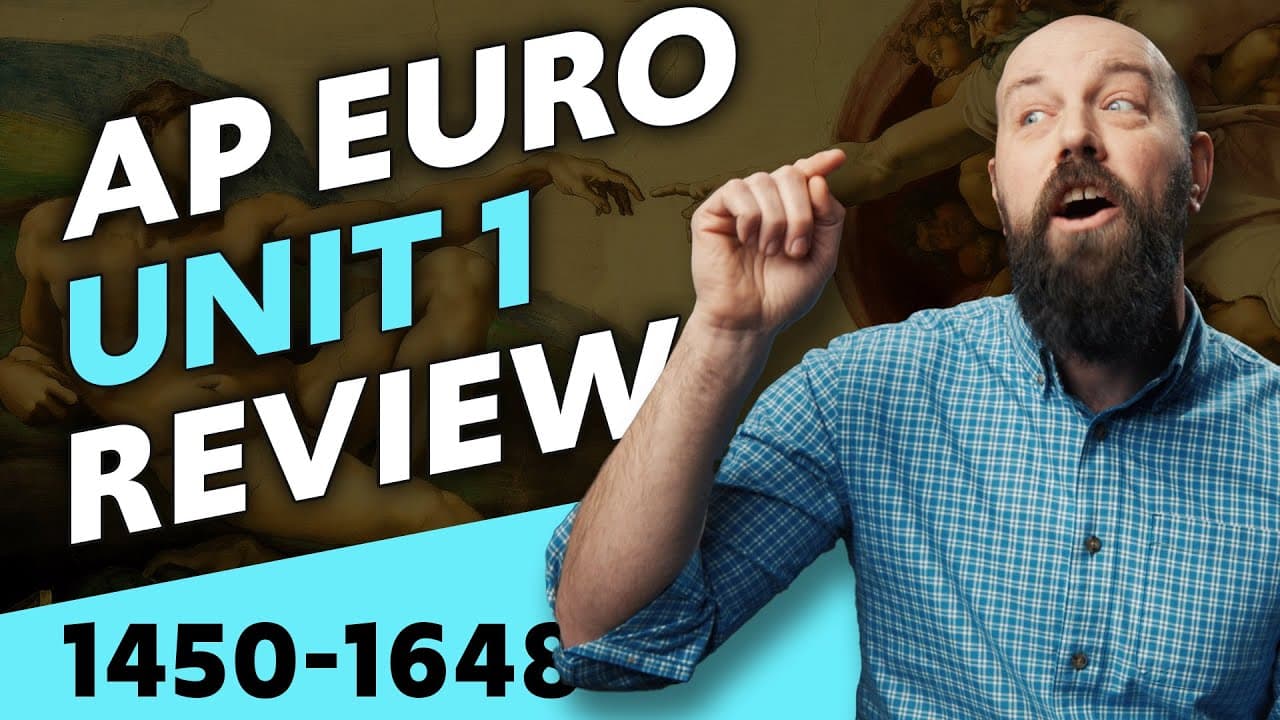
Renaissance ideas transformed Europe by reviving classical Greek and Roman learning and promoting humanism, individual achievement, secular inquiry, realistic art, and new approaches to education and government. Beginning in Italy, these ideas spread rapidly after the movable-type printing press emerged in the 1440s and became more Christian and reform-oriented in northern Europe. Read on to see how key thinkers, methods, and artworks drove these changes.
Transcript
all right if you need a review of the whole dang first unit of ap euro then you are in the right place so if you're ready to get them brain cows milked let's get to it now the first thing we need to talk about is the renaissance and it's a word that means rebirth and that means that something which has died has come back to life so what died and wh... Read More
Key Insights
- The Renaissance was a rebirth of classical Greek and Roman texts and ideas that began in Italy after Europeans regained access to ancient learning preserved and translated by Islamic scholars. Increased contact between Europeans and Islamic peoples during the Crusades also contributed to this intellectual recovery.
- Humanism was a philosophy centered on the unlimited potential of human beings as ends in themselves. Petrarch laid much of its intellectual groundwork, while individualism emphasized the achievements of particular people and became another major feature of Renaissance thought and culture.
- Philology was the study of the history and development of languages, and it offered a method for questioning inherited authority. In 1440, Lorenzo Valla used differences in Latin structure to demonstrate that a document attributed to the fourth-century emperor Constantine was a forgery.
- Renaissance education was reshaped by classical learning and humanistic reasoning. Scholars introduced humanities subjects such as history, moral philosophy, and poetry, while Castiglione argued that an educated gentleman should speak and write eloquently, possess physical strength, and remain mentally alert.
- Civic humanism was the belief that educated men should participate actively in local political life. It drew upon classical political examples and represented a major departure from the feudal structures associated with the Middle Ages, particularly within Italy's city-states and self-governing communities.
- Machiavelli's political theory was based on a ruler maintaining power, order, and security through whatever conduct served those objectives. He argued that fear could be safer than love, but also warned that a prince should avoid becoming hated by the people.
- Renaissance art was distinguished by naturalism, geometric perspective, classical influences, and a broader range of subjects. Michelangelo idealized the human form, Raphael created depth while depicting classical thinkers, and Brunelleschi revived Roman architectural elements and engineered a self-supporting cathedral dome.
- Christian humanism was the northern European synthesis of humanist learning with Christian belief and scriptural authority. Erasmus connected education in the classics and the Bible with social reform, and his satire In Praise of Folly criticized corrupt political and social institutions.
Install to Summarize YouTube Videos and Get Transcripts
Explore YouTube Video Summarizer or Get YouTube Transcript Extractor
Questions & Answers
Q: What caused the Renaissance to begin in Europe?
The Renaissance began as Europeans recovered classical Greek and Roman texts and ideas. Islamic scholars had preserved and translated many ancient works, while increased contact during the Crusades helped Europeans regain access to them. This revival of classical learning began in Italy.
Q: What was humanism during the Renaissance?
Humanism was a philosophy centered on the unlimited potential of human beings as ends in themselves. Petrarch laid much of its groundwork through his engagement with classical writings, including Cicero. Alongside individualism, it directed attention toward individual achievement and human capability.
Q: How did philology challenge established authority?
Philology examined the history, development, and structure of languages, allowing scholars to test inherited claims. In 1440, Lorenzo Valla showed that a document attributed to the fourth-century emperor Constantine used Latin that did not conform to fourth-century standards. He therefore demonstrated that the supposedly authoritative document was a forgery.
Q: How did the Renaissance change European education?
Renaissance education expanded beyond the theological questions that had dominated medieval scholarship. Humanists introduced subjects such as history, moral philosophy, and poetry based on classical texts. In The Courtier, Baldassare Castiglione argued that an educated gentleman should speak and write eloquently, be physically strong, and remain mentally alert.
Q: What was civic humanism in Renaissance Italy?
Civic humanism held that educated men should participate actively in local politics. It developed in Italy's city-states, regional kingdoms, and self-governing communities as classical political ideas influenced public life. This approach marked a major shift from medieval feudal structures.
Q: What did Machiavelli argue in The Prince?
Machiavelli argued that a ruler's basic function was to maintain power, order, and security. A prince should act benevolently when that worked but use harsher conduct when necessary. He considered fear safer than love while warning rulers to avoid becoming hated.
Q: How was Renaissance art different from medieval art?
Renaissance art emphasized naturalism, geometric perspective, classical influences, and realistic human representation, whereas medieval art was flatter, more symbolic, and focused mainly on religion. Renaissance artists also broadened their subjects to include personal, political, and classical material. Michelangelo idealized the human form, Raphael created depth around classical thinkers, and Brunelleschi revived Roman architectural elements.
Q: How did the Northern Renaissance differ from the Italian Renaissance?
The Northern Renaissance retained classical learning and humanism but gave them a more explicitly Christian and reform-oriented emphasis than the more secular Italian movement. Christian humanists combined classical education with Christian belief and scriptural authority. Erasmus used In Praise of Folly to criticize corrupt political and social institutions.
Summary & Key Takeaways
-
The Renaissance was a rebirth of classical Greek and Roman texts and ideas that began in Italy. Islamic scholars preserved and translated ancient works, while increased contact during the Crusades helped Europeans regain access. Petrarch then laid foundations for humanism, which emphasized human potential, individual achievement, and classical models of language and politics.
-
Renaissance thinking transformed education, scholarship, and government. The humanities expanded learning beyond medieval theological concerns, philology enabled scholars such as Lorenzo Valla to challenge authoritative documents, and civic humanism encouraged educated men to participate in politics. Machiavelli further separated political leadership from traditional biblical virtues by emphasizing order, security, and maintaining power.
-
Renaissance art pursued naturalism, idealism, geometric perspective, classical themes, and realistic human representation. Michelangelo, Raphael, and Brunelleschi demonstrated these qualities through sculpture, painting, and architecture. As Renaissance ideas moved north through printing, Christian humanists such as Erasmus combined classical education with scriptural authority and used satire to advocate social reform.
Read in Other Languages (beta)
Share This Summary 📚
Summarize YouTube Videos and Get Video Transcripts with 1-Click
Try YouTube Summary with ChatGPT & Claude or YouTube Transcript Generator
Explore More Summaries from Heimler's History 📚
Summarize YouTube Videos and Get Video Transcripts with 1-Click
Try YouTube Summary with ChatGPT & Claude or YouTube Transcript Generator