How Did New Monarchs Consolidate Power?
TL;DR
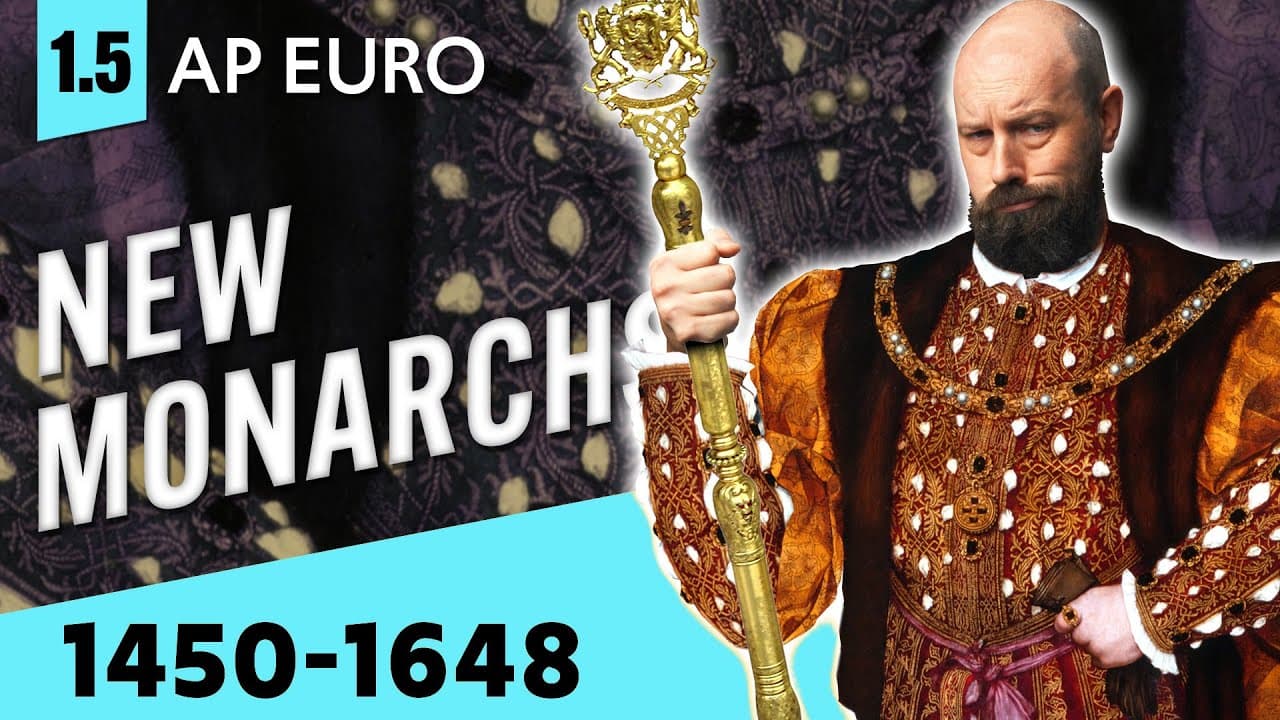
New monarchs consolidated authority by weakening nobles and the church, directing religious policy, controlling taxation, and expanding bureaucracies that enforced laws. England, Spain, France, and the Holy Roman Empire illustrate this transition, while powerful banking families and competing theories of secular government also reshaped European political life.
Transcript
if you've ever seen a movie set during the feudal period of europe which is to say the middle ages you've probably seen the king portrayed as all-powerful i'm the king and i do whatever i want but that is not how power worked in those days instead kings shared powers with their nobles and to some degree the church and if you asked which of those th... Read More
Key Insights
- New monarchs were rulers who consolidated authority under the crown by taking power from nobles and the church. Their power exceeded that of medieval kings, who shared authority with these groups, but it remained below the power later associated with absolutist monarchs.
- Henry VIII consolidated royal authority by becoming head of the Church of England after the pope rejected his desired annulment. Parliament recognized the new state church, and the Treason Act made refusal to acknowledge it a capital crime, forcing remaining Catholics to conceal their beliefs.
- Elizabeth I strengthened Anglicanism through top-down religious reform after Mary Tudor had attempted to return England to Catholicism. Elizabeth ended the persecution of Anglican bishops and used the Act of Uniformity to require weekly Anglican church attendance, with fines imposed for noncompliance.
- Bureaucracy is a body of officials responsible for ensuring that laws are executed. New monarchs expanded bureaucracies because rulers could not personally collect taxes or administer justice across their territories, so appointed officials connected royal commands with local enforcement and the national treasury.
- Ferdinand and Isabella centralized Spanish authority by creating national taxes on the sale or exchange of property. They also established a large bureaucracy that collected those taxes and decided questions of justice, placing important financial and legal responsibilities under monarchical control.
- The Concordat of Bologna was a 1516 agreement between Francis I and Pope Leo X. The pope received the right to collect income from the French Catholic Church, while Francis gained authority to appoint church officials and restricted their ability to communicate directly with the pope.
- The Peace of Augsburg gave individual Holy Roman Empire rulers the authority to choose Catholicism or Lutheranism for their subjects in 1555. This arrangement increased rulers' control over religion by making the recognized Christian confession of their territories a political decision.
- Secular state theory reduced or removed church influence from political government. Machiavelli supported republicanism, where elected representatives govern with consent, while Jean Bodin favored an absolute monarchy whose king claimed divine right and ruled as a substitute for God.
Install to Summarize YouTube Videos and Get Transcripts
Explore YouTube Video Summarizer or Get YouTube Transcript Extractor
Questions & Answers
Q: What were the new monarchs of early modern Europe?
New monarchs were rulers who increased royal authority by transferring power away from nobles and the church and placing it under the crown. Medieval kings had shared substantial power with both groups, especially a dominant nobility. The new monarchs were more powerful than their medieval predecessors, although they had not yet reached the level of later absolutist rulers.
Q: How did religious reform help new monarchs consolidate power?
Top-down religious reform allowed monarchs to determine official worship, control church leadership, and enforce religious conformity through state law. Henry VIII established royal leadership over the Church of England, Mary Tudor attempted to restore Catholicism, and Elizabeth I restored Anglicanism. These policies turned religious organization into an instrument of monarchical authority rather than independent church power.
Q: Why did Henry VIII establish the Church of England?
Henry VIII sought an annulment from Catherine of Aragon because she had not produced a surviving male heir. The pope denied the request after pressure from Catherine's parents, the Catholic monarchs of Spain. Henry divorced Catherine, married the pregnant Anne Boleyn, and accepted Parliament's law making him head of the Church of England.
Q: How did the Treason Act strengthen Henry VIII's authority?
The Treason Act made refusal to recognize the Church of England as the official state church a capital crime. Because Henry VIII headed that church, recognition of the religious settlement also meant recognition of royal authority. Many English people remained Catholic, but the law forced them to keep their religious allegiance private rather than openly challenge the crown's church.
Q: How did taxation and bureaucracy increase monarchical power?
Taxation supplied monarchs with national revenue, while bureaucracies gave them officials who could execute laws, collect payments, and administer justice. A ruler could not personally travel from household to household to gather taxes. Bureaucratic officials therefore extended royal authority throughout a territory and moved collected revenue into the national treasury under centralized direction.
Q: What did the Concordat of Bologna give Francis I?
The Concordat of Bologna, agreed in 1516 by Francis I and Pope Leo X, gave Francis the right to appoint church officials in France. It also restricted those officials' right to communicate directly with the pope. In return, the pope retained the right to collect income from the French Catholic Church, creating a negotiated division of authority.
Q: What did the Peace of Augsburg establish in 1555?
The Peace of Augsburg gave individual rulers within the Holy Roman Empire the right to decide whether their subjects would follow Catholicism or Lutheranism, the earliest strain of Protestantism. The available choice was between these forms of Christianity. The agreement strengthened territorial rulers by placing recognized religious affiliation under their political authority rather than individual choice.
Q: How did bankers and secular political theories reshape power?
Merchants and bankers gained influence because the growing money economy directed wealth through their institutions. The Medici family became powerful bankers in Florence, while the Fugger family established banking in Augsburg and the German states. Close alliances with monarchs increased their political role. Secular thinkers also debated republican government and absolute monarchy without centering church authority.
Summary & Key Takeaways
-
New monarchs emerged as European rulers transferred authority away from nobles and the church toward the crown. They did not yet possess the sweeping control associated with later absolutist monarchs, but their religious policies, taxation systems, and administrative institutions placed European government on a path toward stronger centralized royal rule.
-
English rulers used religious policy to reinforce political authority. Henry VIII became head of the Church of England, while the Treason Act punished refusal to recognize the state church. Mary Tudor attempted to restore Catholicism, and Elizabeth I returned England to Anglicanism while requiring weekly Anglican attendance through the Act of Uniformity.
-
Monarchs also strengthened taxation and bureaucracy, while merchants and bankers gained political influence through alliances with rulers. The Medici and Fugger families benefited from the growing money economy. Meanwhile, secular government inspired competing theories, with Machiavelli supporting republicanism and Jean Bodin favoring absolute monarchy based on divine right.
Read in Other Languages (beta)
Share This Summary 📚
Summarize YouTube Videos and Get Video Transcripts with 1-Click
Try YouTube Summary with ChatGPT & Claude or YouTube Transcript Generator
Explore More Summaries from Heimler's History 📚


Summarize YouTube Videos and Get Video Transcripts with 1-Click
Try YouTube Summary with ChatGPT & Claude or YouTube Transcript Generator