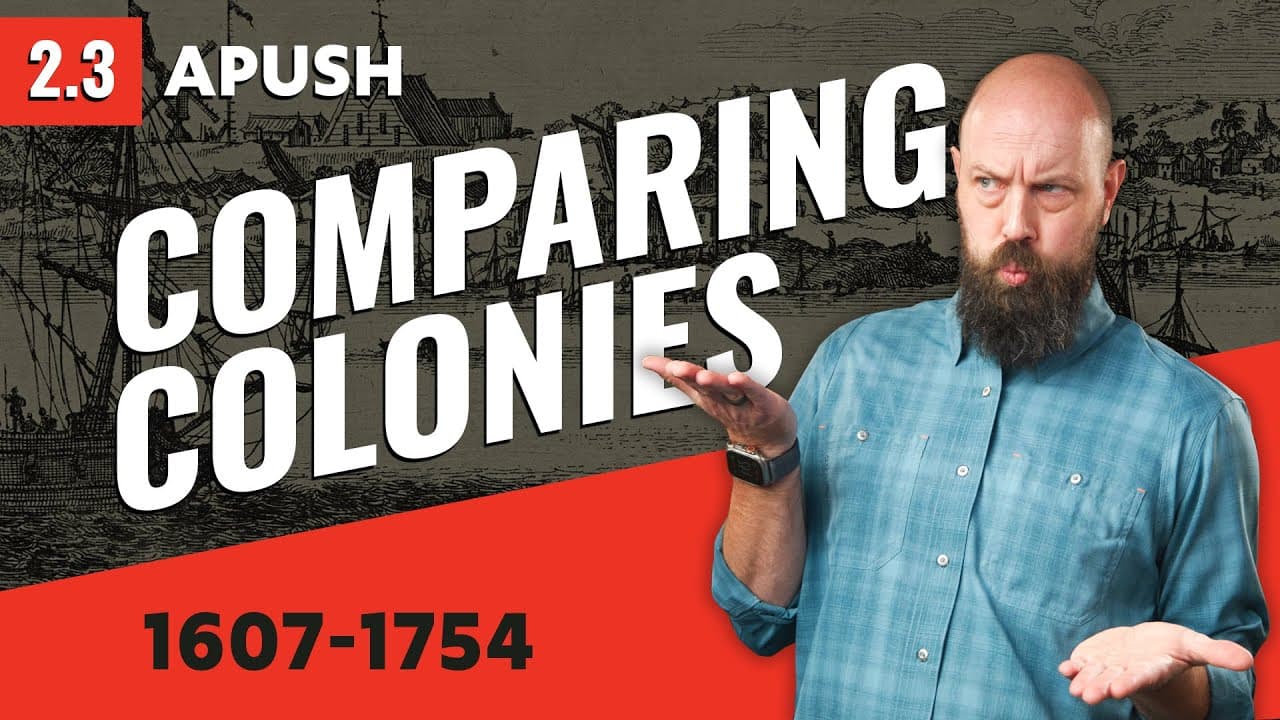
How did the four British colonies differ in America
TL;DR
The four regions developed unique societies due to geography, religion, and governance. New England stressed religion and family towns with a mixed economy of fish and lumber, while the middle colonies grew trade and grain with religious diversity. Each region shaped its laws and culture around local conditions and beliefs.
Transcript
Well, I reckon you're here because you want to learn how to compare the similarities and differences of the four regions of the British colonies in North America. And wouldn't you know it, that's exactly what I want to talk about. So, if you're ready to get them brain cows milked, let's get to it. All right. Now, I can see you're positively stoked ... Read More
Key Insights
- New England society was deeply religious and family based, with church and state tightly linked.
- The Mayflower Compact introduced early democratic elements within a religious colony.
- Massachusetts and Plymouth merged later, but Puritan intolerance led to notable dissenters who founded Rhode Island.
- The Middle Colonies featured diverse populations and strong river-based trade networks.
- New York transitioned from Dutch to English control, retaining commercial priorities and port strength.
- Pennsylvania was founded by William Penn with Quaker ideals emphasizing inner light and pacifism.
- Pennsylvania promoted religious freedom and elected assemblies, attracting a broad immigrant base.
- Colonial regions differed in governance, economy, and social norms, yet shared British roots and Atlantic trade links.
- More videos from this channel:
- More from this channel: Heimler's History
Install to Summarize YouTube Videos and Get Transcripts
Explore YouTube Video Summarizer or Get YouTube Transcript Extractor
Questions & Answers
Q: How did Puritans shape governance in New England colonies?
Puritans in New England established a system where governance was church centered and decisions were made in town meetings by freemen who owned property. This created a democratic style within a religious framework, emphasizing majority will and community oversight while excluding many who did not fit the Puritan model. The result was a tightly knit, church-anchored society.
Q: What role did the Mayflower Compact play in early colonial governance?
The Mayflower Compact was an agreement among the Plymouth settlers to form a simple government based on the will of the majority. It established the practice of self-government within a colonial context, even though it was limited to elite adult males. It laid groundwork for voluntary political collaboration and local rule in the New World.
Q: How did Rhode Island originate in response to Puritan intolerance?
Rhode Island originated when Roger Williams, banished for his religious views, founded a colony that welcomed religious dissenters and separated church from state. This created a haven for tolerance and individual conscience, contrasting with the stricter Puritan framework in Massachusetts and shaping Rhode Island as a liberal refuge within the region.
Q: What was distinctive about the middle colonies’ economy and demographics?
The middle colonies featured diverse immigrant populations and strong river valleys supporting grain production and export. Their geography and ports fostered robust trade networks, leading to a more pluralistic society with less religious conformity compared to New England. This mix of cultures and economic activity defined their regional character.
Q: How did New York retain economic and cultural characteristics after English takeover?
After the English took New York from the Dutch, the colony retained its commercial focus, port strength, and diverse population. The geography of rivers and bays supported grain exports, and the presence of a variety of cultures continued to shape a bustling, cosmopolitan society within a British imperial framework.
Q: What made Pennsylvania’s governance notable in the colonial period?
Pennsylvania stood out for its Quaker leadership under William Penn, emphasizing inner religious guidance, pacifism, and religious tolerance. It relied on an elected assembly and offered broad freedoms in worship, contributing to a democratic and diverse social fabric while maintaining practical governance for an expanding colonial economy.
Q: How did religious beliefs influence New England’s economy and social life?
Religious beliefs in New England guided social life and economic activity, prioritizing community order, family-centered towns, and agricultural practices compatible with their harsh climate. The church played a central role in education and civic life, while the settlement’s export economy focused on fish and timber, reflecting a society that tied religion to daily living.
Q: Why did the colonial regions differ in their treatment of Indigenous peoples?
Differences in colonial attitudes toward Indigenous peoples arose from local governance, religious beliefs, and economic needs. Some regions pursued more cooperative diplomacy, especially Pennsylvania with its pacifist Quaker influence, while others maintained tighter religious conformity and stricter borders, shaping varying policies and relationships with Indigenous communities across the colonies.
Summary & Key Takeaways
-
The New England region built a religiously centered society with town meetings and a Puritan influence, relying on limited agriculture and exporting fish and timber.
-
The middle colonies combined diverse populations, strong ports, and grain production, creating a more tolerant and economically varied society.
-
Pennsylvania stood out with Quaker-led governance, religious tolerance for many, and peaceful relations with indigenous peoples, shaping a relatively democratic framework and broad economic growth.
Read in Other Languages (beta)
Share This Summary 📚
Summarize YouTube Videos and Get Video Transcripts with 1-Click
Try YouTube Summary with ChatGPT & Claude or YouTube Transcript Generator
Explore More Summaries from Heimler's History 📚

Summarize YouTube Videos and Get Video Transcripts with 1-Click
Try YouTube Summary with ChatGPT & Claude or YouTube Transcript Generator