What Were the Articles of Confederation’s Weaknesses and Aftermath
TL;DR
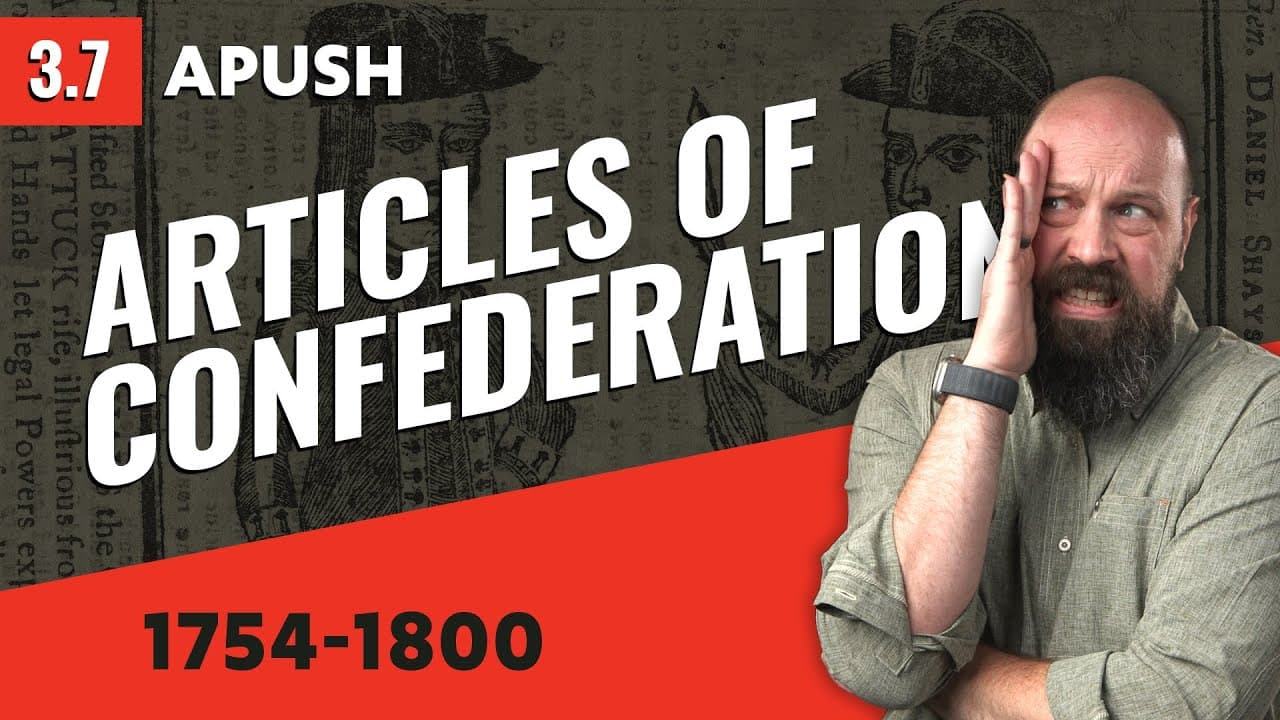
The Articles of Confederation created a weak central government with no tax power, no national court, and no national army, while leaving most power to the states. This video explains the five major problems, the Northwest Ordinance as a limited achievement, and why a new constitution was needed to resolve interstate and foreign issues.
Transcript
Okay, so the American Revolution is won and now it's time to create some brand spanking new state and federal governments here in these United States. And I don't know about you, but I am so down to talk about that. So, if you're ready to get them brain cows milked, let's get to it. Okay. Now, as a result of declaring independence in 1776, each sta... Read More
Key Insights
- The early state constitutions often centralized power in legislatures, limited executive authority, and guaranteed a bill of rights in Virginia as a model.
- The franchise was generally restricted to white male property owners, reflecting property as a proxy for investment and governance participation.
- State constitutions commonly banned titles of nobility as part of Enlightenment influence against aristocracy.
- The Articles of Confederation created a central government that was deliberately weak, lacking an executive, a national court, and the power to tax or raise an army.
- Congress under the Articles could not fund war debts or regulate interstate commerce, leading to economic and security vulnerabilities.
- Foreign relations suffered as Britain and Spain restricted trade and navigation while the federal government could not respond effectively.
- Shays rebellion illustrated the Articles central weakness by showing the federal government could not quell internal unrest.
- The Northwest Ordinance of 1787 was a notable achievement, establishing governance rules for new territories and banning slavery there, signaling a pathway to statehood.
- More videos from this channel:
- More from this channel: Heimler's History
Install to Summarize YouTube Videos and Get Transcripts
Explore YouTube Video Summarizer or Get YouTube Transcript Extractor
Questions & Answers
Q: What is the basic problem with the Articles of Confederation as described in the video?
The basic problem is that the Articles kept the federal government very weak by design, with no executive, no national court, and no power to tax. This meant Congress could not pay war debts, regulate interstate commerce, or raise a national army, making it hard to address domestic or international challenges.
Q: Why were state constitutions described as limiting the franchise to white male property owners?
The video explains this as a common practice reflecting the era's belief that those who owned property invested in society and should have voting influence. It ties this to the broader Enlightenment rejection of hereditary power and the idea that property ownership signaled stake in governance.
Q: What role did the Northwest Ordinance of 1787 play according to the video?
The Northwest Ordinance organized unsettled western land, reserved land for schools, banned slavery in the territories, and laid out rules for how territories could become states. It is presented as a successful federal action that contrasted with the overall weaknesses of the Articles.
Q: How did foreign relations expose the weaknesses of the Articles?
Great Britain kept forts on the Western Frontier and Spaniards restricted access to the Mississippi, while the Articles could not raise an army or respond effectively. This demonstrated the central government’s inability to protect trade and security, undermining the young nation’s interests.
Q: What is Shays rebellion’s significance in the video?
Shays rebellion exposed the failure of the Articles to respond to internal unrest and pay veterans, highlighting the inability of the central government to raise or fund an army to quell uprisings. It underscored the urgent need for a stronger, more capable national framework.
Q: What was the composition of the federal government under the Articles?
Under the Articles, the federal government consisted mainly of a single legislative body with no separate executive or judiciary, reflecting a preference for local control and fear of centralized power among the states.
Q: Why was unanimous consent required for some decisions under the Articles, and why was this a problem?
Unanimous consent was required to pass certain measures like tax collection where nine or more votes were insufficient. This created a built in deadlock, making it nearly impossible to address financial needs or national priorities, and showing why the Articles were structurally weak.
Q: What did the video imply about the shift from the Articles to a new constitution?
The video implies a shift due to accumulated weaknesses in taxation, security, and commerce, plus foreign and internal challenges demonstrated by events like Shays rebellion. This led to recognizing the need for a stronger central government to unify the states and handle external threats.
Summary & Key Takeaways
-
The video reviews state constitutions after independence, highlighting Virginia and other states adopting bills of rights and property-based suffrage, while many rights were restricted to white male property owners. It explains why governance favored legislatures and decentralized power to avoid centralized authority.
-
It covers the Articles of Confederation as the first federal framework, noting its weak structure, lack of executive and judicial branches, and the inability to tax or raise an army, which exposed the fragile union.
-
It ends with the Northwest Ordinance of 1787, which organized western territories, reserved land for schools, banned slavery in those territories, and showed a limited but important federal achievement before reform.
Read in Other Languages (beta)
Share This Summary 📚
Summarize YouTube Videos and Get Video Transcripts with 1-Click
Try YouTube Summary with ChatGPT & Claude or YouTube Transcript Generator
Explore More Summaries from Heimler's History 📚
Summarize YouTube Videos and Get Video Transcripts with 1-Click
Try YouTube Summary with ChatGPT & Claude or YouTube Transcript Generator