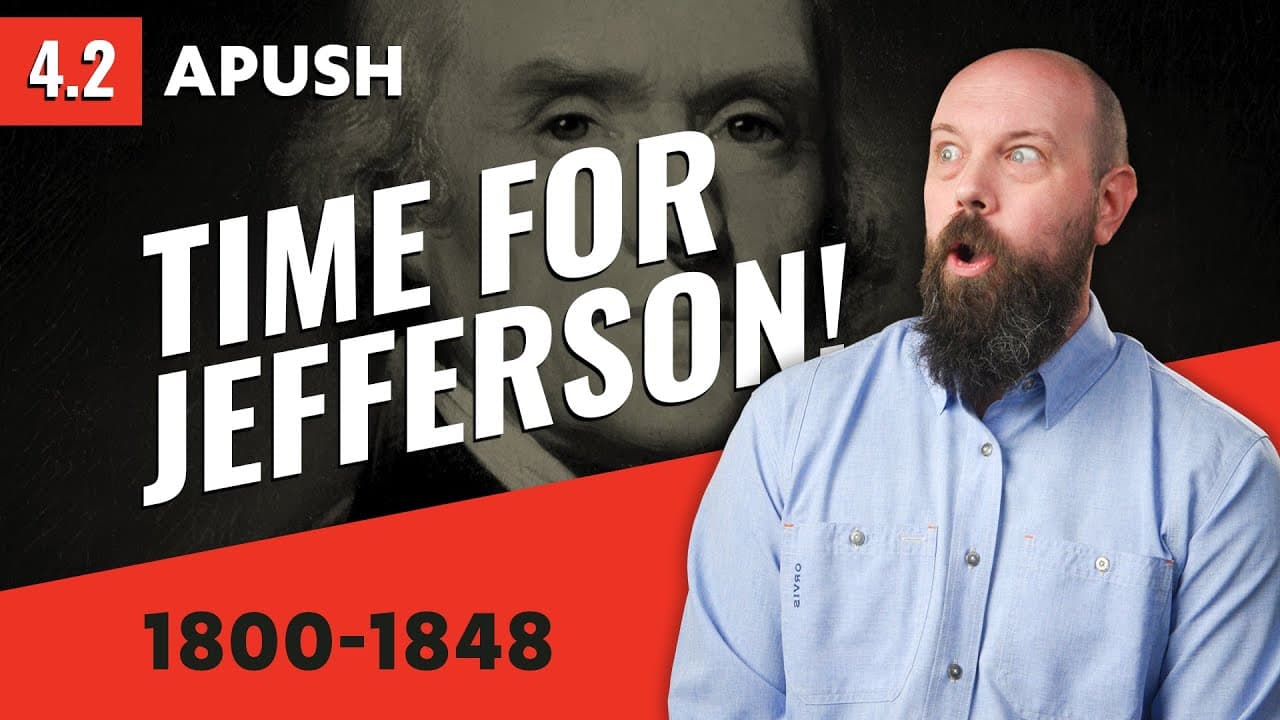
What Is the Jefferson Era conflict between Federalists and Democratic Republicans?
TL;DR
The Federalists and Democratic Republicans clashed over how far the federal government should reach into policy and daily life. Jefferson started with strict limits on power, but his actions in the Louisiana Purchase and embargos broadened federal authority. The era also saw the Supreme Court expanding its own power under Marshall, reshaping early US governance.
Transcript
Okay. Well, it's the era of Jefferson and that means there's all kinds of debates about the proper scope and role of the federal government in the toddler years of America. And I don't think it's too much to say that these debates were pretty dang juicy. So, if you're ready to get them brain cows milked, let's get to it. Okay, so Thomas Jefferson w... Read More
Key Insights
- The Federalists were loose constructionists who believed the federal government could exercise powers not explicitly stated in the Constitution.
- The Democratic Republicans were strict constructionists who argued the federal government may only act when explicitly authorized by the Constitution.
- Jefferson won the election of 1800, marking a peaceful transfer of power between rival parties, a historical first in world history up to that point.
- The Louisiana Purchase doubled US territory and required Jefferson to accept a broad federal power not clearly authorized by the Constitution.
- The purchase surprised Jefferson, who was committed to strict constructionism, highlighting a real tension between principle and practical expansion of federal power.
- The Lewis and Clark expedition and the Pike expeditions extended federal reach by exploring and mapping new territory, informing future statehood decisions.
- The Embargo Act of 1807 aimed to pressure Britain and France by halting trade, but it burdened the US economy and tested Jefferson’s constitutional arguments about power.
- John Marshall’s Supreme Court decisions strengthened judicial power and established the Court as a co-equal branch with the other two.
- Marbury v. Madison (1803) helped set the precedent for judicial review, increasing the practical power of the judiciary.
- More videos from this channel:
- More from this channel: Heimler's History
Install to Summarize YouTube Videos and Get Transcripts
Explore YouTube Video Summarizer or Get YouTube Transcript Extractor
Questions & Answers
Q: What is the key difference between loose and strict constructionists in this era?
Loose constructionists believe the federal government can use powers not explicitly listed in the Constitution if they are implied by the necessary and proper clause, allowing actions like creating a national bank. Strict constructionists insist that the federal government may only do what the Constitution expressly authorizes. This fundamental divide shaped debates on policy like the National Bank and set the stage for Jefferson’s presidency.
Q: How did Jefferson’s election in 1800 represent a peaceful transfer of power, and why is that significant?
Jefferson’s election marked a peaceful transfer of power between rival political factions, which was remarkable at the time because such exchanges were often accompanied by conflict. The event demonstrated a functioning democratic system where new leadership could come to power without violence, reinforcing the legitimacy of constitutional processes and the resilience of the young republic.
Q: Why did Jefferson expand federal power despite his strict principles, particularly with the Louisiana Purchase?
Although Jefferson favored an agrarian republic and limited government, the Louisiana Purchase offered vast land for settlement and economic opportunity that aligned with his goals for national growth. He ultimately embraced the purchase because it fulfilled the vision of an agrarian nation, even though it required accepting a broader federal mandate than strict constructionists would typically allow.
Q: What role did exploration plays have in increasing federal power under Jefferson?
Explorations led by Lewis and Clark and Zebulon Pike mapped and documented new territories, information that helped inform future statehood decisions and managed relations with other European powers. By enabling these expeditions, the federal government extended its reach and gathered critical data that supported governance and strategic planning in the expanding United States.
Q: What were the consequences of the Embargo Act of 1807 for the American economy and political debate?
The Embargo Act aimed to compel Britain and France to respect US neutrality by cutting off international trade, but it inflicted economic hardship on Americans who relied on trade. The act intensified debates over federal power, illustrating that broad economic measures could backfire domestically and challenge the political viability of strict constructionist policies.
Q: How did the Marshall Court change the balance of power among government branches?
Under Chief Justice John Marshall, the Supreme Court asserted greater authority and claimed a co-equal role with the other branches. Decisions like Marbury v. Madison established judicial review, enabling the Court to check and balance actions by the executive and legislative branches and shape the interpretation of federal power for generations.
Q: What does the comparison of the National Bank illustrate about constitutional interpretation during this era?
The debate over the National Bank illustrates the core constitutional clash between loose and strict interpretation. Proponents argued that implied powers, via the necessary and proper clause, justified federal action, while opponents insisted that only powers explicitly granted to the federal government could be exercised. This tension defined policy choices and political alignments of the period.
Q: How did Jefferson reconcile his desire for limited government with practical governance in a growing country?
Jefferson sought to keep federal power in check while pursuing actions necessary for national growth, such as land acquisition, exploration, and stabilizing the economy when required. His approach shows a practical balance between ideal constitutional limits and the realities of governing a large, expanding republic, accepting some centralized powers to achieve strategic objectives.
Summary & Key Takeaways
-
The video explains the transition of power in 1800 and compares Federalist and Democratic Republican interpretations of the Constitution, highlighting the shift in federal power under Jefferson. It covers the Louisiana Purchase, the Embargo Act, and the strengthening role of the Supreme Court in early America.
-
It shows how Jefferson balanced a desire for an agrarian republic with actions that extended federal authority through land acquisition, exploration, and legal changes that increased federal reach and challenged previous limits.
-
The overall message is that the era is defined by debates over constitutional authority, federal power, and the evolving balance between state and national interests, culminating in a stronger central judiciary and expanded government action.
Read in Other Languages (beta)
Share This Summary 📚
Summarize YouTube Videos and Get Video Transcripts with 1-Click
Try YouTube Summary with ChatGPT & Claude or YouTube Transcript Generator
Explore More Summaries from Heimler's History 📚



Summarize YouTube Videos and Get Video Transcripts with 1-Click
Try YouTube Summary with ChatGPT & Claude or YouTube Transcript Generator