How did Hinduism Islam and Buddhism shape SA and SEA
TL;DR
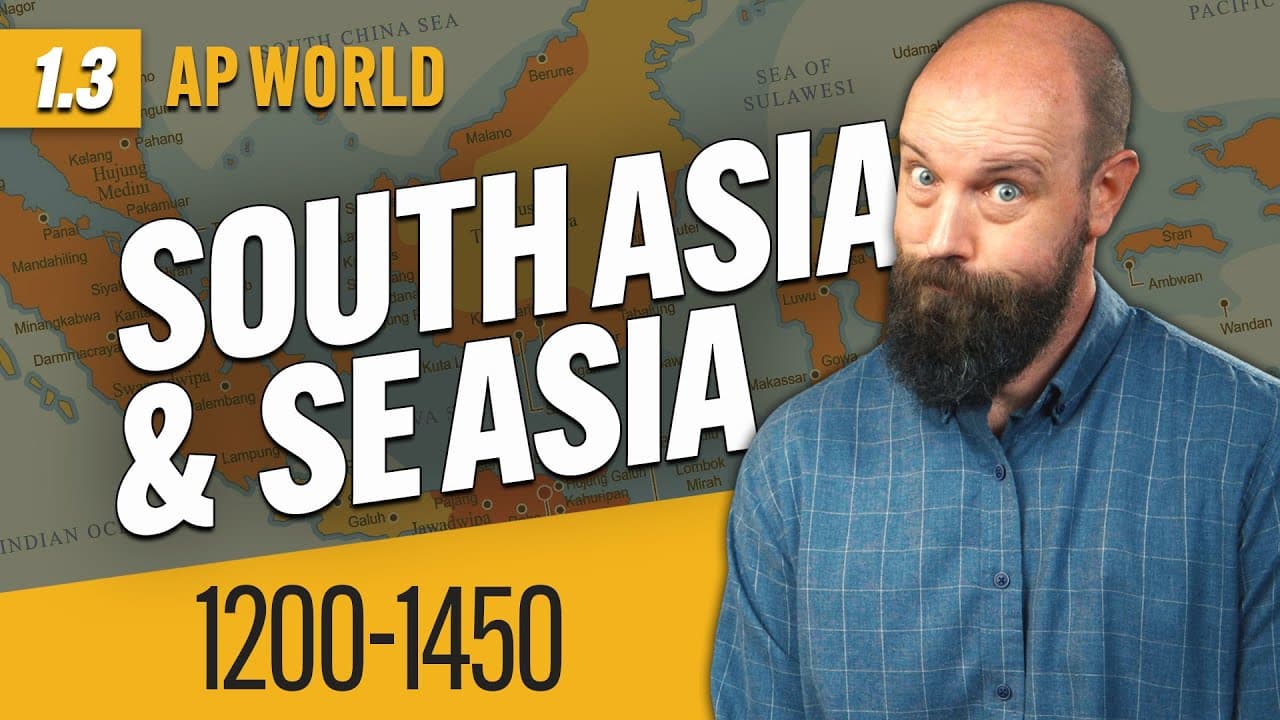
Hinduism remains central in India while Buddhism wanes as Islam rises under the Delhi Sultanate, and Southeast Asia hosts Hinduism, Buddhism, and Islam with bhakti and Sufi movements promoting access for all. Sea and land based powers emerge like Srivijaya, Majapahit, Sinhala, and Khmer during 1200 CE. These shifts illustrate state formation across regions.
Transcript
all right let's take a tour of South Asia and Southeast Asia around the year 1200. I'm going to answer those up at night how did various belief systems affect over time and well don't worry because I'm about to explain it up real nice for you so if you're ready to get them brain cows milked well let's get to it so first things first if you have no ... Read More
Key Insights
- Hinduism dominates Indian social organization through the caste framework.
- Buddhism originated in India but declines there by around 1200, with emphasis moving away from monastic paths.
- Islam enters Northern India with the Delhi Sultanate and becomes a political force there.
- Buddhism experiences changes in Southeast Asia alongside Hinduism and Islam, with syncretism in some kingdoms.
- Bhakti and Sufi movements emerge as universalist and accessible forms within Hinduism and Islam respectively.
- Islam in India remains dominant among elites but Hindu social structure remains entrenched culturally.
- Southeast Asia features three major belief systems, each influencing state formation differently.
- Sea-based states like Srivijaya and Majapahit contrast with land-based Sinhala and Khmer power centers.
- More videos from this channel:
- More from this channel: Heimler's History
Install to Summarize YouTube Videos and Get Transcripts
Explore YouTube Video Summarizer or Get YouTube Transcript Extractor
Questions & Answers
Q: How did Hinduism influence Indian society around 1200
Hinduism created the conditions for a more or less unified culture in India by structuring society through the caste system, a five-tier arrangement where higher castes were more virtuous and lower castes faced social constraints. Reincarnation linked to moral behavior could alter one’s position in the next life, reinforcing social norms.
Q: What happened to Buddhism in South Asia by 1200
Buddhism was founded in India but by around 1200 its influence waned in its land of origin. The video notes that Buddhism shared ideas with Hinduism such as reincarnation but over time it became more exclusive, with monks in monasteries seeking Nirvana rather than broad lay enlightenment.
Q: What role did Islam play in India around 1200
Islam entered Northern India with Turkic Muslim invaders who established the Delhi Sultanate in 1206. Although Muslims ruled the north, Hinduism remained deeply entrenched culturally and socially, making it difficult to impose Islam universally; Islam became the religion of the elite in many areas rather than a uniform national faith.
Q: What is the bhakti movement and where does it fit
The bhakti movement is a new expression of Hinduism that promotes devotion to a single god within the Hindu pantheon, rejects caste hierarchies, and encourages spiritual experience for all people. This makes Hinduism more accessible and can help it spread more effectively across regions.
Q: What changes occurred in Islam with Sufism
Sufism emerged as a mystical, experience-based variant of Islam that reduced emphasis on elaborate doctrinal requirements. It shared similarities with the Bhakti movement in focusing on mystical experience and inclusive access to spiritual practices, which aided its appeal across diverse cultures in the region.
Q: How did Southeast Asia differ in religious landscape
Southeast Asia was diverse in belief systems, with Hinduism, Buddhism, and Islam coexisting in different states. Each belief system influenced political structures differently, with Bhakti and Sufi movements adding pathways for broader religious spread and syncretism among rulers.
Q: What were the major Southeast Asian powers and their bases of power
Sea-based states like Srivijaya controlled power through maritime influence and taxes on passing ships, especially via the Strait of Malacca. Land-based states such as Sinhala in Sri Lanka and the Khmer Empire in the mainland focused on controlling land resources and building monumental religious architecture that reflected syncretic religious blends.
Q: How did state formation vary between sea-based and land-based powers
Sea-based powers leveraged control of maritime routes and trade networks to gain wealth and influence, while land-based powers relied on domestic resources and territorial governance. This distinction shaped how these kingdoms taxed, expanded, and integrated religious beliefs into state legitimacy and cultural identity.
Summary & Key Takeaways
-
Hinduism creates a largely Hindu social system in India, including caste, and Buddhism declines in its land of origin while Islam enters as a ruling elite faith in parts of Northern India. Southeast Asia remains religiously diverse with Hindu, Buddhist, and Islamic influences shaping political structures.
-
The Delhi Sultanate introduces Islam as a ruling system in some regions, while Hinduism and Buddhism persist in various pockets. Bhakti and Sufi movements emerge as flexible pathways that help these religions spread and interact within differing political contexts.
-
Southeast Asian states like Srivijaya and Majapahit leverage sea power and tributary relationships, while Sinhala and Khmer kingdoms focus on land-based power and syncretism, combining Hindu and Buddhist elements in statecraft and monumental architecture.
Read in Other Languages (beta)
Share This Summary 📚
Summarize YouTube Videos and Get Video Transcripts with 1-Click
Try YouTube Summary with ChatGPT & Claude or YouTube Transcript Generator
Explore More Summaries from Heimler's History 📚


Summarize YouTube Videos and Get Video Transcripts with 1-Click
Try YouTube Summary with ChatGPT & Claude or YouTube Transcript Generator