What were Native American societies like before European contact?
TL;DR
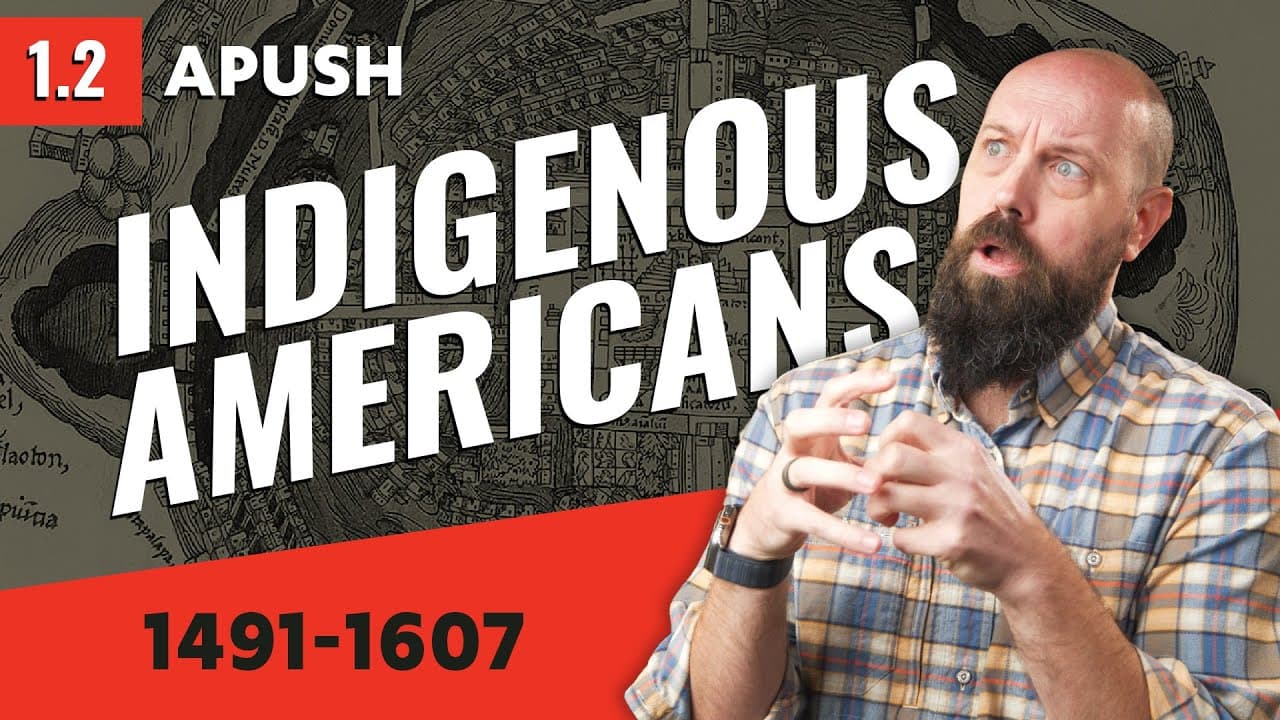
Indigenous peoples across the Americas were diverse in language, culture, and social structure before Europeans arrived. Maize cultivation shaped economies, settlements, irrigation, and social hierarchies, leading to permanent towns and trade networks. Regional differences produced nomadic groups in the Great Basin and Plains, large mound building societies in the Mississippi Valley, and coastal Pacific settlements.
Transcript
Well, welcome to ApushUS, y'all. I am Steve Heimler, your bald bearded gap tooth guide through AP US history. And I reckon we'll get started by talking about the indigenous makeup of the Americas before European contact. And so, if you're ready to get them brain cows milked, let's get to it. Now, probably the very most important thing you need to r... Read More
Key Insights
- Maize cultivation arose in central Mexico around 5000 BCE and became a staple crop for many Americas societies.
- The rise of sedentary agriculture led to economic development, permanent settlements, irrigation advances, and social diversification.
- Geography and climate were major drivers of cultural differences among indigenous groups.
- Great Basin and Great Plains groups tended to be mobile and smaller due to land and resource needs.
- Mississippian cultures created large towns and elite hierarchies supported by trade networks.
- The Irakkoy built long houses and formed a confederacy to manage goods and resolve conflicts.
- Cherokees mixed agriculture with hunting and featured matrilineal social structures where power passed through the mother’s line.
- Pacific coast groups combined rich marine resources with permanent settlements without relying on maize agriculture.
- More videos from this channel:
- More from this channel: Heimler's History
Install to Summarize YouTube Videos and Get Transcripts
Explore YouTube Video Summarizer or Get YouTube Transcript Extractor
Questions & Answers
Q: How did maize cultivation influence non farming communities in the Americas?
Maize cultivation allowed some groups to shift from purely hunter gatherer lifestyles to more sedentary settlements, enabling larger populations and more complex social structures. The development of irrigation and trade networks emerged as societies grew, and labor specialization increased as roles became more defined within these towns and alliances.
Q: What distinguishes Mississippian societies from others in the region?
Mississippian societies were able to build large towns and support a population of thousands due to abundant fertile land near river valleys. They practiced mound building, developed social hierarchies with elite classes, and engaged in long distance trade that connected diverse groups as far away as Canada and Florida.
Q: Who were the Irakkoy and what was unique about their living arrangements?
The Irakkoy were a northeast group that relied on maze farming and abundant timber. They lived in long houses housing generations of families, sometimes up to 200 people, and formed a confederacy with a representative council to settle disputes and manage trade.
Q: How did geography affect the Great Basin and Great Plains communities?
The hot and dry climate fostered mobile, nomadic lifestyles in these regions, with groups like the Ute moving seasonally and living in mobile shelters. The need for vast land to hunt and gather kept settlements smaller and more dispersed compared to agricultural regions.
Q: What role did women play in Cherokee society?
In Cherokee culture, women often held substantial social capital and agricultural work, with maize cultivation, beans, and squash forming the core of their farming. Many Cherokee communities were matrilineal, meaning lineage and inheritance traced through the mother’s line and power often remained with women.
Q: Why were coastal and northwest Pacific settlements able to stay permanent without maize agriculture?
Coastal Pacific groups could rely on abundant marine resources and other local foods, allowing them to sustain large permanent settlements without maize agriculture. Their access to oceanic and forest resources supported dense populations and complex social structures similar to agricultural regions.
Q: What was the impact of permanent settlements on social structure?
Permanent settlements enabled labor specialization, the rise of social hierarchies, and the development of governance structures like councils or elite classes. Trade networks expanded, and communities could coordinate large scale projects such as irrigation, mound building, and defense, shaping long term societal complexity.
Q: What is the significance of irrigation in these pre contact societies?
Irrigation improved water management for crops, enhancing agricultural productivity and enabling populations to sustain larger settlements. As irrigation techniques advanced, settlements could support specialized labor, leading to more complex social and political organizations and expanded trade networks.
Summary & Key Takeaways
-
Native groups varied widely by geography, from nomadic bands to large settled communities and complex trade, governance, and labor systems.
-
Maize cultivation emerged as a unifying agricultural shift that enabled population growth and social specialization.
-
Regional examples include the Ute in arid regions, the Mississippian Hopewell in river valleys, the Irakkoy in the northeast, and Pacific coast settlements that leveraged marine resources.
Read in Other Languages (beta)
Share This Summary 📚
Summarize YouTube Videos and Get Video Transcripts with 1-Click
Try YouTube Summary with ChatGPT & Claude or YouTube Transcript Generator
Explore More Summaries from Heimler's History 📚




Summarize YouTube Videos and Get Video Transcripts with 1-Click
Try YouTube Summary with ChatGPT & Claude or YouTube Transcript Generator