What were the social effects of revolutionary ideals?
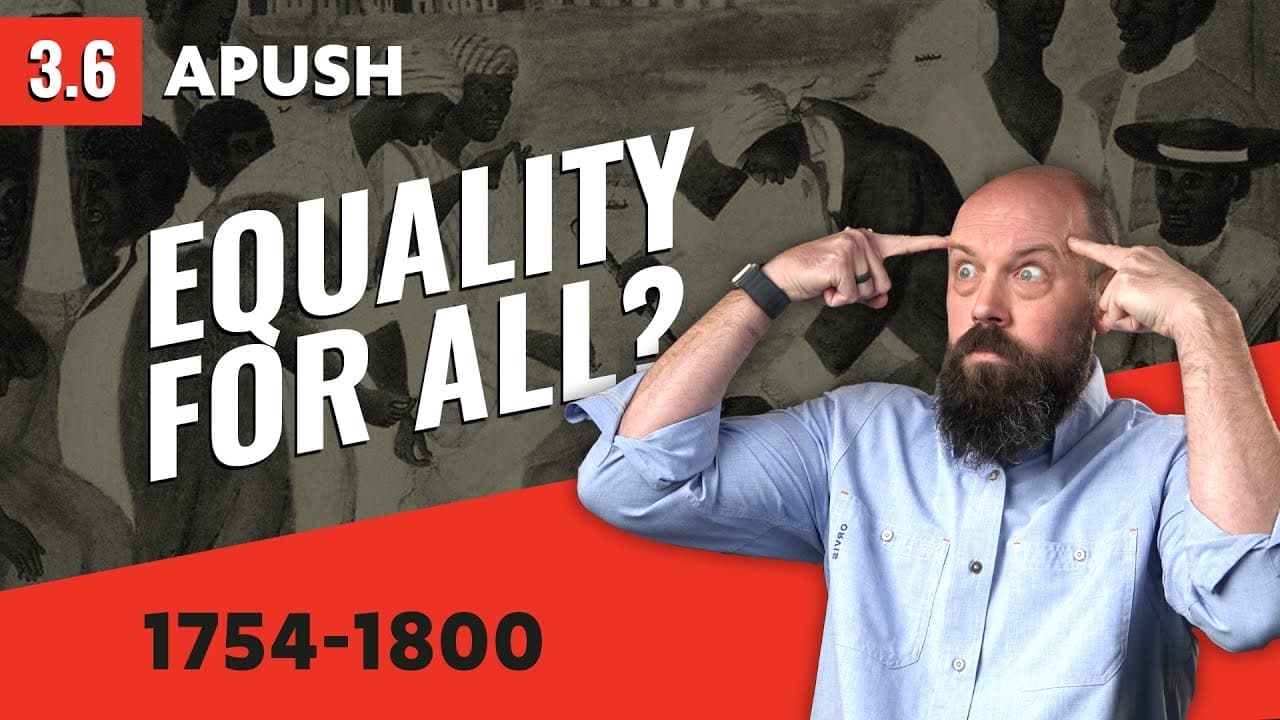
TL;DR
Revolutionary ideas intensified debates over liberty and equality while exposing deep social tensions. Slavery remained entrenched despite calls for universal rights, and women pushed for recognition through ideas like Republican motherhood. The era also sparked Atlantic revolutions in France, Haiti, and Latin America, influencing broader political change.
Transcript
Okay, so all those ideals that shaped and sustained the American Revolution had massive effects on its society as well. And not just American society, but places in Europe and the Caribbean as well. And I reckon we ought to talk about it. So, if you're ready to get them brain cows milked, let's get to it. Okay. Now, as I mentioned in a previous vid... Read More
Key Insights
- Slavery highlighted a core contradiction in revolutionary ideals, as liberties proclaimed in theory clashed with enslaved people being denied basic rights.
- The Dunmore Proclamation triggered fears among southern leaders about slave uprisings and influenced postwar attitudes toward slavery and emancipation.
- Most new state constitutions allowed slavery to continue, with only Vermont abolishing it and Pennsylvania pursuing gradual emancipation, showing gradual reform rather than immediate change.
- The revolution opened discussions on political democracy, leading to debates about extending voting rights beyond property holders, though progress was slow.
- Abigail Adams urged inclusion of women in the new liberty framework, signaling early calls for gender equality that would take longer to realize.
- Republican motherhood framed women as educators of future citizens, expanding educational access but stopping short of political equality.
- The revolution inspired other Atlantic revolutions, notably the French Revolution, the Haitian Revolution, and independence movements in Latin America, spreading Enlightenment ideas beyond America.
- Women’s roles in the war and the home front underscored the broader social contributions that supported independence, even as political power remained limited for women.
- More videos from this channel:
- More from this channel: Heimler's History
Install to Summarize YouTube Videos and Get Transcripts
Explore YouTube Video Summarizer or Get YouTube Transcript Extractor
Questions & Answers
Q: What is the main way revolutionary ideals affected slavery after the war?
Revolutionary ideals brought attention to the contradiction between liberty and slavery. While some delegates in the Continental Congress debated abolition, most postwar constitutions allowed slavery to continue, with Vermont abolishing it and Pennsylvania pursuing gradual emancipation. The result was a growing but uneven movement toward abolition that would take many generations to bear fruit.
Q: How did Dunmore's Proclamation influence revolutionary society?
Dunmore’s Proclamation offered freedom to enslaved people who joined the British side, which frightened southern planters who relied on slave labor. It exposed the fragility of slaveholding interests during wartime and contributed to the Southern fear of rebellion, shaping postwar politics and the hesitation to end slavery immediately.
Q: What role did Abigail Adams play in shaping early ideas about women’s rights?
Abigail Adams urged her husband and the Continental Congress to remember the ladies, signaling an early demand for inclusion of women in the liberty project. Her letters highlighted the gap between revolutionary ideals and the reality of women’s political status, helping seed later discussions on gender equality despite immediate limitations.
Q: What is Republican motherhood and why does it matter?
Republican motherhood was the idea that women should educate their sons in liberty and republican virtue, strengthening the republic indirectly. It raised education for women and elevated their domestic influence, while not granting them political rights. This concept helped expand women’s roles without undermining male political authority.
Q: How did the revolution influence other Atlantic revolutions?
The American Revolution inspired French, Haitian, and Latin American movements by promoting Enlightenment principles, natural rights, and popular sovereignty. French revolutionaries pursued broader social equality, Haitian leaders challenged slavery, and Latin American leaders demanded independence, showing how American ideas traveled across the Atlantic to reshape politics.
Q: What were the limitations on expanding democracy after the war?
Although there were calls to remove property requirements for voting, most state constitutions retained thresholds that limited franchise to property holders. This slowed democratic expansion and showed that while revolutionary ideals spurred debate, practical political reform lagged behind theoretical ideals.
Q: How did social hierarchies persist after independence in America?
Despite the push for liberty, social hierarchies persisted as elite planters retained power and wealth through slavery, while poorer whites and former enslaved people faced limited political and social rights. The new republic maintained hierarchical structures even as it adopted republican rhetoric and expanded some rights gradually.
Q: What lasting impact did these revolutionary ideas have on education and public life?
Revolutionary ideas underscored the importance of education for citizenship, leading to the concept of republican motherhood and broader access to schooling for women. Over time, this laid groundwork for increased literacy and civic participation, even as full political equality remained contested and incomplete in the early republic.
Summary & Key Takeaways
-
The video explains how revolutionary ideals highlighted social inequalities, especially around slavery, and how these contradictions persisted after independence.
-
It shows the push for broader political democracy but notes that voting rights were limited by property requirements, taking decades to expand.
-
It discusses women's roles in the revolution, the concept of Republican motherhood, and the slow path to gender equality.
Read in Other Languages (beta)
Share This Summary 📚
Summarize YouTube Videos and Get Video Transcripts with 1-Click
Try YouTube Summary with ChatGPT & Claude or YouTube Transcript Generator
Explore More Summaries from Heimler's History 📚






Summarize YouTube Videos and Get Video Transcripts with 1-Click
Try YouTube Summary with ChatGPT & Claude or YouTube Transcript Generator