How did Europe’s Wars of Religion shape early modern politics
TL;DR
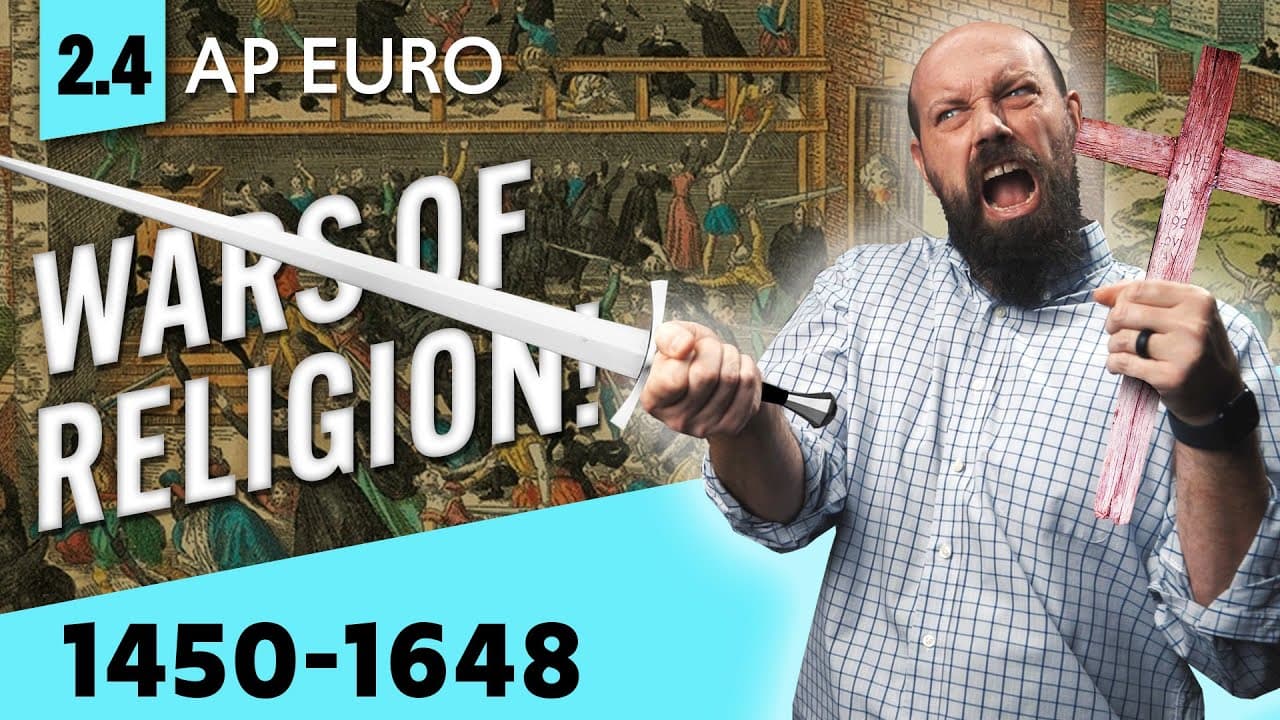
Religious conflict in France, Spain, and the Holy Roman Empire escalated from targeted massacres to broad political warfare, culminating in the Peace of Westphalia. The wars shifted power toward centralized states while expanding religious toleration for Calvinists and other groups, and they ended a universal Christendom notion while weakening the Holy Roman Empire. These events redefined European political order.
Transcript
the last couple of videos we've been talking about the protestant reformation but you didn't think all the religious change in europe wasn't gonna cause christians to start killing each other in the name of jesus did you don't be crazy so if you're ready to get them brain cows milk then let's talk about europe's wars of religion i reckon we ought t... Read More
Key Insights
- The Huguenots in France were Calvinist nobles who pressed for recognition, igniting conflict under Catherine de Medici and leading to mass killings that destabilized the realm.
- The Edict of Nantes in 1598 formalized limited religious toleration in France while preserving Catholic dominance, signaling a shift toward toleration amid political consolidation.
- Spain under Philip II aimed to restore Catholic unity, opposing Dutch and English Protestant resistance and highlighting the broader Catholic effort to contain Protestant growth.
- The Defenestration of Prague sparked the Thirty Years War, illustrating how a religious act can trigger a long, multi-phase war with political ends.
- The Peace of Augsburg initially allowed only Catholic or Lutheran choices, excluding Calvinists and triggering later reform efforts in the Holy Roman Empire.
- France’s financial and military aid to Protestant forces marks a pivotal shift where religious motives recede and political strategy takes precedence.
- France, Spain, and the Holy Roman Empire show a trend from purely religious disputes to complex political-military coalitions and rivalries.
- The Peace of Westphalia ends the major religious wars, redefines sovereignty, and marks the decline of the medieval universal Christendom concept.
- More videos from this channel:
- More from this channel: Heimler's History
Install to Summarize YouTube Videos and Get Transcripts
Explore YouTube Video Summarizer or Get YouTube Transcript Extractor
Questions & Answers
Q: What sparked the French Wars of Religion and who led early Catholic repression
The Wars began when Catherine de Medici, ruling for a young Charles IX, sought to purge Huguenot nobles who demanded recognition and rights. The massacres in 1562 and later events under royal authority ignited decades of violent conflict, mixing religious intolerance with political power struggles that reshaped French governance and the balance between crown and nobility.
Q: Who were the Huguenots and how did they influence French politics
Huguenots were French Calvinists who formed a large portion of the nobility by the 1560s, pressuring for legal recognition and rights within France. Their religious beliefs intersected with political power, prompting Catholic factions to view them as a threat to royal and religious unity, thus fueling a prolonged cycle of massacres, battles, and shifting alliances.
Q: What was the Edict of Nantes and why is it significant
The Edict of Nantes issued in 1598 under Henry IV established France as a Catholic state while granting Huguenots freedom to worship without fear of massacre or harassment. It marked a turning point toward religious toleration and contributed to stabilizing the country after a long period of civil violence, and it signaled the crown’s move toward centralized authority.
Q: How did Philip II of Spain aim to reshape European religion and politics
Philip II pursued Catholic unity across Europe by targeting Protestant rebellion in the Netherlands and England. He supported persecuting Calvinists, faced the Dutch revolt, and engaged in the failed Spanish Armada campaign against England, revealing a strategy where religious goals were tied to broader political power and influence in Europe.
Q: What started the Thirty Years War and what did it evolve into
The war began with the Defenestration of Prague, when protestant nobles rejected Catholic attempts at re-catholicizing Bohemia, leading to a multi-phase conflict. It started as a religious struggle within the Holy Roman Empire but gradually incorporated external powers such as Denmark, Sweden, and France, turning into a broader political struggle over sovereignty and balance of power.
Q: How did the phases of the Thirty Years War differ in motive and outcome
Phase one was religious, with Catholic victory close to reestablishing Catholic dominance in Bohemia. Phase two introduced political motives through Danish involvement. Phase three saw Swedish military leadership and increased Protestant success, aided by French financial support despite France’s Catholic identity. Phase four solidified political aims with France opposing Habsburg revival and reshaping the regional order.
Q: What is the significance of the Peace of Westphalia
The Peace of Westphalia in 1648 ended the major religious wars in Europe, recognized Calvinism as legitimate, weakened the Holy Roman Empire, and strengthened state sovereignty. It marked a turning point away from universal Christendom toward a system where states independently determine their own religious and political arrangements.
Q: How did religious intolerance lead to political realignments in Europe
Religious intolerance driven rulers and nobles to form strategic alliances across religious lines, as seen with French support for Protestant forces against Habsburgs. This shift demonstrates that political calculations often outweighed theological concerns, ultimately redefining national power structures, sovereignty, and the way religious pluralism was managed within new state frameworks.
Summary & Key Takeaways
-
In France, Catholic rulers and Huguenot nobles clashed from 1562, leading to massacres and shifting power dynamics that culminated in religious toleration for Protestants under Henry IV. France moved toward centralized royal authority and religious coexistence through the Edict of Nantes in 1598.
-
The Spanish crown pursued Catholic unity across Europe, clashing with Protestant powers in the Netherlands and England, where the Armada failed and Dutch independence grew, reinforcing Protestant resistance to Habsburg dominance.
-
The Thirty Years War began as a religious conflict within the Holy Roman Empire but evolved into a political struggle that dragged in France and Sweden, ending with the Peace of Westphalia and a weakened Holy Roman Empire and stronger state sovereignty.
Read in Other Languages (beta)
Share This Summary 📚
Summarize YouTube Videos and Get Video Transcripts with 1-Click
Try YouTube Summary with ChatGPT & Claude or YouTube Transcript Generator
Explore More Summaries from Heimler's History 📚




Summarize YouTube Videos and Get Video Transcripts with 1-Click
Try YouTube Summary with ChatGPT & Claude or YouTube Transcript Generator