How Does the Laplace Transform Reveal Exponentials?
TL;DR
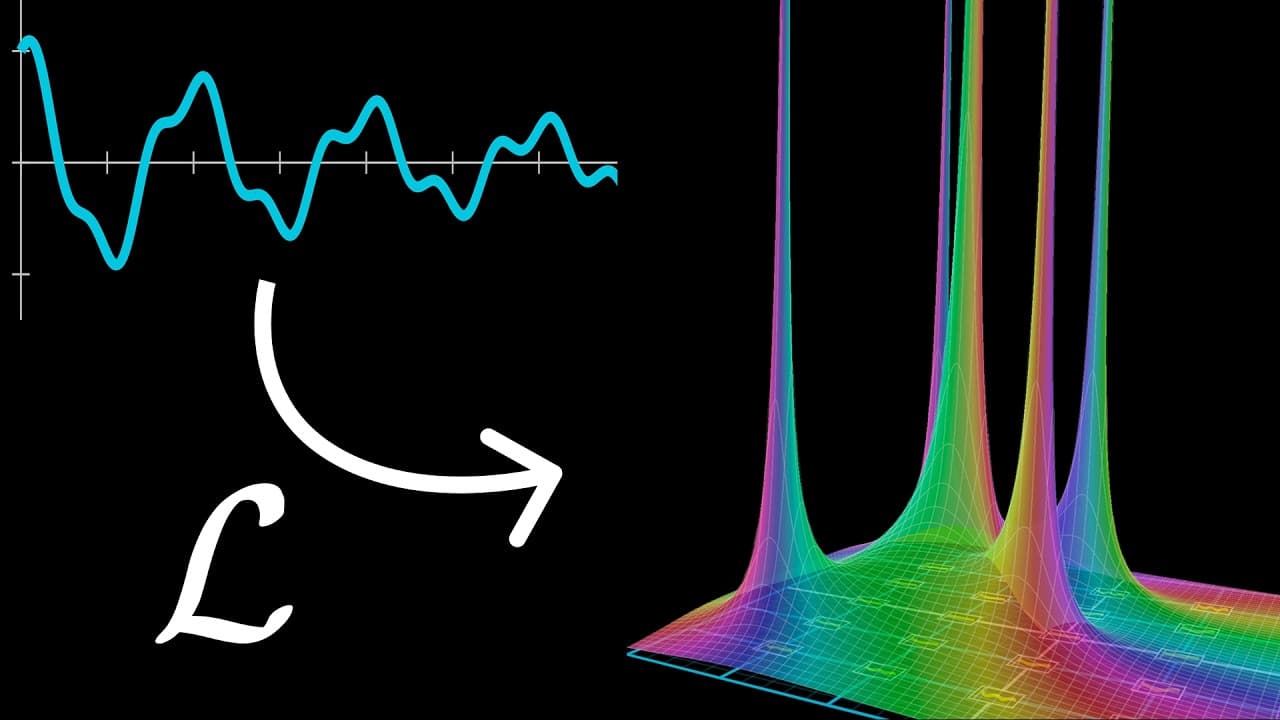
The Laplace transform reveals exponential components hidden inside a function by multiplying the function by e^(-st) and integrating over time from zero to infinity. Its poles identify special complex values of s associated with those components, while the derivative-friendly behavior of exponentials allows differential equations to be converted into algebraic problems involving multiplication by s.
Transcript
[Translated by Grant Sanderson. Submit corrections at criblate.com] What you're looking at, a somewhat complicated diagram that you and I are going to build up in this video, is a visualization unpacking the meaning behind one of the most powerful tools used to study differential equations. It's known as the Laplace transform. This is one of those ... Read More
Key Insights
- The Laplace transform is a transformation that accepts an entire time-dependent function and returns a new function whose input is a complex number s. Capitalizing the original function's name is a typical convention for naming this transformed function.
- A complex exponential e^(st) encodes different behavior through the value of s. A larger imaginary part produces faster oscillation, a negative real part produces exponential decay, and a positive real part produces exponential growth as time moves forward.
- Many functions arising in physics can be expressed as combinations of exponential components. Cosine is a simple example because it equals one half of the sum of e^(it) and e^(-it), whose imaginary components cancel while their real components oscillate together.
- Exponentials are especially useful for differential equations because differentiating e^(st) has the same effect as multiplying it by s. A transform that identifies exponential components can therefore replace derivatives with multiplication and turn a differential equation into an algebraic problem.
- The s-plane represents all possible complex values of s used in e^(st). Each point can be viewed as encoding an entire exponential function, with vertical movement changing oscillatory behavior and horizontal movement changing the balance between exponential decay and growth.
- Poles are sharp spikes in the transformed function located above important values in the s-plane. When an original function is composed of exponential pieces, these poles reveal the s values associated with those pieces, even when the decomposition was not known beforehand.
- The Laplace transform works in two stated steps: multiply f(t) by e^(-st), then integrate the result over time from zero to infinity. The complex parameter s can be moved around the s-plane to test alignment with exponential components in f(t).
- A matching value of s makes an exponential product become constant. For the e^(it) component of cosine, setting s equal to i changes e^((i-s)t) into e^0, or one, whose integral over an infinite interval blows up and signals a pole.
Install to Summarize YouTube Videos and Get Transcripts
Explore YouTube Video Summarizer or Get YouTube Transcript Extractor
Questions & Answers
Q: What is the Laplace transform used for?
The Laplace transform is used to reveal the exponential components into which a time-dependent function can be decomposed. It produces a new function of a complex variable s, and its poles indicate important s values associated with those components. Because differentiation of an exponential corresponds to multiplication by s, the same method can convert differential equations into algebraic problems.
Q: How is the Laplace transform defined?
The Laplace transform is defined through two main operations. First, multiply the original function f(t) by e^(-st), where s is a complex-valued parameter. Second, integrate the resulting product over time from t equal to zero to infinity. Repeating this process conceptually across values of s creates a transformed function defined over the complex s-plane.
Q: Why are exponential functions useful for differential equations?
Exponential functions are useful because their form is preserved by differentiation. For e^(st), taking a derivative has the same effect as multiplying the function by the number s. When a function is decomposed into exponential pieces, derivatives acting on those pieces can therefore be represented through multiplication, allowing a differential equation to be rewritten as algebra.
Q: What does the complex number s represent in a Laplace transform?
The complex number s identifies a particular exponential function e^(st). Its imaginary part controls rotation in the complex plane and therefore the rate of oscillation, while its real part controls changes in magnitude. A negative real part produces decay toward zero, and a positive real part produces exponential growth as time advances.
Q: What is the s-plane in Laplace transform analysis?
The s-plane is the complex plane containing all possible values of the parameter s in e^(st). Each point can be understood as representing an entire complex-valued exponential function. Moving vertically changes the imaginary part and the oscillation rate, while moving horizontally changes the real part and determines whether the exponential decays or grows.
Q: How does the Laplace transform detect hidden exponentials?
The transform multiplies a function by e^(-st) while s moves conceptually across the s-plane. When s matches the exponent of an exponential component inside the function, the two exponents cancel in the product. That component then becomes constant over time, and integrating it from zero to infinity produces divergent behavior that identifies the matching value.
Q: Why does the Laplace transform of cosine have poles near i and negative i?
Cosine can be written as one half of e^(it) plus one half of e^(-it). These are exponential components associated with s equal to i and s equal to negative i. At either matching value, multiplication by e^(-st) makes the corresponding component constant, so its integral over the infinite time interval blows up and creates a pole.
Q: What are poles in a Laplace-transformed function?
Poles are sharp spikes in a plot of the transformed function over the s-plane. They occur at special values of s associated with exponential pieces in the original function. By locating and understanding these poles, one can identify the exponentials hidden in a function, including cases where the decomposition was not already known.
Summary & Key Takeaways
-
The Laplace transform is presented as a machine that takes an entire time-dependent function and produces a new function of a complex variable, s. Its purpose is to expose the exponential pieces underlying the original function, including their characteristic s values and corresponding coefficients, which is especially useful for functions arising in physics.
-
Complex exponentials e^(st) combine oscillation, decay, and growth. The imaginary part of s controls rotation and oscillation, while the real part controls whether magnitude decays or grows. Cosine provides a simple example because it is the sum of two oppositely rotating imaginary exponentials, each scaled by one half.
-
The transform multiplies f(t) by e^(-st) and integrates from zero to infinity. When s matches an exponential component hidden in f(t), their exponents cancel and produce a constant term. Integrating that constant over an infinite interval creates divergent behavior, visualized as a pole identifying the matching exponential component.
Read in Other Languages (beta)
Share This Summary 📚
Summarize YouTube Videos and Get Video Transcripts with 1-Click
Try YouTube Summary with ChatGPT & Claude or YouTube Transcript Generator
Explore More Summaries from 3Blue1Brown 📚

Summarize YouTube Videos and Get Video Transcripts with 1-Click
Try YouTube Summary with ChatGPT & Claude or YouTube Transcript Generator