How to Master 20 Agentic AI Design Patterns Today
TL;DR
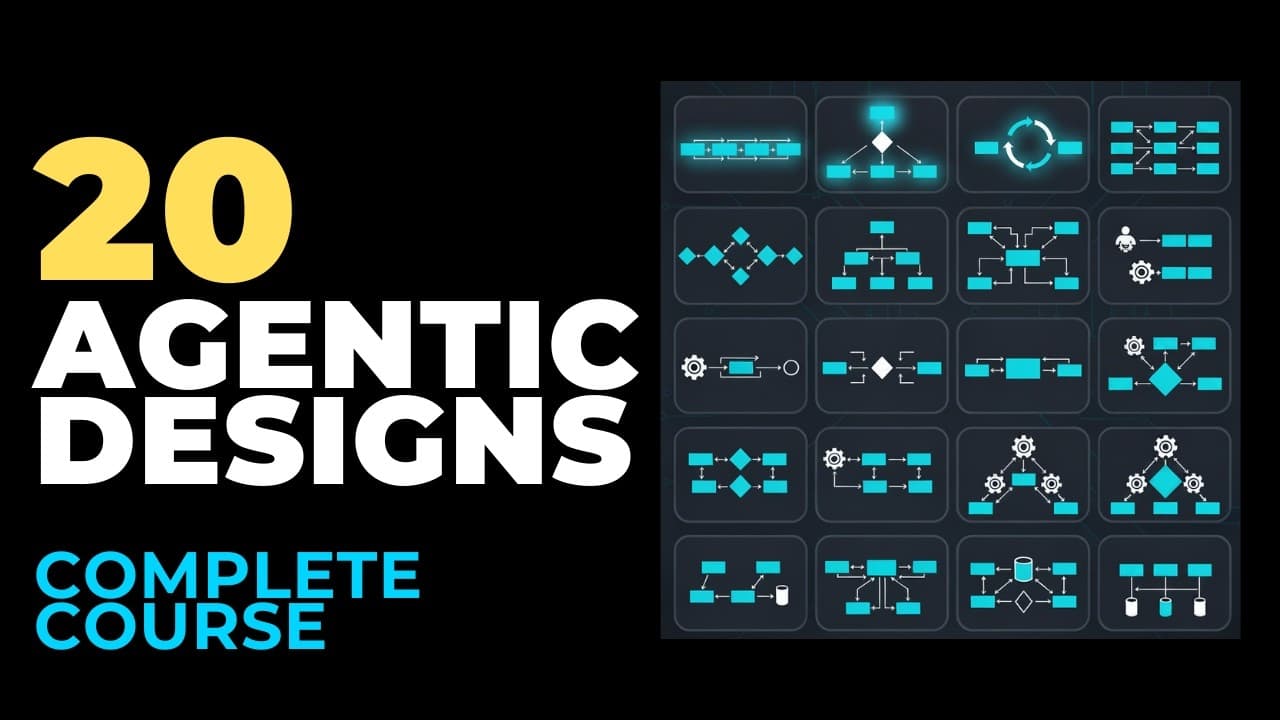
Prompt chaining breaks a big task into smaller steps and validates each step before passing data forward, reducing errors and enabling modular design. The video also covers routing, parallelization, memory management, and other patterns with concrete workflows, discussing tradeoffs like cost, latency, and risk while offering free resources to help you implement patterns quickly.
Transcript
There are 20 agentic design patterns that separate pros from beginners. A Google engineer recently released a 400page book on agentic design patterns. And in this video, I'm going to give you a summary of that book in plain English. I spent hours trying to simplify these architectures to make them as easy to understand as possible. No jargon, no th... Read More
Key Insights
- Prompt chaining breaks large tasks into smaller steps for modular processing.
- Each chain step validates the previous output before passing it on to the next step.
- Context explosion is a risk when chaining many steps due to large payloads.
- Routing analyzes user intent to direct requests to the correct specialist agent.
- Confidence-based routing can help determine when to ask for clarification.
- Parallelization splits tasks to run concurrently, increasing throughput.
- Memory management and data contracts help control data flow between steps.
- Tradeoffs include cost, latency, and potential for hallucination if prompts are poorly tested.
- More videos from this channel:
- More from this channel: Mark Kashef
Install to Summarize YouTube Videos and Get Transcripts
Explore YouTube Video Summarizer or Get YouTube Transcript Extractor
Questions & Answers
Q: How does prompt chaining reduce errors in multi-step AI tasks?
Prompt chaining reduces errors by dividing a complex task into smaller subtasks where each step validates its output before passing data forward. This modular approach creates clear data contracts, makes it easier to catch mistakes early, and allows for retrying only the failing portion without redoing the entire task.
Q: What is the role of routing in agentic designs?
Routing directs incoming requests to the appropriate specialized agent based on intent and context. It increases scalability and efficiency by ensuring the right tools and expertise are used for each task, while also enabling clarifying questions if the initial routing decision is uncertain to prevent misfires.
Q: What are common risks when using multiple patterns together?
Common risks include context explosion from carrying large payloads across many steps, error propagation where an early mistake contaminates subsequent steps, and increased cost and latency due to multiple inferences. Testing prompts and implementing safeguards like human-in-the-loop can mitigate these issues.
Q: How can parallelization benefit AI workflows?
Parallelization splits tasks into independent sub-tasks that can run concurrently, increasing throughput and reducing total processing time. It is especially useful for data-heavy or multi-tenant workflows where independent steps can be executed in parallel without interdependencies.
Q: Why is memory management mentioned in these patterns?
Memory management is important to control what context and data are carried across steps. Proper memory management reduces token usage, prevents context overflow, and helps maintain performance and cost efficiency when chaining multiple AI calls.
Q: What tradeoffs should be considered with prompt chaining?
Tradeoffs include potential context explosion, higher upfront design effort to define clear data contracts, and slower overall turnaround if prompts are poorly tested. When implemented well with validation and logging, it yields robust, modular, and reusable workflows.
Q: How does routing interact with tool use and specialized agents?
Routing ensures that the correct tool and agent are used for a given task, avoiding misfires where an agent uses an inappropriate tool. This separation supports specialized capabilities and cleaner orchestration across multiple domains such as support, sales, or health care triage.
Q: What are the practical benefits of the free repo mentioned in the video?
The free repo provides diagrams, ASCII flows, and Mermaid files that help you implement the 20 patterns immediately. It serves as a practical starter kit, reducing time to first operational workflow and helping you validate concepts in real projects without building everything from scratch.
Summary & Key Takeaways
-
In this summary the video presents 20 agentic design patterns with visuals and practical workflows, focusing on how to apply each pattern to real problems you face today. It emphasizes the balance between modularity and complexity, and shows how to log artifacts and validate outputs across a multi-step process. You will learn when to use each pattern and what to watch for in failures.
-
The course material explains prompt chaining in depth, describing how to break tasks into subtasks, set data contracts, and iterate with validation loops. It also discusses routing to specialized agents, parallelization to speed up processing, and how to combine patterns to build robust, scalable agentic systems for production use.
-
The description promises a free repository with diagrams, ASCII flows, and Mermaid files to help you implement patterns immediately, along with tips to avoid common pitfalls such as context explosion and error propagation, enabling you to ship reliable agents faster without over-engineering
Read in Other Languages (beta)
Share This Summary 📚
Summarize YouTube Videos and Get Video Transcripts with 1-Click
Try YouTube Summary with ChatGPT & Claude or YouTube Transcript Generator
Explore More Summaries from Mark Kashef 📚




Summarize YouTube Videos and Get Video Transcripts with 1-Click
Try YouTube Summary with ChatGPT & Claude or YouTube Transcript Generator