How to Use Six Claude Code Workflow Patterns
TL;DR
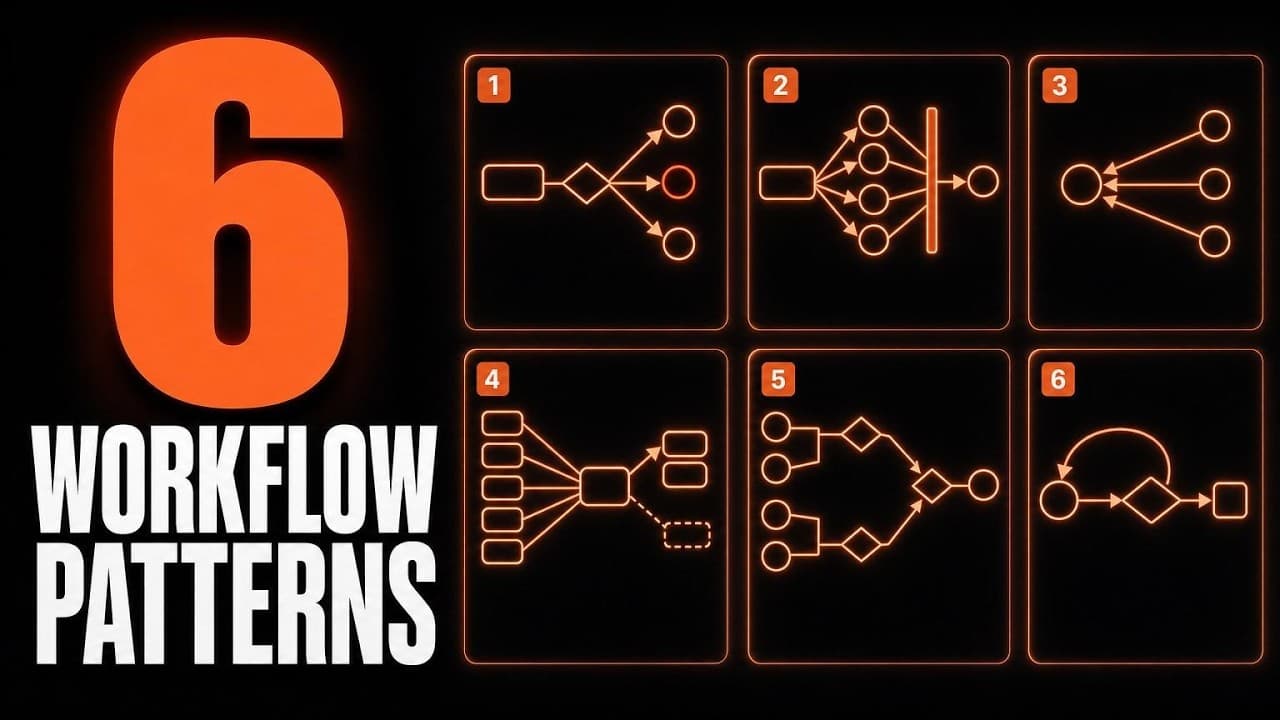
Use dynamic workflows to divide complex or long-running tasks among agents with clean, independent context windows, then route, combine, challenge, filter, compare, or repeat their outputs. Six reusable patterns address agent laziness, self-preference, and goal drift: classify and act, fan out and synthesize, adversarial verification, generate and filter, tournament, and loop until done.
Transcript
There are six patterns that separate the people who actually get how to use dynamic workflows to their fullest potential versus those who just turn it on once and never use it again. The engineers at Enthropic that both design and built this feature just released a full masterass on how to get the most out of it. So, in this video, I'm going to bre... Read More
Key Insights
- Dynamic workflows are task-specific harnesses that Claude Code constructs on the fly, rather than merely a convenient way to launch more agents. Their value comes from arranging multiple agents and context windows into a process suited to the structure and quality requirements of a particular assignment.
- A single context window functions as short-term memory and can become unreliable during long or complex work. The presentation identifies three resulting failure modes: agent laziness that leaves assigned tasks unfinished, self-preference that inflates evaluations of the agent's own output, and goal drift after compactions, tool calls, and summaries.
- Classify and act is a routing pattern that assigns incoming items to the appropriate specialist before any action occurs. An inbox workflow can classify tickets as bugs, refunds, leads, spam, or other categories, remove duplicates against tracked items, quarantine inputs, and then send them to trusted handlers.
- Fan out and synthesize divides a broad task into mutually exclusive parts, gives each part to an agent with a clean context, and combines the findings after all agents finish. Research and due diligence benefit because separate agents can examine distinct lenses, folders, financials, contracts, or legal materials without cross-contamination.
- Adversarial verification reduces self-preference by separating creation from evaluation. Skeptical agents test outputs against a checklist or rubric, while claim-level fact-checking can extract factual and technical assertions, assign each assertion to an independent verifier, and report failed claims with exact reasons for correction.
- Generate and filter improves variety by deliberately producing far more candidates than will survive. It suits work involving taste, including titles, project names, cold-email openings, product names, and offers. Independent research and generation can be followed by synthesis that reduces a large candidate pool to a few options.
- Judges can strengthen generate-and-filter workflows by critiquing candidate ideas against an explicit rubric. This creates a second evaluation layer after generation and lets the workflow quality-control its quality controllers instead of accepting the first agent's preferences or a narrow initial set of suggestions.
- The six-pattern framework includes classify and act, fan out and synthesize, adversarial verification, generate and filter, tournament, and loop until done. The chapter structure also presents stacking patterns into one workflow, sharing a workflow as a skill, saving workflows and token budget, and identifying situations where workflows should not be used.
- More videos from this channel:
- More from this channel: Mark Kashef
Install to Summarize YouTube Videos and Get Transcripts
Explore YouTube Video Summarizer or Get YouTube Transcript Extractor
Questions & Answers
Q: What are Claude Code dynamic workflows?
Claude Code dynamic workflows are task-specific harnesses that Claude Code can construct on the fly for the assignment it receives. Instead of keeping every responsibility inside one session and one context window, a workflow coordinates multiple agents with separate contexts. Those agents can classify inputs, investigate independent parts, verify claims, generate candidates, judge results, or repeat work until completion.
Q: Why use multiple context windows for complex tasks?
Multiple context windows isolate separate responsibilities so each agent can concentrate on a specific problem without carrying the entire history of a long session. The presentation says a single context can begin to unwind during lengthy or complicated work. Separate contexts help address incomplete execution, biased self-assessment, and loss of the original goal after repeated compactions, summaries, and tool calls.
Q: What problems do dynamic workflows address?
Dynamic workflows address three highlighted failure modes of a single long-running session. Agent laziness occurs when an agent accepts many tasks but completes only some of them. Self-preference appears when the same session judges its own output too favorably. Goal drift occurs when the original objective loses detail through long conversations, automatic compactions, tool calls, and summarization.
Q: How does the classify-and-act workflow work?
Classify and act places a routing stage before execution. A reader or classifier examines an incoming item, determines its category, and sends it to the responsible handler. For inbox triage, categories can include bugs, refunds, leads, and spam. The workflow can also remove duplicates and quarantine inputs before a trusted agent takes action, limiting premature or misdirected handling.
Q: How does fan out and synthesize support research?
Fan out and synthesize breaks one broad research question into smaller, mutually exclusive angles and assigns each angle to an agent with a clean context. The agents work in parallel, return individual contributions, and wait at a barrier before synthesis. A final step merges their structured findings into one result, with exact source paths attached when citations and traceability are required.
Q: How can adversarial verification improve fact-checking?
Adversarial verification separates the creator from the evaluators and asks independent skeptical agents to challenge the output against a checklist or rubric. For a blog post, one agent can extract factual and technical claims, while separate agents verify individual claims against their real sources. The final report identifies failed claims and explains exactly why each one needs correction.
Q: When should generate and filter be used?
Generate and filter should be used when a task benefits from variety, judgment, or taste. Examples in the presentation include video titles, project names, cold-email openings, product names, and popup offers. Multiple agents can research and overgenerate candidates, after which synthesis narrows the pool. Judges and a rubric can add another layer of structured criticism before final selection.
Q: What are the six Claude Code workflow patterns?
The six patterns are classify and act, fan out and synthesize, adversarial verification, generate and filter, tournament, and loop until done. They represent different shapes for a task-specific agent harness. The presentation also describes stacking patterns into a larger workflow, sharing a workflow as a skill, saving workflows and token budget, and considering when workflows should not be used.
Summary & Key Takeaways
-
Dynamic workflows let Claude Code construct a task-specific harness instead of relying on one increasingly crowded context window. Separate agents handle distinct responsibilities with clean contexts, helping counter three problems described in the presentation: incomplete task execution, biased self-evaluation, and drift away from the original objective during lengthy sessions.
-
The first patterns organize work in different ways. Classify and act routes an input to the responsible handler before action begins. Fan out and synthesize divides a broad task into mutually exclusive parts, runs agents in parallel, and combines structured findings after every agent finishes, ideally preserving exact source paths for claims.
-
Other patterns strengthen selection and quality control. Adversarial verification assigns independent skeptics to test claims against sources and rubrics. Generate and filter deliberately creates many candidates before judges narrow them down. The complete framework also includes tournament and loop-until-done patterns, and patterns can be stacked into larger workflows or shared as skills.
Read in Other Languages (beta)
Share This Summary 📚
Summarize YouTube Videos and Get Video Transcripts with 1-Click
Try YouTube Summary with ChatGPT & Claude or YouTube Transcript Generator
Explore More Summaries from Mark Kashef 📚




Summarize YouTube Videos and Get Video Transcripts with 1-Click
Try YouTube Summary with ChatGPT & Claude or YouTube Transcript Generator