How to Master Prompt Engineering Across All Modalities
TL;DR
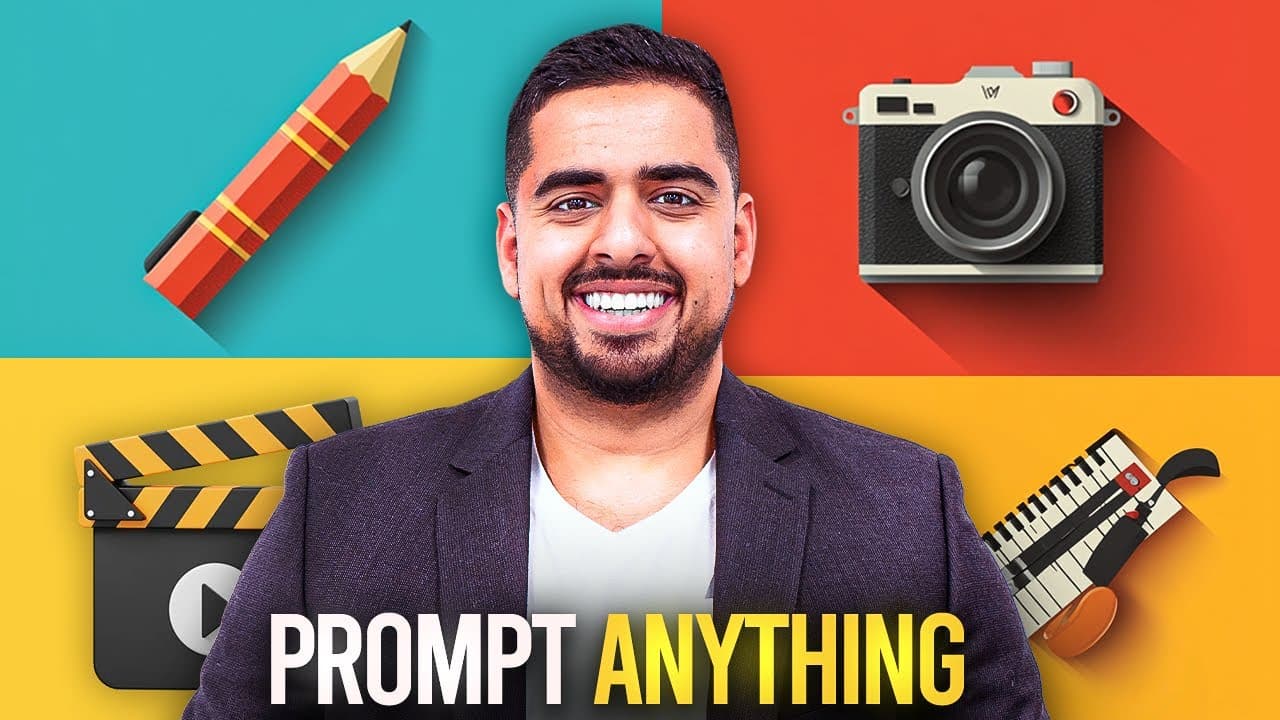
The core idea is a mindset: treat every modality as a language and master its vocabulary to prompt effectively across text, image, video, and music. Use meta prompting to have an AI generate richer prompts, and specialize prompts for each modality to unlock higher quality results without relearning from scratch.
Transcript
AI is evolving faster than ever you have new models coming out practically every month and new modalities popping up like text to video text to music and soon enough it's going to be text to anything you can imagine but here's the truth while tools and models will come and go there's one Evergreen skill that will always set you apart no matter what... Read More
Key Insights
- Modalities have distinct languages that require tailored vocabulary.
- Meta prompting lets AI craft richer prompts, reducing manual effort.
- Text prompts for images benefit from descriptors like sketch or photorealistic.
- Text prompts for video benefit from cinematic terms and camera angles.
- Music prompts rely on tempo, harmony, and genre cues.
- A structured workflow includes prompt design, testing, and refinement.
- Prompting excellence comes from mindset, not a fixed template.
- Long-term skillfulness persists as AI models evolve across modalities.
- More videos from this channel:
- More from this channel: Mark Kashef
Install to Summarize YouTube Videos and Get Transcripts
Explore YouTube Video Summarizer or Get YouTube Transcript Extractor
Questions & Answers
Q: What is the evergreen skill for AI prompts according to the video
The evergreen skill is mastering the mindset of prompt engineering across modalities, treating each medium as its own language and learning to speak that language fluently. This approach lets you prompt for text, images, video, and music without relearning from scratch whenever a new tool or model arrives, ensuring adaptability and consistent quality.
Q: How does meta prompting help in prompt creation
Meta prompting assigns the AI the role of a prompt engineer and specialized subroles (like for music, image, or video prompts). This enables the AI to generate richer, more complete prompts that include the vocabulary and structure needed for high-quality outputs. It reduces the burden of memorizing modality-specific terms and accelerates workflow.
Q: Why should each modality have its own language or vocabulary
Each modality encodes information differently, and the right vocabulary activates specific features in output. For example, text to image benefits from descriptors like sketch or photorealistic, while text to video benefits from cinematic terms and camera angles. Using the appropriate vocabulary yields outputs that align more closely with intent.
Q: What role does specific vocabulary play in text to video prompts
In text to video prompts, vocabulary such as cinematic, aerial shot, drone, time lapse, and camera angles guides the AI to produce clips with the desired composition, motion, and pacing. This specialized language helps the model understand and render the scene with the intended mood and visual dynamics.
Q: How can you use AI to avoid memorizing every prompting word
You can rely on meta prompting to have the AI write prompts enriched with the necessary vocabulary for a given modality. By instructing the AI to act as a specialist, you generate prompts that already incorporate the key terms needed to achieve high-quality outputs, reducing the mental load and speeding up the process.
Q: What examples of vocabulary are used for image prompts
Image prompts use words like sketch, vivid coloring, photorealistic, and cinematic cues to influence style, mood, and realism. These terms guide the image-generation model toward specific aesthetics and levels of detail, helping creators achieve outputs that match their envisioned look.
Q: What is the recommended workflow for prompting across modalities
The recommended workflow starts with defining the target modality, then using meta prompting to craft a detailed, enriched prompt. Next, apply modality-specific vocabulary to refine the output, test, and iterate based on results, ensuring alignment with goals such as SEO for text, visuals for images, and mood for music.
Q: How does mindset affect staying relevant with new AI tools
A growth-oriented mindset that treats prompts as a language to master allows you to adapt quickly to new tools. By focusing on modality-specific language and continuous refinement, you maintain a stable, transferable skill set that remains valuable as models and capabilities evolve, rather than chasing every new prompting style.
Summary & Key Takeaways
-
Prompt engineering hinges on a mindset that treats each modality as its own language, requiring distinct vocabulary to maximize results. The approach emphasizes using meta prompting to offload the word-choosing task to AI, producing richer, more actionable prompts for text, image, video, and music. This mindset reduces the need to relearn prompts for every new tool or modality.
-
A practical workflow is demonstrated: define the target modality, leverage specialized descriptors like cinematic for video or drone for aerial shots, and use AI to generate prompts that align with SEO, visuals, or music characteristics. This results in outputs that closely match user intent and creative goals.
-
The video underscores continuous adaptation as models evolve; by internalizing the language of each modality, users can harness new tools and formats without starting from scratch, maintaining a stable skillset that stays relevant across AI advancements.
Read in Other Languages (beta)
Share This Summary 📚
Summarize YouTube Videos and Get Video Transcripts with 1-Click
Try YouTube Summary with ChatGPT & Claude or YouTube Transcript Generator
Explore More Summaries from Mark Kashef 📚
Summarize YouTube Videos and Get Video Transcripts with 1-Click
Try YouTube Summary with ChatGPT & Claude or YouTube Transcript Generator